
Short answer
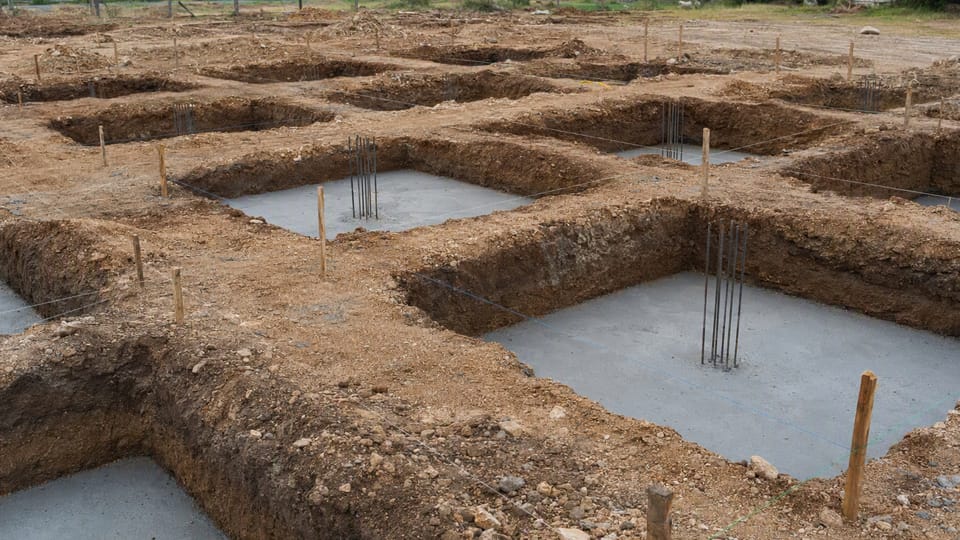
How much concrete is in a footing? The concrete in a rectangular footing is its length times width times depth. For an illustrative footing of 5 ft × 5 ft × 1.5 ft the volume is 1.06 m³ (37.5 cft), which in nominal M20 needs about 9 bags of 50 kg cement with 5 percent wastage. The size is an example, not a design, and your drawing sets the real footing.
On this page (11)
- How do I work out the concrete in a footing?
- Worked example with illustrative dimensions
- How do I turn the volume into bags, sand and aggregate?
- What is PCC under the footing, and how is it counted?
- How much wastage should I add?
- What does this number leave out?
- Who decides the footing size, depth and grade?
- Frequently asked questions
- Related guides
- Work out your quantities
- Sources
Need quantities? Cement, sand and aggregate calculator
The concrete in a footing is easy to work out once you have the sizes, and easy to get wrong if you guess them. This page shows the method with an example. The example footing is illustrative. It is not a design, and it is not a size to build.
How do I work out the concrete in a footing?
For a rectangular footing, multiply three sizes: length, width and depth. Convert them to metres first if you want cubic metres, or stay in feet to get cubic feet.
Volume of concrete = length × width × depth
Do the same for every footing, and add the volumes. Sloped or stepped footings need each part counted separately, because length × width × depth would overstate them.
Worked example with illustrative dimensions
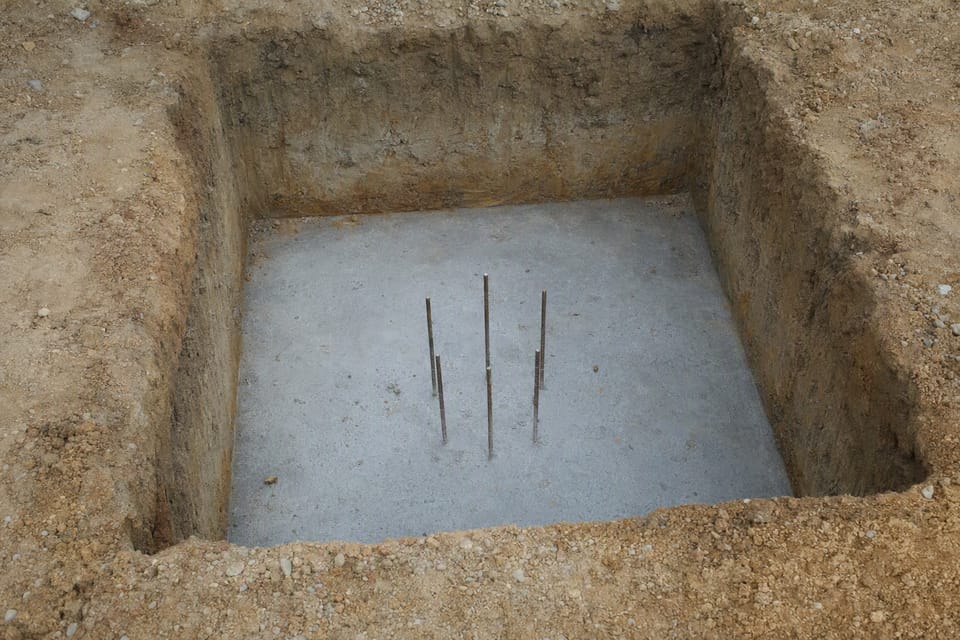
This example is for arithmetic only. Take one isolated footing that is 5 ft long, 5 ft wide and 1.5 ft deep. These sizes are not a recommendation, and a real footing is sized by an engineer from the load and the soil.
| Item | Quantity |
|---|---|
| Volume in cubic feet | 5 × 5 × 1.5 = 37.5 cft |
| Volume in cubic metres | 1.062 m³ |
| Cement, no wastage | 8.56 bags |
| Cement, 5% wastage | 8.99 bags, buy 9 |
| Sand, 5% wastage | 0.47 m³ (16.5 cft) |
| Coarse aggregate, 5% wastage | 0.94 m³ (33.1 cft) |
The calculator inputs behind the table are: volume 1.062 m³, mix M20 (1 : 1.5 : 3), 50 kg bags, a dry-volume factor of 1.54, and wastage of 0 or 5 percent.
If a building has 12 such footings, the concrete is 12 × 1.062 = 12.74 m³, and with 5 percent wastage the cement is about 107.9 bags, which you buy as 108 bags.
How do I turn the volume into bags, sand and aggregate?
Multiply the volume by the quantities per cubic metre for your mix, and add wastage. The quantities for M5 to M20 are in Cement, sand and aggregate per cubic metre. The cement, sand and aggregate calculator does the arithmetic and rounds the cement up to whole bags.
What is PCC under the footing, and how is it counted?
Many footings sit on a layer of plain cement concrete, called PCC, which gives a clean, level surface to work on. It is counted separately from the footing concrete, as its own length, width and thickness, and in its own mix. Its thickness and grade come from your drawing, so this page gives none.
How much wastage should I add?
The calculator starts at 5 percent, which is a common allowance. Footings poured into rough pits can use more, because the sides and bottom of the pit are uneven. Ask your contractor what their rate includes.
What does this number leave out?
The footing concrete only. It leaves out:
- the column and its stub, which are counted separately;
- the plinth beam and the tie beams between footings;
- the PCC under the footing;
- the reinforcement steel.
Your drawing lists each of these.
Who decides the footing size, depth and grade?
Your structural engineer, from the load of the building and the soil report. The size, the depth and the concrete grade come from the drawing and not from a table or a thumb rule. This page does not give a depth or a soil capacity, and you should not use the example for your own footing.
Frequently asked questions
How do I calculate the concrete for a footing?
Multiply length, width and depth for each footing and add them. Convert feet to metres if you want cubic metres.
Is PCC counted with the footing concrete?
No. PCC is counted separately, with its own volume and mix.
How many bags of cement for one footing?
For the 5 × 5 × 1.5 ft example in M20 with 5 percent wastage, 9 bags. Your own footing will differ.
Can I use this example for my own footing size?
Use the method, and not the sizes. Take the sizes from your structural drawing.
Why do the footing dimensions come from the drawing?
Because they depend on the load, the soil and the design, which only your engineer can assess.
Related guides
This guide is general information that shows an arithmetic example. Read the disclaimer.
Work out your quantities
- Cement, sand and aggregate calculator: Estimate cement bags, sand and aggregate for a nominal-mix concrete slab, footing or beam from its size and mix grade.
Sources
- IS 456:2000, Plain and Reinforced Concrete - Code of Practice
General information only. It is not a structural design or professional advice. Ask a licensed structural engineer or architect to check your plans and site.