
Short answer
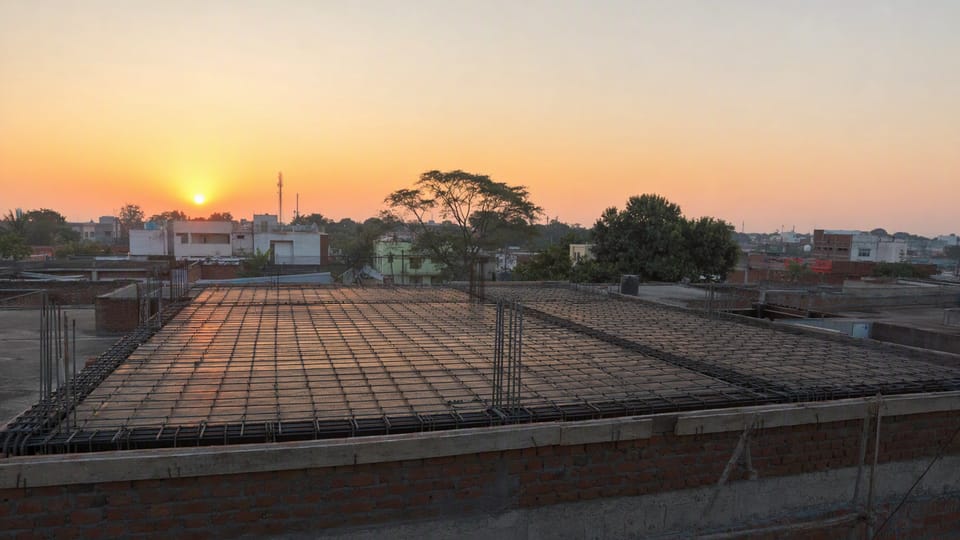
How many cement bags does a 1000 sq ft slab need? A 1000 sq ft slab that is 5 inches (127 mm) thick holds 11.80 m³ of concrete. In nominal M20 (1 : 1.5 : 3) with 5 percent wastage it needs about 100 bags of 50 kg cement and 184 cft of sand. The structural drawing sets the real thickness, and this excludes beams, steel and plaster.
On this page (12)
- How many cement bags does a 1000 sq ft slab need?
- How is the number worked out?
- What assumptions are behind the number, and why do sites quote different ones?
- How do the bags change with the thickness on your drawing?
- How do the bags change with the area?
- What does this number leave out?
- How do I use the calculator for my own slab?
- Who decides the thickness and the mix?
- Frequently asked questions
- Related guides
- Work out your quantities
- Sources
Need quantities? Cement, sand and aggregate calculator
Ask three contractors how many cement bags a 1000 sq ft slab needs and you may hear three answers, anywhere from about 75 to about 140. They are rarely wrong at arithmetic. They are using different thicknesses, mixes and wastage. This page works one slab through step by step, prints every assumption, and shows how the answer changes with thickness and area.
How many cement bags does a 1000 sq ft slab need?
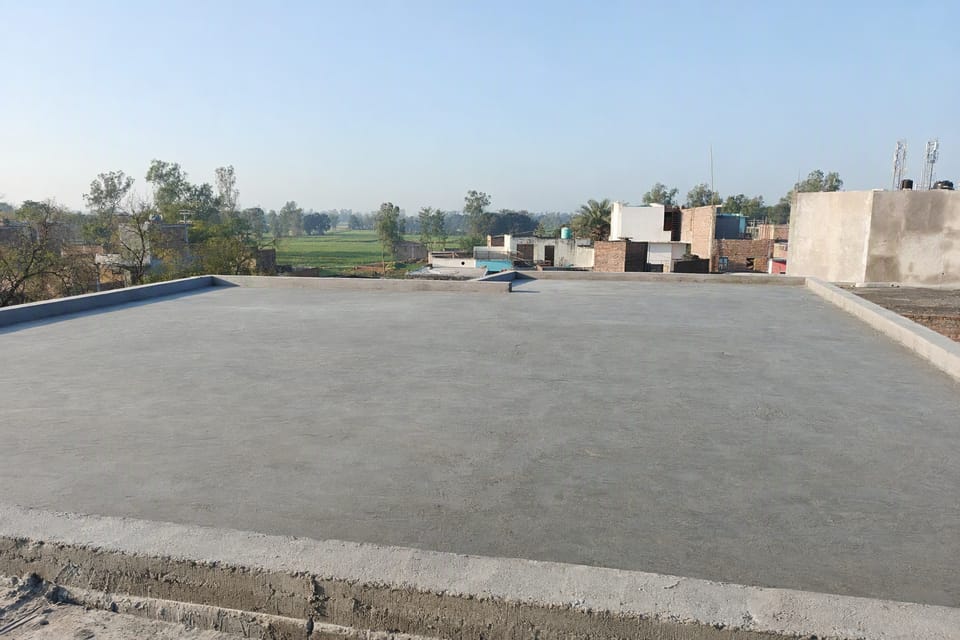
For a slab 1000 sq ft in area and 5 inches (127 mm) thick, made of nominal M20 concrete, you need about 100 bags of 50 kg cement with 5 percent wastage included. Without any wastage the figure is about 95 bags. The same slab also needs about 5.20 m³ of sand (184 cft) and 10.41 m³ of coarse aggregate (368 cft).
How is the number worked out?
The inputs are: slab area 1000 sq ft, thickness 5 inches, mix M20 (1 : 1.5 : 3), 50 kg bags, a dry-volume factor of 1.54 and wastage of 5 percent.
- Area: 1000 sq ft × 0.0929 = 92.9 m².
- Thickness: 5 inches × 25.4 = 127 mm = 0.127 m.
- Volume of concrete: 92.9 m² × 0.127 m = 11.80 m³.
- Dry volume with wastage: 11.80 × 1.54 × 1.05 = 19.08 m³.
- Cement share: 19.08 × 1 ÷ 5.5 = 3.47 m³, which at about 0.0347 m³ per 50 kg bag is 99.9 bags, rounded up to 100.
- Sand share: 19.08 × 1.5 ÷ 5.5 = 5.20 m³. Aggregate share: 19.08 × 3 ÷ 5.5 = 10.41 m³.
The cement, sand and aggregate calculator does exactly these steps. The per-cubic-metre version of this table is on the cement, sand and aggregate per cubic metre page.
What assumptions are behind the number, and why do sites quote different ones?
Quotes differ because one or more of these assumptions differ:
- Thickness. Every extra inch adds about 20 bags to a 1000 sq ft slab.
- Mix. M20 needs more cement than M15 for the same volume.
- Bag volume. Treating a 50 kg bag as exactly 1 cubic foot gives a different answer from 1,440 kg per cubic metre.
- Wastage. Some quotes add none and some add 10 percent or more.
- What is counted. Some quotes include beams, staircase and sunshades, and some are for the flat slab alone.
If a figure does not match this page, ask which of these differs. Do not assume the other person is wrong.
How do the bags change with the thickness on your drawing?
The table shows the same 1000 sq ft slab at two thicknesses. These are inputs for the calculator, not recommendations.
| Thickness | Concrete (m³) | Cement bags, no wastage | Cement bags, 5% wastage | Sand, m³ (cft), 5% wastage | Aggregate, m³ (cft), 5% wastage |
|---|---|---|---|---|---|
| 5 inch (127 mm) | 11.80 | about 95 | 100 | 5.20 (184) | 10.41 (368) |
| 6 inch (152 mm) | 14.16 | about 114 | 120 | 6.24 (221) | 12.49 (441) |
How do the bags change with the area?
The next table keeps the thickness at 5 inches and the wastage at 5 percent and changes only the slab area.
| Slab area | Concrete (m³) | Cement bags (50 kg) | Sand, m³ (cft) | Aggregate, m³ (cft) |
|---|---|---|---|---|
| 200 sq ft (18.6 m²) | 2.36 | 20 | 1.04 (37) | 2.08 (74) |
| 400 sq ft (37.2 m²) | 4.72 | 40 | 2.08 (74) | 4.16 (147) |
| 600 sq ft (55.7 m²) | 7.08 | 60 | 3.12 (110) | 6.24 (221) |
| 800 sq ft (74.3 m²) | 9.44 | 80 | 4.16 (147) | 8.33 (294) |
| 1,000 sq ft (92.9 m²) | 11.80 | 100 | 5.20 (184) | 10.41 (368) |
| 1,200 sq ft (111.5 m²) | 14.16 | 120 | 6.24 (221) | 12.49 (441) |
| 1,500 sq ft (139.4 m²) | 17.70 | 150 | 7.80 (276) | 15.61 (551) |
What does this number leave out?
The figures are for the flat slab only, measured on its plan area. They do not include:
- beams, columns, the staircase, sunshades or parapets, which add concrete;
- reinforcement steel;
- plaster, screed or flooring on top;
- extra concrete from uneven shuttering or a sagging deck.
A real roof slab with its beams needs more concrete than the flat area alone, so your contractor’s total will be higher than this page’s. Ask for the slab and beams to be listed separately.
How do I use the calculator for my own slab?
Open the calculator, enter the length, width and thickness of your slab, pick M20 and keep the wastage at 5 percent. It shows the working and rounds the cement to whole bags. Do the same for each element on your drawing and add the results.
Who decides the thickness and the mix?
Your structural engineer does. The thickness of a slab depends on its span, its support and the load it carries, and it is shown on the structural drawing. M20 is the lowest grade IS 456 allows for reinforced concrete in mild exposure, so this page uses M20 and does not offer leaner mixes for slabs. Do not change the thickness or the mix to save cement.
Frequently asked questions
How many bags for a 1200 sq ft slab?
For a 5 inch slab in M20 with 5 percent wastage, about 120 bags, 221 cft of sand and 441 cft of aggregate.
How much cement for a 12 ft × 12 ft room slab?
A 144 sq ft slab, 5 inches thick, in M20 with 5 percent wastage needs about 15 bags, 26 cft of sand and 53 cft of aggregate.
Do these figures include beams or steel?
No. They are for the flat slab only. Beams add concrete, and steel is bought separately.
Is the area the plan area or does it include the sunshade?
It is the plan area of the slab you enter. Sunshades and projections add concrete, so measure them separately.
Why does 5 inch say 127 mm and not 125 mm?
5 inches is exactly 127 mm. A drawing that says 125 mm gives a volume about 2 percent smaller and a bag count about 2 bags lower in this example.
Why is my contractor’s number different?
Compare thickness, mix, wastage, bag volume and what is included, as in the list above.
Related guides
This guide is general information that shows a worked example under stated assumptions. Read the disclaimer and follow the thickness and mix on your structural drawing.
Work out your quantities
- Cement, sand and aggregate calculator: Estimate cement bags, sand and aggregate for a nominal-mix concrete slab, footing or beam from its size and mix grade.
Sources
- IS 456:2000, Plain and Reinforced Concrete - Code of Practice (nominal mix concrete and minimum grades)
- IS 383:2016, Coarse and Fine Aggregate for Concrete - Specification
General information only. It is not a structural design or professional advice. Ask a licensed structural engineer or architect to check your plans and site.