
Short answer
How do I find and fix a leaking water tank? First find out whether water is really leaving the tank, with a level-drop check, because a damp patch alone is not always a leak. Then seal cracks and joints with methods suited to drinking water, never plaster alone, and test again. For a new concrete tank, IS 3370 allows a 7-day drop of no more than the larger of 1/500 of the water depth or 10 mm, after allowing for evaporation and rain.
On this page (12)
- Is it really a leak?
- How do I check whether a tank is losing water?
- What does the Indian Standard say about testing a tank?
- Where do tanks usually leak?
- How are leaks in a concrete tank repaired?
- What about plastic tanks?
- How often should I clean a tank?
- When should I call an engineer?
- Frequently asked questions
- Related guides
- Work out your quantities
- Sources
Need quantities? Water tank capacity calculator
A water tank that loses water wastes it, damages the walls and ceilings around it, and can let dirt into your drinking water. But a damp patch is not always a leak, and the cure depends on where the water is going. This page explains how to check, what the Indian Standard says about testing, the usual leak points, and how concrete and plastic tanks are repaired.
Is it really a leak?
IS 3370 makes a useful distinction: a wet patch on a concrete surface may not be a leak. A leak is liquid flowing through the concrete from one face to the other. So the first job is to find out whether the tank is really losing water.
How do I check whether a tank is losing water?
This simple level-drop check is site practice. It is not a method from the standard.
- Fill the tank to its normal full level, close the inlet and the outlets, and mark the water level inside.
- Put a bucket of water beside the tank, in the same shade, and mark its level too.
- Leave both for 24 hours, and use no water.
- Compare the drops. If the tank level fell much more than the bucket, water is leaving the tank. If both fell about the same, the cause is evaporation.
For an underground sump, also look at what happens when the sump is empty. If water or damp appears on the inside while it is empty, groundwater may be coming in. That is reasoning from how the water behaves, not a method from the standard, so ask your engineer to look.
What does the Indian Standard say about testing a tank?
IS 3370 (Part 1:2021, the current edition) sets the water-tightness test for new concrete tanks.
- Fill the tank gradually, at no more than 2 m rise in water level in 24 hours, to the normal maximum level.
- Keep it full for a stabilising period of 7 days, topping up as needed. The period is 7 days for a design crack width of 0.1 mm, and 21 days for 0.2 mm or more. During this time the concrete absorbs water and small cracks begin to heal.
- Then record the water level every 24 hours for 7 days.
- After allowing for evaporation and rainfall, the total drop should not exceed the larger of 1/500 of the average water depth of the full tank and 10 mm, unless another value is agreed. For a tank with water 1.5 m deep, 1/500 is 3 mm, so the 10 mm figure applies.
- For a covered underground tank, the drop over 7 days should not exceed 20 mm.
- Even if the test passes, seepage to the outer faces should be checked against the specification. For an elevated tank, the earlier edition says the test is satisfied if the outside faces stay apparently dry.
- For the roof slab of a tank, flood it to at least 25 mm for 24 hours, or run a continuous sheet of water over it for at least 6 hours if flooding is impractical. There should be no leaks or wet patches on the underside.
The standard is written for new tanks, but it is a useful guide. Keep in mind that earlier editions are different, and an older tank may have been tested to the earlier rules.
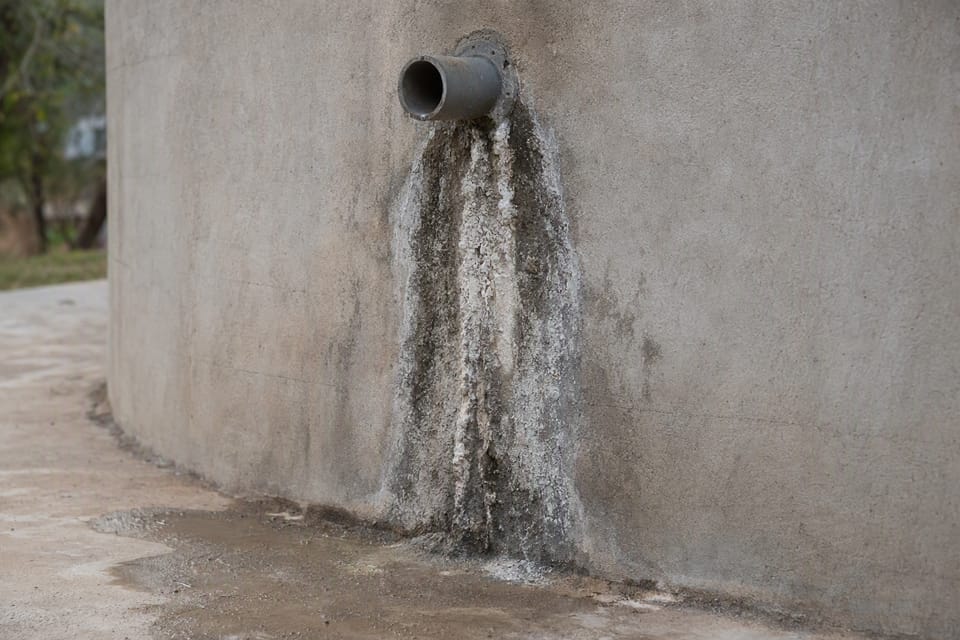
Where do tanks usually leak?
- Cracks. IS 3370 (Part 2) limits the calculated surface crack width in water-retaining members to 0.2 mm, and its design formulas also cover a tighter 0.1 mm limit.
- Construction joints. The joints between the wall and the floor, and between pours, are weak points.
- Pipe connections. The places where the inlet, outlet, overflow and washout pipes pass through the wall are common leak points.
- The manhole, float valve and cover. These let in dirt and rainwater even when they do not let water out.
- For underground sumps, groundwater pressure from outside can push water in, and an empty sump can lift if it is not designed against uplift.
How are leaks in a concrete tank repaired?
IS 3370 says that cracks and joints can be sealed with grout. The choice of grout depends on where you work from:
- from the outside, with polyurethane grouts whose performance in the presence of water is well established;
- from the liquid face (the face that gets wet), with cement-based grouts, which cannot perform in the presence of liquid, so the tank must be emptied first.
A lining applied inside should be flexible enough to follow small movements and must not react with the stored water. The standard also says cement plaster on the inside is not a substitute for watertight concrete, so plastering alone does not cure a leaking tank. After any repair, refill the tank, allow a further stabilising period if needed, and repeat the 7-day level test.
Anything that touches drinking water must be suitable for it. We found no Indian standard that covers coatings for drinking-water tanks, so ask the supplier for a certificate of suitability from a recognised body, and do not use bitumen paints or anything that is not approved for drinking-water contact. Follow the product’s data sheet for the time to cure before refilling, because it differs between products.
What about plastic tanks?
IS 12701 covers rotationally moulded polyethylene tanks. Its recommendations for installation also explain many leaks:
- Support the whole base on a flat, rigid platform. The standard says these tanks are not meant for underground use.
- Do not use jointing compounds or putty on polyethylene. PTFE tape may be wrapped round a threaded fitting.
- Fit check-nuts after the rubber gaskets and do not overtighten them.
- Holes for fittings should be round, with clean edges and no notches or scratches in the wall.
- Support the pipework so that it does not pull on the tank wall.
Hot-air welding is a factory repair for manufacturing defects. We found no standard guidance for repairing a cracked plastic tank on site, so ask the maker whether it should be replaced.
How often should I clean a tank?
We did not find an official interval for household tanks. A common routine is to clean the tank at least twice a year, and a state education department circular says so for school tanks. Ask your local water authority for its advice, and scrub and flush the tank clean before any disinfection.
When should I call an engineer?
- Cracks that grow, or cracks across the whole wall thickness.
- Water appearing on the outside walls, or damp ceilings below the tank.
- A tank that leans, sags or has moved on its supports.
- A sump that rises or leaks when empty.
- Any repair that needs the tank to be emptied and treated inside.
Frequently asked questions
How much water loss is allowed in a new tank test?
Over 7 days, the total drop after allowing for evaporation and rain should not exceed the larger of 1/500 of the average water depth and 10 mm. For a covered underground tank it is 20 mm.
Is a damp patch a leak?
Not necessarily. IS 3370 says that a wet patch on the surface may not be a leak.
Can I plaster the inside of a leaking tank?
Plaster alone is not a cure. IS 3370 says cement plaster is not a substitute for watertight concrete.
Can I use bitumen paint inside a drinking water tank?
Do not. Anything inside must not react with the stored water and must be suitable for drinking water. Ask for a certificate.
How long should I wait before refilling after a repair?
Follow the product’s data sheet. The time differs between products.
Related guides
- Terrace leakage and waterproofing: methods, slope and ponding test
- Hairline cracks in plaster: causes and what to do
- Cement, sand and aggregate per cubic metre: M5 to M20
This guide is general information. Read the disclaimer. A leaking tank, especially a large or elevated one, should be inspected by your engineer before repair, and a tank holding drinking water needs materials suited to it. To size a tank, use the water tank capacity calculator.
Work out your quantities
- Water tank capacity calculator: Estimate the daily water need of a house from the number of people, and the smallest standard tank that holds one day of it.
Sources
- IS 3370:2021, Concrete Structures for Retaining Aqueous Liquids, Part 1 (General Requirements) and Part 2 (Reinforced Concrete Structures)
- IS 3370 (Part 1):2009, Concrete Structures for Storage of Liquids: General Requirements
- IS 3370 (Part 2):2009, Concrete Structures for Storage of Liquids: Reinforced Concrete Structures (calculated crack width limits)
- IS 12701:1996, Rotational Moulded Polyethylene Water Storage Tanks - Specification
General information only. It is not a structural design or professional advice. Ask a licensed structural engineer or architect to check your plans and site.