
Short answer
How many 12 mm bars are in 1 tonne? A 12 mm bar weighs about 0.889 kg per metre (diameter squared divided by 162), so 1 tonne is about 1,125 m of bar, or about 94 rods of 12 m. Check a delivery by counting the rods and weighing the loaded truck. Charts that print 0.888 differ only in the last decimal.
On this page (11)
- How many 12 mm bars make 1 tonne?
- How much does a 12 mm bar weigh per metre?
- Where does D squared by 162 come from?
- How do I check a steel delivery against the bill?
- What does the weight chart look like from 6 to 32 mm?
- Why do some sources print 0.888 and others 0.889?
- How do I use the steel calculator?
- Frequently asked questions
- Related guides
- Work out your quantities
- Sources
Need quantities? Steel bar weight calculator
Steel is bought by weight but used by length, so you keep converting between the two. A mason counts rods, the bill shows tonnes, and the drawing gives bar lengths. This page gives the conversions for 12 mm bars, a chart from 6 to 32 mm, and a simple way to check that what arrives matches what you paid for.
How many 12 mm bars make 1 tonne?
A 12 mm bar weighs about 0.889 kg for every metre of length. One tonne is 1,000 kg, so it holds about 1,125 m of 12 mm bar. Steel bars are commonly sold in lengths of 12 m, which makes about 94 rods to the tonne. The exact figure is 93.75 rods, so a tonne is not a whole number of rods.
How much does a 12 mm bar weigh per metre?
About 0.889 kg per metre, or about 0.271 kg per foot. A 12 m rod weighs about 10.67 kg. Some charts print 0.888 kg per metre instead of 0.889. The two are the same bar: one rounds the formula’s result and the other uses a slightly different divisor, so they differ by well under 1 percent.
Where does D squared by 162 come from?
The weight of a bar is its volume times the density of steel. A round bar of diameter D mm has a cross-section area of π × D² ÷ 4 mm². Steel weighs about 7,850 kg per cubic metre, so one metre of bar weighs about D² × 0.00617 kg, which is D² ÷ 162. The formula works for plain round bars and is used for ribbed TMT bars as a close nominal figure. A bar delivered to the site can differ slightly from this nominal weight, which is why Indian Standard IS 1786 allows a small tolerance on mass.
How do I check a steel delivery against the bill?
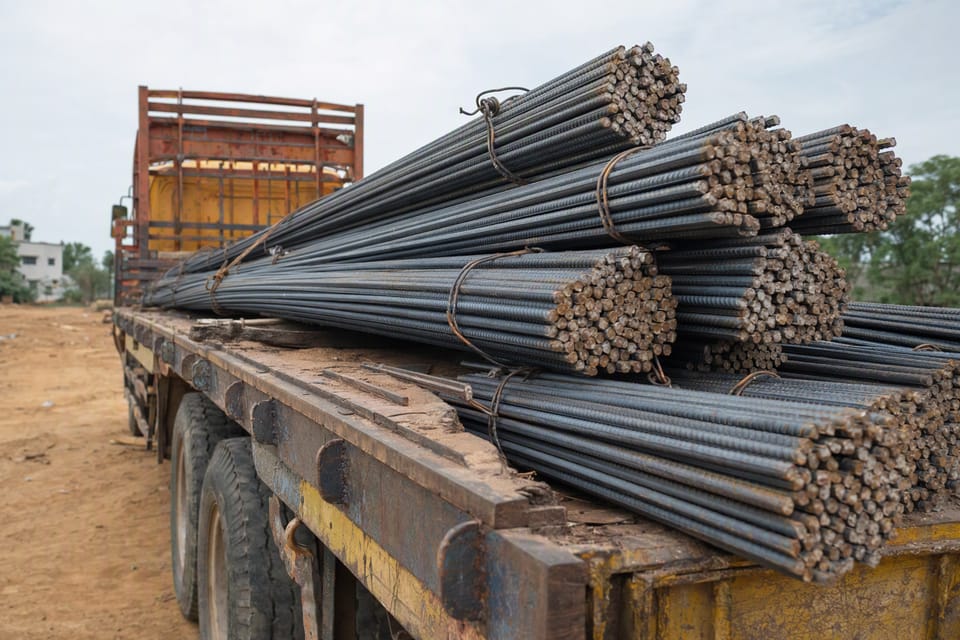
Take a bill for 2.5 tonnes of 12 mm bar as an example. It should contain about 2,813 m of bar, which is about 234 rods of 12 m (234.4 before rounding). To check it:
- Count the rods in every bundle and add them up. Compare the count with the figure above.
- Weigh the loaded truck at a weighbridge, then weigh it empty after unloading. The difference is the weight of the steel. Keep both slips.
- Compare the weighbridge figure with the bill. A small difference can be the tolerance in the standard, while a large gap is worth a question to the supplier. Ask your engineer what difference is acceptable.
- Check that the bars carry the grade and the maker’s mark that you ordered, and that the supplier’s test certificate is with the delivery.
What does the weight chart look like from 6 to 32 mm?
The chart uses the same formula for each bar size. Per-rod and per-tonne figures come from the unrounded weight per metre.
| Bar diameter | kg per metre | kg per foot | kg per 12 m rod | Metres per tonne | Rods of 12 m per tonne |
|---|---|---|---|---|---|
| 6 mm | 0.222 | 0.068 | 2.67 | 4,500 | 375.0 |
| 8 mm | 0.395 | 0.120 | 4.74 | 2,531 | 210.9 |
| 10 mm | 0.617 | 0.188 | 7.41 | 1,620 | 135.0 |
| 12 mm | 0.889 | 0.271 | 10.67 | 1,125 | 93.8 |
| 16 mm | 1.580 | 0.482 | 18.96 | 633 | 52.7 |
| 20 mm | 2.469 | 0.753 | 29.63 | 405 | 33.8 |
| 25 mm | 3.858 | 1.176 | 46.30 | 259 | 21.6 |
| 32 mm | 6.321 | 1.927 | 75.85 | 158 | 13.2 |
Why do some sources print 0.888 and others 0.889?
They round the same quantity differently. D² ÷ 162 gives 0.8889 for a 12 mm bar, which rounds to 0.889. Some charts use a divisor of 162.2 or copy the figure printed in the standard and show 0.888. Both are close to the real bar, and the difference is far smaller than the tolerance on a delivery. Pick one figure and use it consistently when you compare a bill with your own count.
How do I use the steel calculator?
Open the steel bar weight calculator, choose the bar diameter, enter the length of one bar and the number of bars, and it gives the weight in kilograms and tonnes. Use it to turn a bar bending schedule from your drawing into the weight to order.
Frequently asked questions
How many 12 mm bars are in 1 tonne?
About 94 bars of 12 m, or about 1,125 m of bar.
What is the weight of a 12 mm bar per metre?
About 0.889 kg per metre.
What is the weight of a 16 mm bar per metre?
About 1.580 kg per metre, or about 18.96 kg for a 12 m rod.
Is 12 m the standard rod length?
Bars are commonly sold in 12 m lengths, but the length depends on the maker and the order. Confirm the length with your supplier.
What is the weight of a 12 mm bar per foot?
About 0.271 kg per foot.
Related guides
- Cement, sand and aggregate per cubic metre: M5 to M20
- Cement bags for a 1000 sq ft slab: a worked M20 example
This guide is general information. Read the disclaimer. The quantity and size of bars for your building come from your structural drawing, and this page does not replace it. For the cement side of the same job, see OPC vs PPC vs PSC cement: which one for your house?
Work out your quantities
- Steel bar weight calculator: Find the weight of reinforcement bars by diameter, length and number of bars, using the standard D squared over 162 formula.
Sources
- IS 1786:2008, High Strength Deformed Steel Bars and Wires for Concrete Reinforcement - Specification
General information only. It is not a structural design or professional advice. Ask a licensed structural engineer or architect to check your plans and site.