
Short answer
How long can cement be stored? Use bagged cement within 3 months of its packing date. Bags made to the current Indian Standards carry a best-before date 3 months after packing, and cement older than that should be tested before use. Cement kept dry may stay usable longer but loses strength slowly, and hard lumps mean moisture has got in. Stack it off the floor, covered, and use the oldest first.
On this page (10)
Cement is not like rice or flour: it does not go bad on a fixed date. But it does absorb moisture from the air, and when it does it slowly loses strength and turns into lumps. That is why a bag of cement carries a date, and why where and how you store it matters as much as how long. This page explains the date, the storage rules in the Indian Standard, and what to do with stock you doubt.
How long can cement be stored?
The rule of thumb is 3 months from the packing date. Bags made to the current Indian Standards for ordinary Portland cement and for Portland pozzolana cement carry three things:
- a batch number that shows the week, month and year of packing;
- a “best before” date, 3 months after the date of packing;
- a note that cement more than 3 months old should be tested before use.
The printing differs between makers, so ask your dealer to show you where the date is on the bag.
Does cement expire after 3 months?
Not in the sense of a hard expiry. The 3 months is the point after which the standard wants the cement tested again before it is used. Cement held in bags in a dealer’s stock for more than 3 months is to be retested before use, and rejected if it fails the requirements. Some manufacturers also say that cement stored properly can stay usable for up to about 6 months. For a house, the safe approach is simple: buy cement that is as fresh as possible, use it within 3 months, and test anything older before it goes into structural work.
How much strength does old cement lose?
No single figure is right for all cement. You may see a table of about 20 percent loss at 3 months, 30 percent at 6 months and 40 percent at a year, but that table is a rule of thumb that is copied from site to site, and it does not come from an Indian code. The best-known measurements are from a 1922 study in the United States, which found that cement stored in a shed in cloth sacks kept about 80 percent of its strength after 3 months, about 71 percent after 6 months and about 61 percent after a year. Modern cement and modern bags are different, and the loss depends mostly on how much moisture reaches the bag. The lesson is the same either way: cement does weaken as it ages, and damp makes it much worse.
How should I store cement on site?
IS 4082 sets out the rules for stacking and storing cement bags at site.
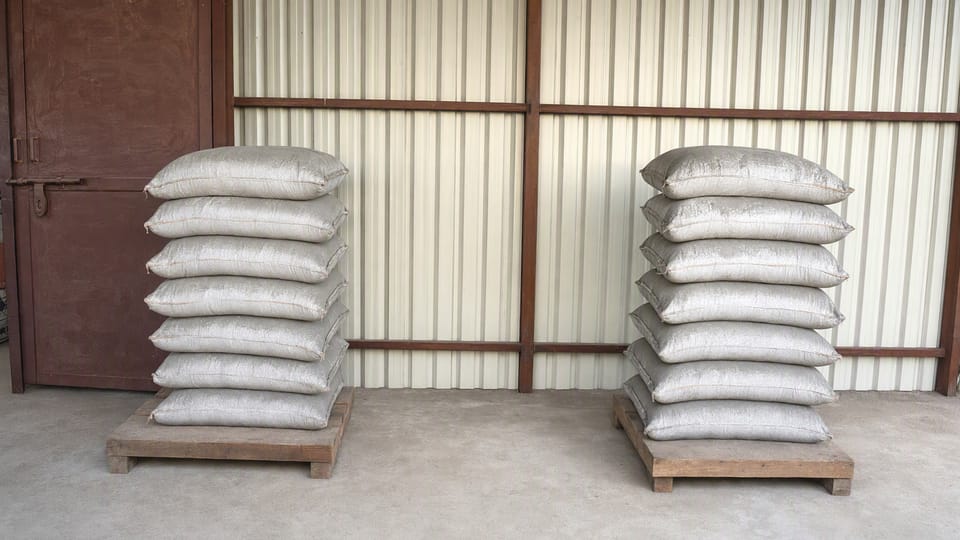
- Keep the cement in a shed or a room that is dry, does not leak and is as damp-proof as possible, with few windows and doors that close well.
- Stack the bags on wooden planks, so that there is a clear gap of about 150 to 200 mm above the floor.
- Leave at least 600 mm between the stacks and the outside walls.
- Put the bags close together, to reduce the air that moves between them.
- Do not stack more than 10 bags high, because the bags at the bottom can lump up under the weight. Keep the width of a stack to no more than four bags in length, or 3 metres.
- Where a stack is more than 8 bags high, lay the bags alternately lengthwise and crosswise.
- Stack so that you can use the cement in the order it arrived, and put a label on each stack with the date of receipt, so you know its age.
- Store different types of cement separately, and store gunny, paper and polythene bags separately.
- In the monsoon, or when cement will be stored for an unusually long time, cover the whole stack with a waterproof sheet such as polyethylene, closed over the top.
Do OPC and PPC need different storage?
No. The standards give the same 3-month marking for both, and no standard or maker we found sets a different storage rule for blended cement. Treat them the same way.
How do I check old or doubtful cement?
- Look at the packing date and the batch number first.
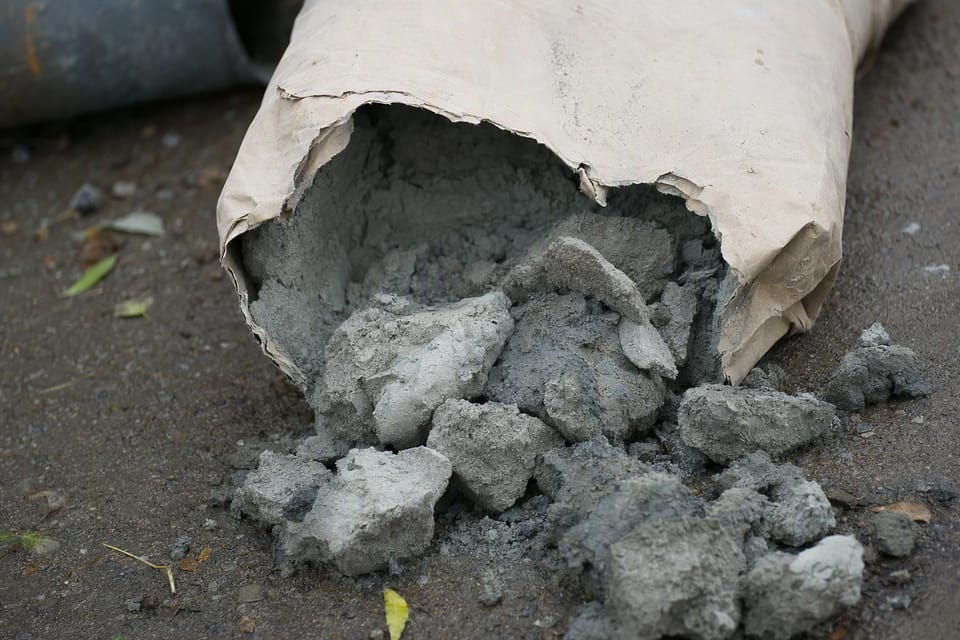
- Hard lumps that will not crumble mean moisture has got in. IS 4082 says that lumped bags should be removed and disposed of. Do not use hard-lumped cement in structural work.
- A handful of good cement flows as a fine powder, as described in OPC vs PPC vs PSC cement: which one for your house? Hand tests like this only give a hint.
- The reliable check is a strength test in a laboratory under IS 4031. If you must use stock older than 3 months, ask your engineer to arrange one first.
What is the formula of cement?
People searching for the “cement formula” usually mean what cement is made of. Cement is made by heating limestone and clay, and it is mainly lime (typically about 60 to 67 percent), silica (about 17 to 25 percent), alumina (about 3 to 8 percent) and iron oxide (about 0.5 to 6 percent), with small amounts of other compounds. These are typical ranges, not limits from an Indian Standard. The mix ratio of concrete, such as 1 : 1.5 : 3, is a different thing and is explained in Cement, sand and aggregate per cubic metre.
Frequently asked questions
What is the shelf life of cement?
About 3 months from the date of packing, as printed on the bag. After that it should be tested before use.
Can I use cement that is 6 months old?
Only after your engineer has had it tested. Do not use it for structural work on a guess.
Can I use cement with lumps?
Not if the lumps are hard. Soft lumps that crumble easily are a warning, and the safest course is to ask your engineer.
How high can I stack cement bags?
No more than 10 bags high, with the stack no wider than four bags in length or 3 metres, as in IS 4082.
How do I keep cement dry in the monsoon?
Keep it in a dry shed, on planks off the floor, away from the walls, and cover the stack with a waterproof sheet.
Related guides
- OPC vs PPC vs PSC cement: which one for your house?
- Cement, sand and aggregate per cubic metre: M5 to M20
- Sand bulking: why damp sand gives you less sand
This guide is general information. Read the disclaimer. For structural work, follow your engineer’s instructions on cement that is old or doubtful.
Sources
- IS 4082:1996, Recommendations on Stacking and Storage of Construction Materials and Components at Site (cl. 4.2.2 on cement)
- IS 269:2015, Ordinary Portland Cement - Specification (marking of bags; storage and re-testing)
- IS 1489 (Part 1):2015, Portland Pozzolana Cement - Specification: Fly Ash Based
- IS 1489 (Part 2):2015, Portland Pozzolana Cement - Specification: Calcined Clay Based
- W. M. Myers, Storage and Transportation of Portland Cement, U.S. Bureau of Mines Report of Investigations 2377 (1922)
General information only. It is not a structural design or professional advice. Ask a licensed structural engineer or architect to check your plans and site.