
Short answer
What is sand bulking? Sand bulking is the increase in volume of sand when it holds a little moisture, because the water film pushes the grains apart. A box of damp sand holds less actual sand than a box of dry sand, so mixes made by volume come out short of sand. Test the bulking with a measuring jar and add that percentage to the damp sand you measure.
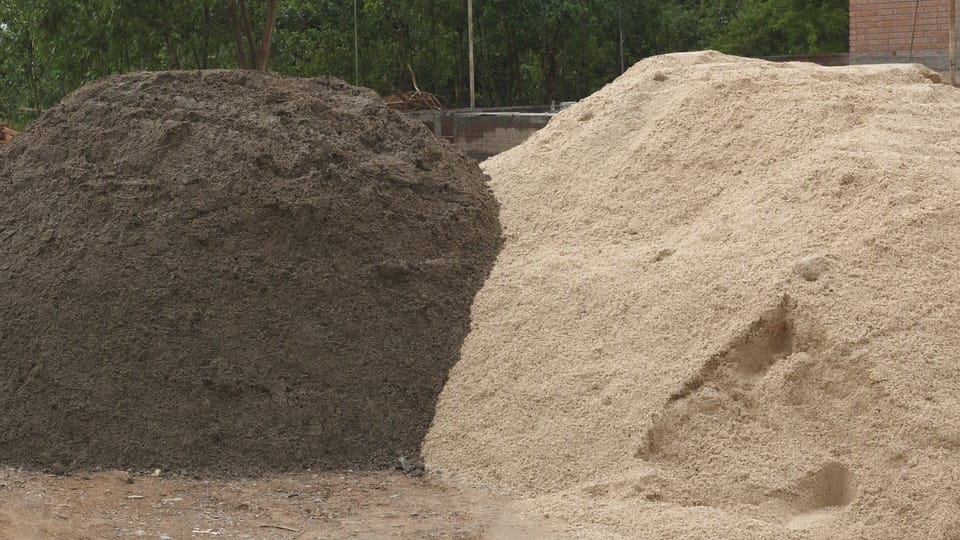
On this page (9)
Need quantities? Cement, sand and aggregate calculator
Concrete and mortar on most Indian sites are mixed by volume, in boxes or buckets. That works only if a box of sand always holds the same amount of sand. It does not: damp sand takes up more space than dry sand. This effect is called bulking, and it quietly leaves a mix short of sand. This page explains it and shows a simple test you can do on site.
What is sand bulking?
When sand holds a small amount of water, a thin film of water forms around each grain and pushes the grains apart. The heap takes up more space, so a box filled with damp sand holds fewer grains than a box of dry sand. If the sand is completely flooded with water, the film disappears and the volume falls back. The increase in volume, written as a percentage of the dry volume, is the bulking.
Why does bulking matter for concrete and mortar?
Mix ratios such as 1 : 1.5 : 3 are measured on dry sand. If the sand is damp and you fill the box to the same mark, you add less real sand than the ratio needs. The mix then has too much cement and too little sand, which is richer, shrinks more and costs more, and the quantity of concrete you get can fall short. Bulking can be large, so it is worth testing.
How do I test sand for bulking on site?
You need a clear measuring jar or a straight-sided glass and a ruler.
- Fill the jar with the damp sand from your heap to a convenient level and press it lightly. Measure the height of the sand, h1.
- Tip the sand out into a container, half fill the jar with water, and put the sand back a little at a time, stirring so that it is completely under water. Let it settle.
- Measure the height of the settled sand, h2.
- Bulking in percent is (h1 ÷ h2 − 1) × 100.
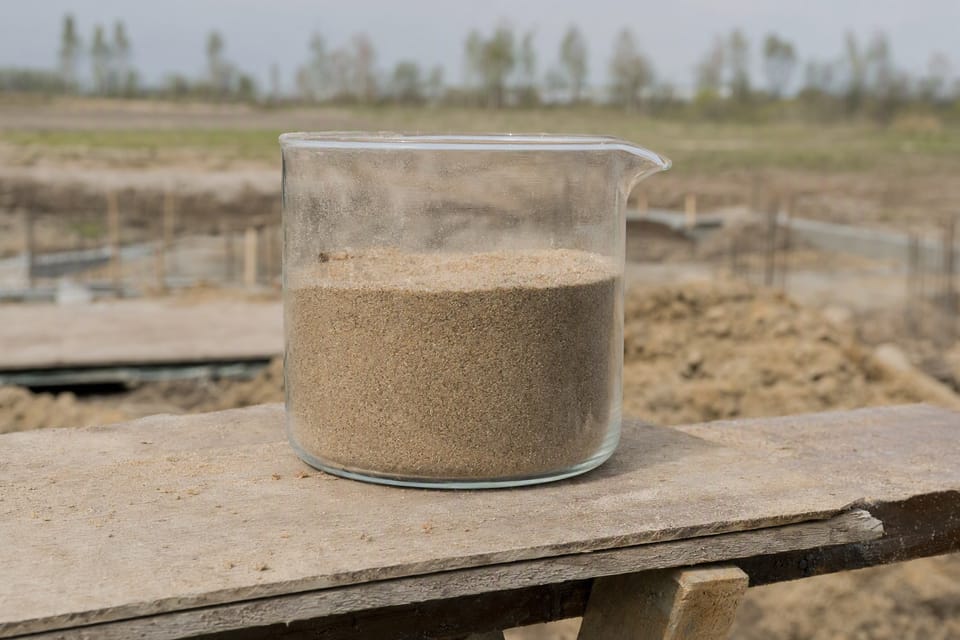
For example, if h1 is 100 mm and h2 is 80 mm, bulking is (100 ÷ 80 − 1) × 100 = 25 percent. This example is illustrative. Your sand will give its own number, and the number changes with the moisture in the sand, so repeat the test when the weather changes.
How do I correct my mix for bulking?
Increase the volume of damp sand by the bulking percentage. If the mix needs 3 boxes of dry sand and the test gives 25 percent bulking, take 3 × (1 + 25 ÷ 100) = 3.75 boxes of damp sand. The quantities from the cement, sand and aggregate calculator are for dry sand, so apply the bulking correction when you measure damp sand on site. Ask your engineer or supervisor which test and which allowance the site will use.
Does bulking change what I buy?
It changes how much sand goes into the mix, not the quantity the ratio asks for in dry terms. Ask how your sand is sold and measured, and check it when it is delivered. For the cement and sand per cubic metre of concrete, see Cement, sand and aggregate per cubic metre.
Frequently asked questions
Why does damp sand take up more space?
A thin film of water around each grain pushes the grains apart.
Does very wet sand bulk more?
No. When sand is flooded, the film disappears and the volume falls back, so the largest bulking is at low moisture.
How do I do the bulking test?
Measure the damp sand in a jar, then flood it with water, measure again, and use (h1 ÷ h2 − 1) × 100.
Does bulking affect the cement quantity?
It affects the sand you measure, and therefore the balance of the mix. Correct the sand and the cement ratio stays right.
Do the calculator figures include bulking?
No. They are dry-volume figures, so add the bulking correction when you measure damp sand.
Related guides
- Cement, sand and aggregate per cubic metre: M5 to M20
- Cement bags for a 1000 sq ft slab: a worked M20 example
- Mortar ratio for brick walls: 1:4, 1:5 or 1:6?
This guide is general information. Read the disclaimer. Follow the method specified for your site.
Work out your quantities
- Cement, sand and aggregate calculator: Estimate cement bags, sand and aggregate for a nominal-mix concrete slab, footing or beam from its size and mix grade.
Sources
- IS 2386 (Part 3):1963, Methods of Test for Aggregates for Concrete - Specific Gravity, Density, Voids, Absorption and Bulking
- IS 383:2016, Coarse and Fine Aggregate for Concrete - Specification
General information only. It is not a structural design or professional advice. Ask a licensed structural engineer or architect to check your plans and site.