
Short answer
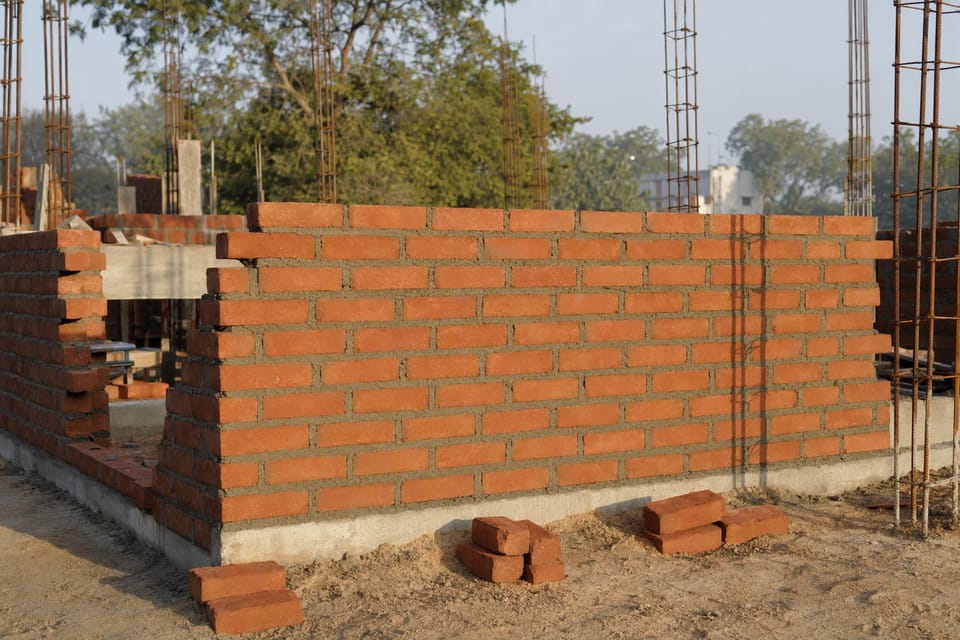
Which mortar ratio should I use for brickwork? Brickwork mortar is usually a cement-sand mix between 1:4 and 1:6 by volume. Richer mortar is often specified for thin 4.5 inch walls, the plinth and damp or exposed places, and 1:6 for ordinary one-brick walls. The ratio for each wall comes from your engineer's specification. For 100 sq ft of 9 inch wall, 1:6 needs about 2.7 bags of cement.
On this page (12)
- Which mortar ratio should I use?
- Which ratio goes where?
- How much cement and sand does 100 sq ft of wall need?
- Why can two sources differ by about 4 percent?
- Why is richer mortar not always better?
- How does the quality of the sand change the result?
- How do I calculate it for my wall?
- How is mortar different from plaster?
- Frequently asked questions
- Related guides
- Work out your quantities
- Sources
Need quantities? Brick and mortar quantity calculator
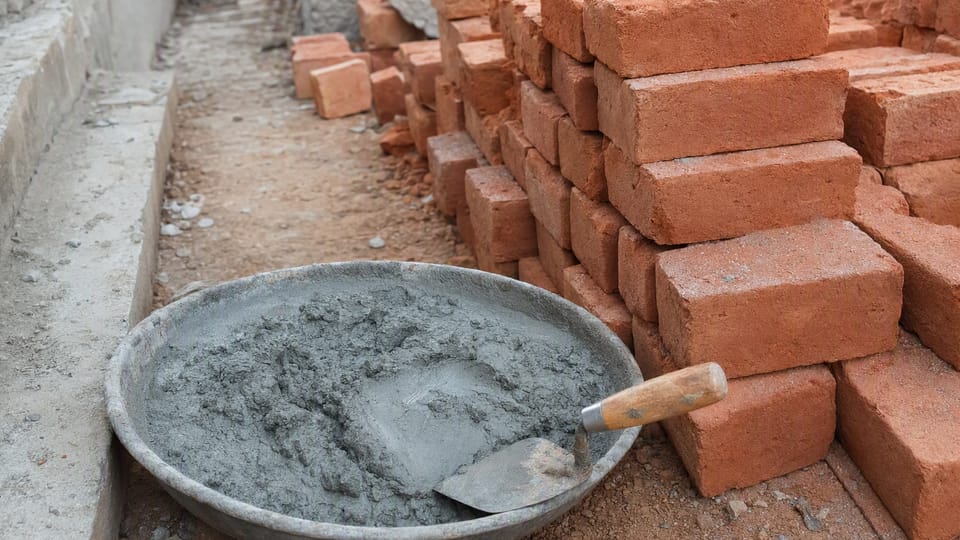
Mortar is the paste that joins the bricks into a wall. It is made from cement, sand and water, and its ratio, such as 1:6, means 1 part cement to 6 parts sand by volume. The ratio changes how strong the joints are, how much cement you buy and how the wall behaves over the years. This page explains which ratios are used where, and gives the cement and sand for each ratio so you can check a quote.
Which mortar ratio should I use?
In Indian practice, brickwork mortar usually falls between 1:4 and 1:6.
- 1:6 is a common choice for ordinary walls of one brick and thicker.
- 1:4 and 1:5 are often specified for thin 4.5 inch walls, for masonry below the plinth or in contact with damp, and where the drawing asks for a stronger joint.
These are common practice and they vary between specifications, so they are not a rule for your house. The ratio for each wall is set in your structural drawing or specification, so ask your engineer and follow it.
Which ratio goes where?
| Ratio | Common use | What to ask |
|---|---|---|
| 1:4 | Often specified for 4.5 inch walls, plinth and below-ground masonry, damp or exposed places | Does the specification ask for it for this wall? |
| 1:5 | Sometimes specified where a stronger joint than 1:6 is wanted | Is the extra cement needed here? |
| 1:6 | Commonly specified for ordinary one-brick (9 inch) and thicker walls | Does the specification give a different ratio for this wall? |
How much cement and sand does 100 sq ft of wall need?
The table gives the mortar materials for 100 sq ft of wall, built with traditional bricks, for each ratio and for two wall thicknesses. It is a volume-method result from the brick quantity calculator, with the wall entered as 230 mm and 115 mm thick, a dry-volume factor of 1.27, a 50 kg bag and 5 percent wastage.
| Mortar ratio | 9 inch wall: cement bags | 9 inch wall: sand, m³ (cft) | 4.5 inch wall: cement bags | 4.5 inch wall: sand, m³ (cft) |
|---|---|---|---|---|
| 1:4 | 3.80 | 0.53 (19) | 1.90 | 0.26 (9) |
| 1:5 | 3.16 | 0.55 (19) | 1.58 | 0.27 (10) |
| 1:6 | 2.71 | 0.57 (20) | 1.36 | 0.28 (10) |
Without wastage, the 9 inch wall needs 3.62 bags at 1:4, 3.01 at 1:5 and 2.58 at 1:6.
Why can two sources differ by about 4 percent?
The calculator takes the volume of the wall at 230 mm and 115 mm thick. A course-by-course count uses the nominal 240 mm and 120 mm, so it gives about 4 percent more mortar, just as it gives about 4 percent more bricks. The table above is therefore the lower of the two figures. When you order, add the extra, and tell the supplier the basis you used. The brick counts and the two bases are explained in How many bricks for 100 sq ft of wall?
Why is richer mortar not always better?
More cement makes mortar stronger, but it also makes it shrink more as it dries. A mortar much stronger than the bricks can crack and pull away from them, and it costs more. The aim is a mortar that is strong enough for the wall and well mixed, not as rich as possible. Where a stronger joint is needed, your engineer will say so.
How does the quality of the sand change the result?
Clean, well-graded sand makes a smooth, strong mortar. Sand with a lot of silt or clay weakens the bond. Damp sand also takes up more space than dry sand, so a measure of damp sand holds less sand than it seems. IS 2116 sets the grading limits for sand used in masonry mortar. Ask your supplier for clean sand, measure it in a box, not by the shovel, and keep it covered.
How do I calculate it for my wall?
Open the brick quantity calculator, enter the wall length, height and thickness, the doors and windows, the brick size and the mortar ratio. It gives the cement bags and the sand for the mortar, rounded up to whole bags.
How is mortar different from plaster?
Mortar joins the bricks. Plaster covers the finished wall. They use cement and sand too, but the ratio, the sand grading and the thickness differ, and plaster has its own page. Do not use the plaster ratio for brickwork or the other way round without asking your engineer.
Frequently asked questions
How much cement for 100 sq ft of brick wall?
For a 9 inch wall at 1:6 about 2.7 bags with 5 percent wastage, and for a 4.5 inch wall about 1.4 bags, by the calculator’s volume method.
Is 1:6 mortar too weak?
It is a common ratio for ordinary one-brick walls. Some specifications ask for a richer mortar for thin walls or for walls that carry load, so follow the ratio in your specification.
Can I use the same ratio for plaster and brickwork?
Do not assume you can. They have different ratios and thicknesses. Follow your drawing and your engineer.
How do I check sand quality?
Look for clean sand without lumps of clay. Rub a pinch between your fingers, and if it leaves a muddy stain, ask for cleaner sand. Measure it dry or allow for damp sand.
Does the mortar ratio change with the cement type?
The ratio is normally specified the same way for OPC, PPC and PSC, but setting and curing differ, so follow your engineer. Which cement suits which work is in OPC vs PPC vs PSC cement: which one for your house?
Related guides
- Which walls can be 4.5 inch? Load-bearing and partition walls
- Cement, sand and aggregate per cubic metre: M5 to M20
- How many days to cure a concrete slab?
This guide is general information that gives quantities under stated assumptions. Read the disclaimer. The mortar for your wall is set by your engineer.
Work out your quantities
- Brick and mortar quantity calculator: Estimate the number of bricks and the cement and sand for mortar for a wall, from its length, height and thickness.
Sources
- IS 2250:1981, Code of Practice for Preparation and Use of Masonry Mortars
- IS 2212:1991, Brickwork - Code of Practice
- IS 2116:1980, Sand for Masonry Mortars - Specification
General information only. It is not a structural design or professional advice. Ask a licensed structural engineer or architect to check your plans and site.