
Short answer
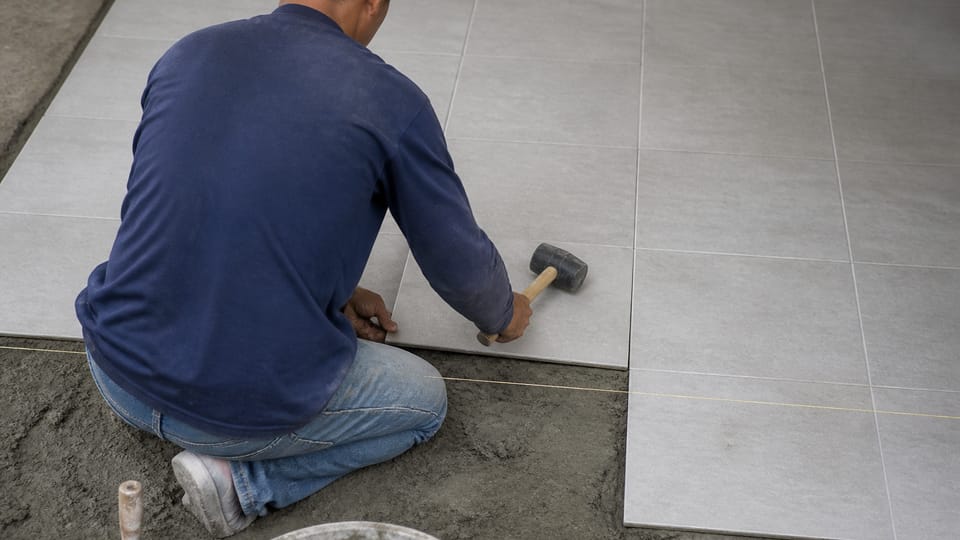
What mortar does IS 1443 specify for laying cement concrete floor tiles? IS 1443:2018 specifies one part Portland cement to five parts coarse sand by volume for the bedding, normally not less than 10 mm and not more than 30 mm thick, with the tile laid over a rough mortar top that absorbs cement slurry. It covers cement concrete tiles only, not ceramic or vitrified tiles, and gives no slurry quantity per square metre.
On this page (11)
- What does IS 1443:2018 cover?
- What does it say about the bedding mortar?
- What does it say about slurry, grout and curing?
- How do I work out cement and sand?
- A worked example
- What about ceramic and vitrified tiles?
- What should I check?
- What mistakes should I avoid?
- Frequently asked questions
- Related guides
- Sources
“How much cement and sand for floor tiles?” has no single answer, and the figures on the web differ by an order of magnitude because they hide the bed thickness and the mix. IS 1443 gives the mix and the thickness range for one kind of tile, cement concrete tiles, and says nothing about ceramic or vitrified tiles, which follow their maker’s adhesive or bedding instructions. This page says what IS 1443:2018 asks, then shows how to work out cement and sand for your own floor with a worked example. It gives no price, no per-square-foot rule and no wastage figure from a standard, because none exists.
What does IS 1443:2018 cover?
Clause 1 says the standard “covers the laying, finishing and maintenance of cement concrete tiles in floors, walls, staircases, pavings, etc”. The tiles are plain, coloured, terrazzo, chequered or embossed non-slip tiles and precast treads and risers, and clause 4.4 says the cement concrete flooring tiles used shall conform to IS 1237. It does not cover ceramic, vitrified, stone or other tiles. Its older title said “flooring tiles”; the 2018 title is “Laying and Finishing of Cement Concrete Tiles”. Clause 6.1.2 refers to a tile-laying procedure “described in 6.2”, but the published text has no clause 6.2, so the standard does not describe the laying of each tile in detail.
What does it say about the bedding mortar?
| Subject | What IS 1443:2018 says |
|---|---|
| Mix (6.1.1) | “Cement mortar shall consist of one part of Portland cement and five parts of coarse sand by volume thoroughly mixed”, with the minimum water needed for workability. A high water-cement ratio “should be avoided” because it gives a bed with drying and shrinkage cracks |
| Thickness (6.1.2) | “The thickness of the bedding shall normally be not less than 10 mm and not more than 30 mm in any one place” |
| Base (6.1.2) | The base is well compacted, with a rough surface for a key, cleaned of scum, laitance or plaster droppings, and properly wetted without water pools |
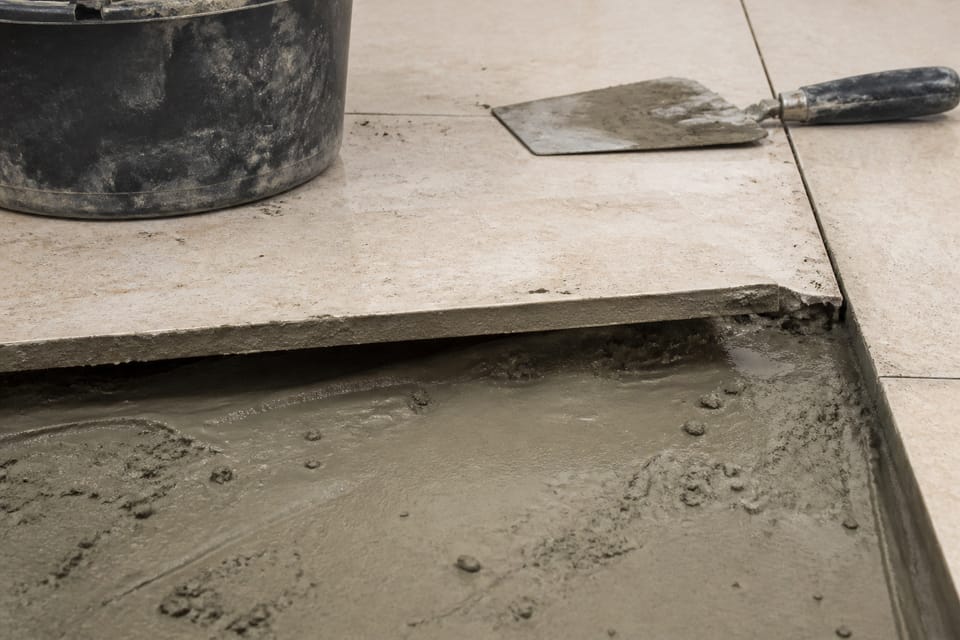
| Spreading (6.1.2) | Mortar is spread for two rows of tiles and up to 3 m in length with a thread level fixed at both ends, and “the top of mortar shall be kept rough so that cement slurry can be absorbed” |
| Cement (4.2) | To IS 269, IS 455, IS 1489 (Part 1 or Part 2) or IS 16415 |
| Sand (4.1) | To IS 2116, with a minimum fineness modulus stated in the clause |
| Water (4.7) | “Clean and free from oil, acid, alkali, organic or vegetable matter. Sea water shall not be used” |
| Sub-floor level (5.2) | Finished a stated distance below the level of the finished floor |
Clause 6.1.3 also allows lime mortars for bedding within the same thickness range. We print none of the lime mixes.
What does it say about slurry, grout and curing?
IS 1443 defines grout or slurry (3.1.3) as “neat cement mixed with water to honey-like consistency”, which may include pigments, and to which “sand, stone dust or any other aggregate shall not be added”. That is all it says about slurry: no quantity per square metre, no cement-to-water ratio and no method of applying it beyond the mortar top being rough so that slurry can be absorbed. Websites that give a slurry ratio or a kilogram per square metre are not quoting IS 1443. After laying, surplus slurry is cleaned off the surface and joints “before it sets hard” (7.1), and the joints are filled the next day with cement grout of the same shade as the tile (7.2). The floor is kept moist and allowed to mature undisturbed for seven days, then light traffic is allowed, and heavy traffic is kept off “for at least ten days after fixing the tiles” (7.4). Grinding and polishing, where the tile needs it, are not earlier than ten days after laying (9.1). For floors above a stated length or width the level is fixed at intervals and the central portion is crowned slightly (7.5), and a local deviation is limited under a straight edge (7.6). We print only the days.
How do I work out cement and sand?
IS 1443 gives no quantity, so the arithmetic is yours, in four steps. This is the same method as for plaster, and the 1.27 dry factor is borrowed from the site’s plaster and brick modules, so it is an estimate for a tile bed too.
- Wet volume of the bed = floor area x bed thickness.
- Dry volume of cement plus sand = wet volume x a dry factor, because the dry materials fill more space than the wet mortar. The site calculator uses 1.27 for mortar.
- Split the dry volume by the mix. For 1:5, one part in six is cement and five parts in six is sand.
- Convert the cement volume to bags: the calculator takes a 50 kg bag as 50/1440 of a cubic metre. Then add an allowance for waste and an uneven base.
The 20 percent allowance and the 1.27 factor are the site’s estimating conventions, not IS 1443 figures. The site’s plaster quantity calculator accepts thicknesses of 6 to 25 mm, so it covers most of the IS 1443 range but not a bed of more than 25 mm, which needs the same arithmetic by hand. See plaster quantity: cement and sand per sq ft, with a calculator for the method, and sand bulking: why damp sand gives you less sand for ordering sand.
A worked example
A room of 12 m2, bedded in 1:5 mortar, using the plaster quantity calculator module (inputs: area 12 m2, mix 1:5):
| Bed thickness | Wet mortar | Dry material | Cement, net | Sand, net | Cement with 20% allowance | Sand with 20% allowance |
|---|---|---|---|---|---|---|
| 10 mm | 0.12 m3 | 0.152 m3 | 0.73 bags | 0.127 m3 | 0.88 bags | 0.152 m3 |
| 20 mm | 0.24 m3 | 0.305 m3 | 1.46 bags | 0.254 m3 | 1.76 bags | 0.305 m3 |
| 25 mm | 0.30 m3 | 0.381 m3 | 1.83 bags | 0.318 m3 | 2.19 bags | 0.381 m3 |
The bed thickness drives the answer: doubling it doubles the cement and sand. That is why a per-square-foot rule without a thickness is not reliable. The thickness is set by how level the base is and by the specification, within the standard’s range for cement concrete tiles, and a thicker bed is not better. Your mason or engineer sets it. This example is the arithmetic for a mortar bed only: it covers no slurry, no joint grout and no floor base.
What about ceramic and vitrified tiles?
IS 1443 is not for them. They have their own standards, and their laying follows the tile maker’s instructions, usually a tile adhesive or a specified bed. Adhesive bonds a tile: it does not level a floor, so the base has to be flat first. We did not read the adhesive standard for this page, so we make no claim about its types.
What should I check?
This is practice, apart from the clauses named.
- Which tile you have: cement concrete tiles (IS 1237) follow this code; ceramic and vitrified follow the maker.
- The mix and the bed thickness in writing, from the specification or your engineer (the 1:5 and the 10 to 30 mm are the standard’s, for cement concrete tiles).
- Clean, graded sand with little silt, and cement of a standard the clause names (4.1, 4.2).
- That the base is cleaned, wetted without pools and rough, and the bed is spread for a short run at a time.
- That the tile goes on a full bed: after laying, tap to find hollow spots, and lift one early tile to see the coverage.
- Curing and keep-off time as in 7.4, and no early grinding.
- In a wet area, the slope to the drain is set before tiling.
What mistakes should I avoid?
These are practice unless a clause is named.
- Using a per-square-foot rule without a thickness and a mix.
- Forgetting the dry factor, so the order falls short.
- Ordering damp sand by volume without allowing for bulking.
- Using silty sand.
- A high water-cement ratio, which the standard warns against (6.1.1).
- Putting sand in the slurry: the definition says no sand, stone dust or aggregate (3.1.3).
- Letting the slurry dry before the tile goes down.
- Tapping only the edges, so voids stay under the centre.
- Walking or driving heavy loads on the floor too early (7.4).
- Applying a mortar bed to vitrified or large-format tile when the maker specifies adhesive.
- Attributing a slurry quantity or a wastage figure to IS 1443.
Frequently asked questions
What is the mortar ratio for floor tiles in IS 1443?
One part Portland cement to five parts coarse sand by volume (clause 6.1.1), for cement concrete tiles.
How thick should the bedding be?
IS 1443 says normally not less than 10 mm and not more than 30 mm in any one place (6.1.2).
What is the cement slurry ratio for tiles?
IS 1443 gives none. It defines slurry as neat cement mixed with water to a honey-like consistency, with no sand or other aggregate.
How many days before I can walk on new tiles?
IS 1443 keeps the floor moist and undisturbed for seven days, then allows light traffic, and heavy traffic only after at least ten days.
Does this apply to vitrified tiles?
No. Follow the tile maker’s adhesive or bedding instructions.
Related guides
- Plaster quantity: cement and sand per sq ft, with a calculator
- Sand bulking: why damp sand gives you less sand
- Cement, sand and aggregate per cubic metre: M5 to M20
This guide is general information. Read the disclaimer. Your mason, engineer and tile supplier decide the bed, the mix and the laying method for your floor.
Sources
General information only. It is not a structural design or professional advice. Ask a licensed structural engineer or architect to check your plans and site.