
Short answer
What is the difference between ceramic, vitrified and porcelain tiles? IS 13712:2019 divides ceramic tiles by water absorption. Group Ia, up to 0.08 percent, is its fully vitrified tile; Group Ib, over 0.08 up to 3 percent, is its porcelain tile; Groups IIa and IIb are ceramic floor tiles and Group III is the wall tile. Glazed, polished and rectified are separate marks, not groups.
On this page (10)
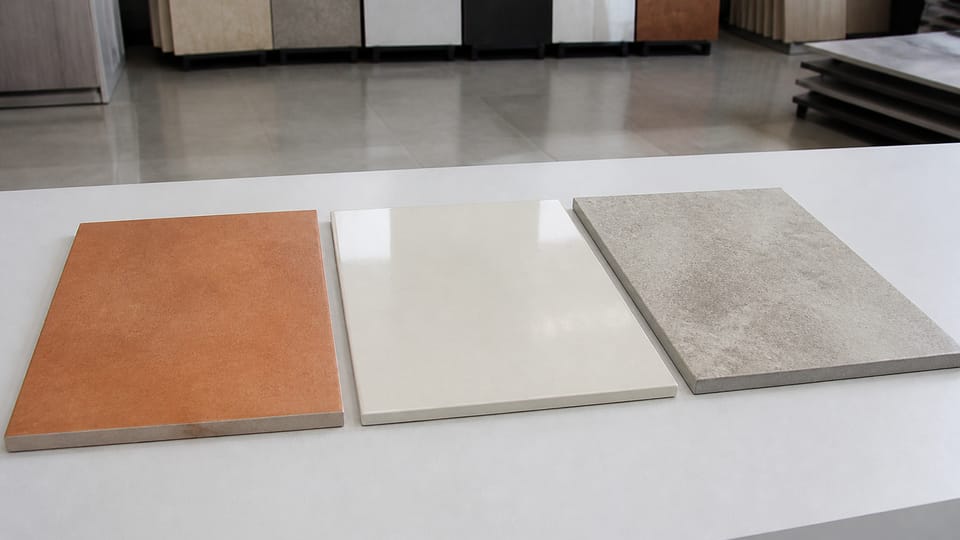
Tile shops sell “ceramic”, “vitrified”, “porcelain”, “GVT”, “PGVT” and “double charge”, and customers are told one is better. The Indian standard sorts tiles a different way: by how much water they absorb and how they are shaped. This page maps the shop words to the standard’s groups, says what the standard does and does not say about each, and gives a checklist for the carton. It gives no price, brand, breaking strength or thickness. For what to check at handover, see snag list for a new house: what to check before final payment.
How does IS 13712 group tiles?
Clause 4 of IS 13712:2019 says ceramic tiles “are divided into groups according to their method of manufacture and their water absorption”. Water absorption is the percent by mass measured by IS 13630 (Part 2) (clause 3.9). The groups, as clauses 4.2.1 to 4.2.3 and Table 2 word them:
| Group | Water absorption, E | Named in the standard |
|---|---|---|
| B Ia | E ≤ 0.08 percent | Ceramic fully vitrified tiles |
| B Ib | 0.08 percent < E ≤ 3 percent | Ceramic porcelain tiles |
| B IIa | 3 percent < E ≤ 6 percent | Ceramic floor tiles |
| B IIb | 6 percent < E ≤ 10 percent | Ceramic floor tiles |
| B III | E > 10 percent | Ceramic wall tiles |
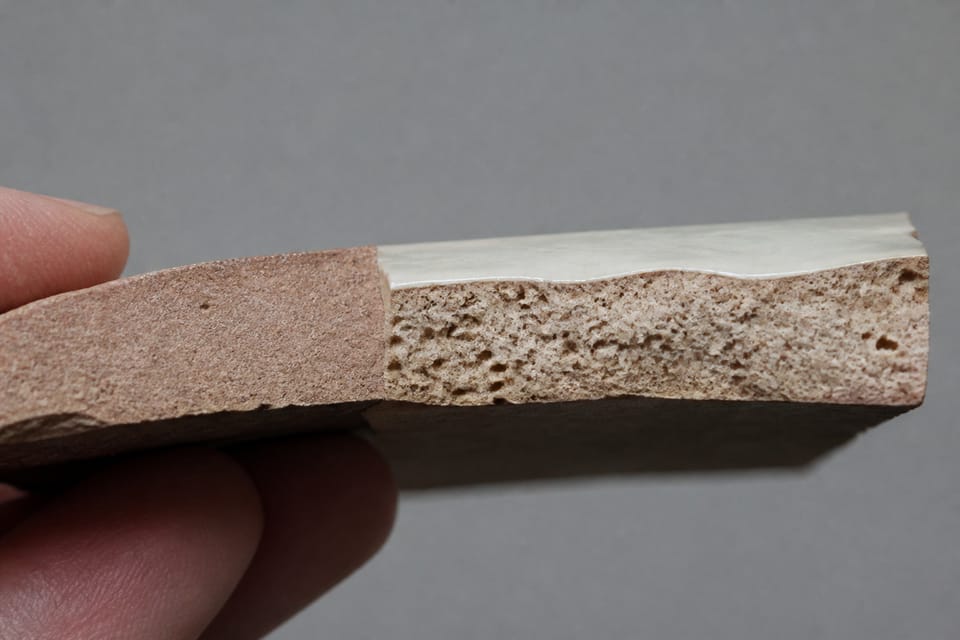
The “B” is the pressed method of shaping, and Table 2 also has extruded (A) and cast (C) rows. Clause 3.1 explains: “Depending on degree of vitrification their water absorption may vary. A low water absorption tile is also called porcelain tile. An extremely low water absorption tile is called a fully vitrified tile and this may be glazed or unglazed and polished or unpolished.”
What do the shop words map to?
| Shop word | What the standard says |
|---|---|
| Porcelain | Its name for Group B Ib, low water absorption |
| Vitrified | The standard does not define “vitrified” as a product. “Fully vitrified” is Group B Ia. (Practice reading: a tile sold as vitrified can be Ia or Ib) |
| Ceramic | The word for the whole standard; the floor groups IIa and IIb and the wall group III carry the name |
| Glazed | A surface: “a vitrified covering that is practically impermeable” (clause 3.2). Not a group |
| Polished | A surface given a glossy finish by mechanical polishing (clause 3.16). Not a group |
| Rectified | A tile whose edges are ground after firing to precise dimensions (clause 3.15). Not a group |
| GVT, PGVT, double charge, full body | Not in IS 13712:2019 or IS 15622:2017 at all |
Glazed, unglazed, polished, unpolished, rectified and unrectified are separate items. The marking (clause 6.1) carries the nature of the surface, the edge finish and the final finishing, the specification supplied (clause 6.2) carries the classification, and clause 7.1 leaves size, thickness, nature of surface, colour and relief to be agreed. The foreword mentions that “the glazed vitrified tiles and glazed polished tiles have been duly covered”. So the group letter, on the carton or the supplied specification, and not the shop word, tells you the water absorption class.
What does IS 15622 add?
IS 15622:2017, the specification for pressed ceramic tiles, classes tiles into the same five groups “as defined in IS 13712” (clause 4.1) and allows a glazed or unglazed surface and polished, semi-polished or unpolished finish (clause 4.2). It sets acceptance limits for each group, and its foreword says that, in view of the “possibility of discoloration and staining from cement slurry, spillage, splitting” and similar, it covers lower absorption limits for Groups B Ia and B Ib than ISO 13006. The earlier edition, IS 15622:2006, had four groups with no IIa or IIb, and was withdrawn in 2022, so a page or shop sheet that quotes four groups is quoting the old text.
What do the standards not say?
- IS 13712 and IS 15622 do not say which group suits a bathroom or a wet area, and do not say that a lower absorption group is better or lasts longer. Annex C of IS 13712 is informative, is about glazed tiles, mentions bathrooms in its lightest recommended wear class, and ties no group to wet areas.
- They do not say vitrified is only for floors or ceramic only for walls. Only Group III is named wall tiles, and floor use asks for abrasion and slip properties, with the slip value, where required, declared by the maker (Annex B).
- They give no slip number.
- No standard we read defines “double charge”, “glazed vitrified” as a trade product, or ranks any of these methods. A claim that one is stronger has to be backed by the data sheet of that tile.
- IS 13712 does not cover natural granite, which has its own standard.
What should I ask the dealer? (practice)
This is practice, apart from the clauses named.
- Which IS 13712 group is this tile, and where is it stated: on the carton or in the supplied specification?
- Is it glazed or unglazed, polished or matt, rectified or not?
- For a floor: can I see the slip declaration and the test method?
- Is the whole order from one batch and shade?
- Can I return unopened cartons, and keep spares of the same batch?
How do I choose by room? (practice)
- Bathroom and toilet floors: ask for a floor-rated tile with a surface that is not glossy when wet, and a declared slip value.
- Kitchen: an easy-to-wipe surface, low absorption and a grout choice that suits it.
- Balcony or open terrace: a floor-rated tile for exterior use, with a non-glossy surface.
- Dry rooms: polished or glossy is a look choice, if kept dry.
- Walls: a wall-group tile is intended for walls; a floor-rated tile on a wall is also fine.
What mistakes should I avoid? (practice)
- Assuming “vitrified” means zero water absorption. The standard says low, not zero.
- Treating “porcelain” and “vitrified” as marketing words and not reading the group on the carton or specification.
- Assuming polished vitrified is safe when wet.
- Using a wall-group tile on a floor without a floor rating.
- Buying by thickness or price alone, with no data sheet.
- Mixing batches and shades, and keeping no spare tiles.
Frequently asked questions
Is porcelain the same as vitrified?
IS 13712 lists them as two groups: porcelain is Group B Ib, with low water absorption, and fully vitrified is Group B Ia, with extremely low water absorption. Shops often use the words loosely.
Can ceramic tiles be used on floors?
Yes. IS 13712 names Groups B IIa and B IIb as ceramic floor tiles. Floor use asks for abrasion and slip properties.
Do vitrified tiles absorb water?
Yes, a little. Group B Ia is up to 0.08 percent, and the standard says water absorption may vary with the degree of vitrification.
What are GVT and PGVT?
They are trade names, and neither IS 13712 nor IS 15622 uses them. IS 13712 mentions glazed vitrified and glazed polished tiles as categories it covers, with the group set by water absorption.
Is polished vitrified slippery when wet?
This is practice: a glossy polished surface is slippery when wet. The standard asks the maker to declare a slip value where required for floor tiles and gives no number.
Related guides
- Snag list for a new house: what to check before final payment
- Epoxy flooring vs tiles for a house: where each works
- IS codes for house construction: which standard covers what
- IS 13630 explained: the tile test methods and what a report shows
This guide is general information. Read the disclaimer. Your dealer, tiler and engineer decide the tiles for your house.
Sources
- IS 13712:2019, Ceramic Tiles: Definitions, Classification, Characteristics and Marking (second revision): clauses 3.1, 3.2, 3.9, 3.15, 3.16, 4, 4.2.1 to 4.2.3, 6.1, 6.2, 7.1 and Table 2 and Annex B and C (page images read). BIS lists it as in force, valid to 2029-05-31.
- IS 15622:2017, Pressed Ceramic Tiles: Specification (first revision): clauses 4.1 and 4.2 and the foreword (page images read). BIS lists it as in force, valid to 2030-12-29, with an Amendment 2 which was not read. IS 15622:2006 (withdrawn 2022) had four groups.
Change log
- : Added Related guides link to newly published article(s): is-13630-explained-the-tile-test-methods-and-what-a-report-shows. No other text changed. Approved by the reviewing engineer (owner report, 2026-10-31).
General information only. It is not a structural design or professional advice. Ask a licensed structural engineer or architect to check your plans and site.