
Short answer
How do I tell an asbestos cement roof sheet from a fibre cement sheet? Not by looks. IS 459 covers asbestos cement sheets and asks for the source, the year and date, and a pictorial warning sign to be marked on each sheet. IS 14871 covers non-asbestos fibre cement sheets and asks for marking that shows they do not contain asbestos. A sheet with no marking cannot be identified from the standards; ask your local authority and a qualified professional.
On this page (8)
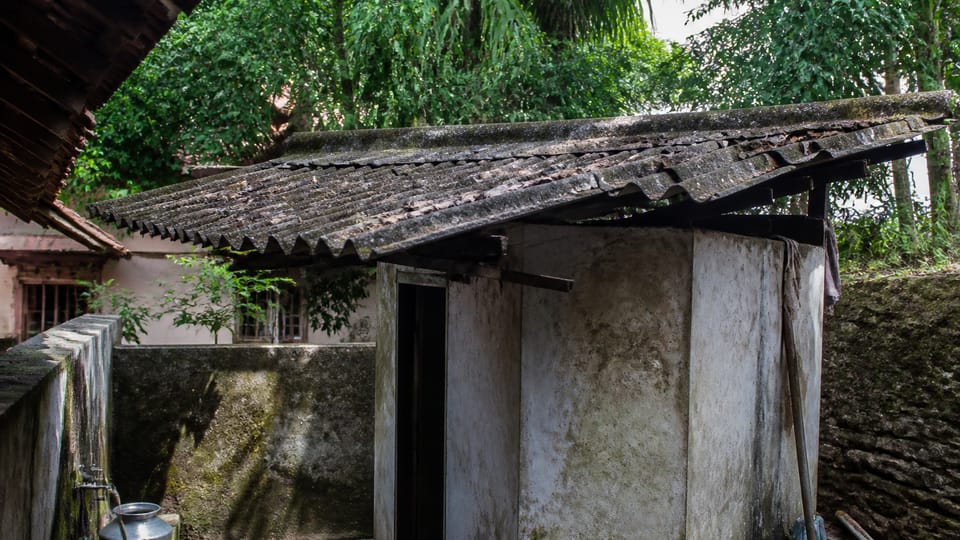
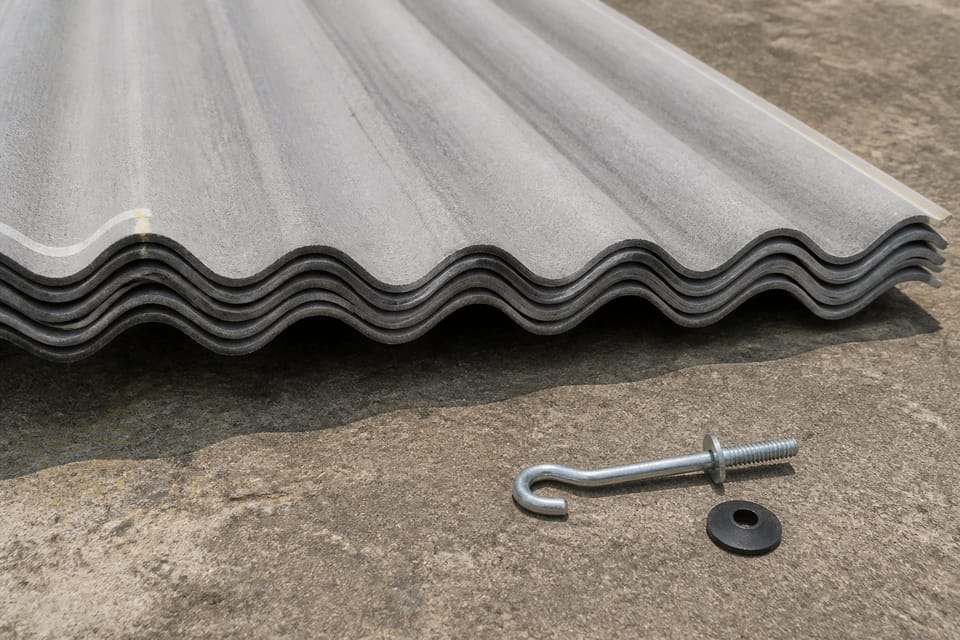
Two different roof sheets are sold as “cement sheet”, and from a distance they look alike: the older grey corrugated sheet made with asbestos fibre and cement, and the newer sheet made with other fibres. The Indian standards keep them apart by what is marked on the sheet, not by how it looks. This page sets out what IS 459 and IS 14871 say, what each requires on the sheet, and what neither says. It gives no price, size or lifetime. It also gives no health, removal or disposal advice: we did not check the Indian rules on asbestos, so for an existing roof ask your local authority and a qualified professional before you cut, drill, repair or remove anything. For the general choice of roof, see roof tiles vs metal sheets vs RCC slab: choosing a roof for a house.
What is each sheet made of?
| Asbestos cement sheet | Fibre cement sheet | |
|---|---|---|
| Standard | IS 459:1992 | IS 14871:2000 |
| What it covers | “Corrugated and semi-corrugated asbestos cement sheets” (clause 1) | Profiled fibre cement sheets and fittings for roofing and cladding (clause 1.1); the standard “does not apply to asbestos cement profiled sheets which are covered by IS 459” (clause 1.3) |
| Material | Asbestos fibre “including other suitable fibres”, cemented together with cement of the types listed in clause 3 | An inorganic hydraulic or calcium silicate binder, reinforced by organic fibres and/or inorganic synthetic fibres (clause 5.1) |
| Profiles | Corrugated and semi-corrugated (clause 5) | Categories A to D by corrugation height and classes by breaking load (clause 5.3) |
IS 459 allows “other suitable fibres” in addition to the asbestos, so a sheet that has other fibres in it is not necessarily asbestos-free. Neither standard defines a sheet by its looks.
What must be marked on the sheet?
This is where the standards separate the two:
- IS 459, clause 12: each sheet is “indelibly stamped or marked by any suitable method” with the source of manufacture, the year and date of manufacture, and “pictorial warning signs as given in IS 12081 (Part 2)”. IS 459 does not ask for an IS number or a Standard Mark on the sheet. Clause 13 asks that deliveries come with a safety rules sheet. IS 12081 allows a symbol “a” to be stamped on unpacked articles such as sheets where the full sign cannot be marked. IS 11769 (Part 1), Amendment 1, says the sign is to caution users that these products contain asbestos fibre and that improper use may generate asbestos dust, inhalation of which may cause serious damage to health.
- IS 14871, clause 10: “sheets shall be marked with indelible characters to show that they do not contain asbestos”. Clause 7.1 also asks for the maker, the date, the type, category and class, and the size and thickness. The Standard Mark “may” be added (clause 7.2).
These clauses apply to a sheet made to the standard. They say nothing about how to identify a sheet whose marking has worn off, an old sheet, or an imported one. For that, the standards offer nothing, and the answer is a qualified person.
What do the standards not say?
- How to tell a sheet by colour, weight or look. Neither standard does, and this page does not either.
- How to remove, repair, wrap or dispose of old sheets. IS 11768, the disposal recommendations, was not read for this page.
- The legal position on asbestos sheets. We did not read the Indian rules; BIS standards existing is not the legal position, and rules change.
- Price, or service life for fibre cement.
- NBCS 2026 still lists IS 459 among the materials, and one masonry clause (in the earthquake provisions) says that for pitched roofs “corrugated iron or asbestos sheets shall be used in preference to” country, Allahabad or Mangalore tiles; it carries no health caveat, so do not take it as advice.
What should I do with a new roof or an old one? (practice)
This is practice, apart from the clauses named.
- New shed or outhouse: choose the material first, and ask the supplier which standard the sheet is made to. Ask for the marking to be shown on the sheet, and for the maker’s written declaration. Compare with metal roof sheets: GI vs galvalume vs colour-coated, and TCT and BMT.
- Old cement sheet roof of unknown type: leave it undisturbed, and ask your local authority and a qualified professional before you cut, drill, break, wash hard, repair or remove it.
- Check: the marking on the edge or back of the sheet, and the supplier’s papers.
What mistakes should I avoid? (practice, not from the standards)
- Assuming the type from the look of the sheet.
- Cutting, drilling, breaking or power-washing an old sheet without asking first.
- Burning or dumping the debris.
- Reusing old sheets on a new roof.
- Mixing sheet types on one roof.
- Buying sheets with no marking and no documents.
- Walking on sheets without a crawl board.
Frequently asked questions
Is a cement sheet the same as an asbestos sheet?
No. IS 459 covers asbestos cement sheets and IS 14871 covers non-asbestos fibre cement sheets. The marking separates them.
How can I tell if a roof sheet has asbestos?
Not by looks. Check the marking against IS 459 and IS 14871, and ask the supplier for papers. If the sheet is unmarked or old, ask a qualified professional.
Are asbestos roof sheets banned in India?
We did not check the Indian rules, and they change. Ask your local authority and the State Pollution Control Board.
Is it safe to drill or cut an old sheet?
We give no advice on this. Ask your local authority and a qualified professional first.
What does the warning sign on a sheet mean?
IS 11769 says it cautions users that the product contains asbestos fibre and that improper use may generate dust.
Related guides
- Roof tiles vs metal sheets vs RCC slab: choosing a roof for a house
- Metal roof sheets: GI vs galvalume vs colour-coated, and TCT and BMT
- Ceiling boards: gypsum, calcium silicate, cement or PVC
This guide is general information. Read the disclaimer. Ask your local authority and a qualified professional about any old cement sheet roof.
Sources
- IS 459:1992, Corrugated and Semi-corrugated Asbestos Cement Sheets, Specification (third revision), with Amendments 1 to 4: clauses 1, 3, 5, 12 and 13 (clause 12 and 13 page images read; others text). BIS lists it as in force, valid to 2028-01-31.
- IS 14871:2000, Products in Fibre Reinforced Cement, Long Corrugated or Asymmetrical Section Sheets and Fittings for Roofing and Cladding, Specification, with Amendment 2 (2021): clauses 1.1, 1.3, 5.1, 5.3, 7.1, 7.2 and 10 (page images read; 5.1 text). BIS lists it as in force, valid to 2030-08-01.
- IS 11769 (Part 1):1987, Guidelines for Safe Use of Products Containing Asbestos, Part 1 Asbestos Cement Products, with Amendment 1 (2005): Amendment clause 9.1 (page image read). BIS lists it as in force, valid to 2027-01-31.
- IS 12081 (Part 2):1987, Recommendations for Pictorial Warning Signs and Precautionary Notices for Asbestos and Products Containing Asbestos, Part 2 Asbestos and its Products: clause 3 (page image read). BIS lists it as in force, valid to 2027-01-31.
General information only. It is not a structural design or professional advice. Ask a licensed structural engineer or architect to check your plans and site.