
Short answer
What is the safe bearing capacity of soil? Safe bearing capacity is the most load per unit area that the soil can carry with a margin of safety against the soil giving way. It ignores how much the building will sink. The value your engineer designs with is the allowable bearing pressure, the lower of that safe value and the pressure that keeps settlement within limits. It comes from a soil test on your plot, not from a table.
On this page (10)
- What is safe bearing capacity?
- How is it different from ultimate bearing capacity and allowable bearing pressure?
- Why does settlement matter so much?
- Why is safe bearing capacity not one number for a soil type?
- Where does the value come from?
- What should I look for in the soil report?
- What mistakes should I avoid?
- Frequently asked questions
- Related guides
- Sources
“What is the SBC of the soil?” is one of the first questions an engineer asks about a plot. Many websites answer with one number per soil type. That number is not what your foundation should be designed on. This page explains what safe bearing capacity means, how it differs from ultimate bearing capacity and allowable bearing pressure, why it changes with depth, width and groundwater, and what to look for in your soil report. It gives no bearing values, no footing sizes and no depths, because those come from a test on your plot and from your structural engineer.
What is safe bearing capacity?
Safe bearing capacity is the most load per unit area that the soil can carry with a margin of safety against the soil failing in shear. Shear failure means the soil under the footing gives way and pushes out to the sides. The definition in the National Building Code adds the important words “irrespective of any settlement that may occur”. So safe bearing capacity looks only at the soil giving way. It does not look at how much the building sinks.
How is it different from ultimate bearing capacity and allowable bearing pressure?
Four terms appear in soil reports. They are not the same thing.
| Term | What it means in plain words | Where it is defined |
|---|---|---|
| Ultimate bearing capacity | The pressure at which the soil under the footing actually fails in shear | NBC 2016 Part 6 Sec 2, cl 2.3.3; IS 6403 cl 2.1.2 |
| Factor of safety | The number the ultimate value is divided by to get the safe value | NBC 2016 Part 6 Sec 2, cl 2.3.5 |
| Safe bearing capacity | Ultimate value reduced by the factor of safety; ignores settlement | NBC 2016 Part 6 Sec 2, cl 2.3.2 and 2.3.5; IS 6403 cl 2.1.3 and 6.1(a) |
| Allowable bearing pressure | The value used for design: the lower of the safe bearing capacity and the pressure that keeps settlement within the permissible limit | NBC 2016 Part 6 Sec 2, cl 2.3.4 and 7.2.2; IS 6403 cl 6.1 (called allowable bearing capacity) |
The last line is the one that matters for your house. The code takes “whichever is less” of two checks:
- Strength check. The soil must not give way. This gives the safe bearing capacity.
- Settlement check. The building must not sink more than is acceptable for that structure. This gives the safe bearing pressure.
On some plots the strength check controls. On others the settlement check gives the lower value; in general engineering experience this is common on soft clays. So “SBC” alone is not the full answer. IS 2809, the soil engineering glossary, puts it well: the allowable pressure is “a combined function of both the site conditions and characteristics of the particular structure”. In other words, it depends on your building as well as your soil.
You may also see “net” and “gross”. Gross is the total pressure at the base of the footing. Net takes away the weight of the soil that was dug out above that level. IS 6403 works in net values. Check which one your report gives.
Why does settlement matter so much?
If a whole building sinks evenly, it suffers no damage in theory, says IS 8009 (Part 1), the code on calculating settlement, though buried pipes and cables can still be harmed. In practice settlement is rarely even. When one part sinks more than another, the frame and walls are strained, and cracks can follow. That is why the settlement check sits alongside the strength check and is not an extra.
Why is safe bearing capacity not one number for a soil type?
Because the calculation in IS 6403 uses more than the soil type. It also uses the width of the footing, how deep it sits, its shape and the groundwater level. Change any of these and the result changes.
- Groundwater. IS 6403 asks for the position of the water table and how it rises and falls. If groundwater is at, or can rise to, the footing level, or sits within about one footing width below it, the calculation reduces the bearing capacity. A level read on one dry day can mislead.
- A weaker layer below. If a weaker soil lies under a stronger top layer, the pressure that reaches the weaker layer must stay within what that layer can safely carry, the NBC says.
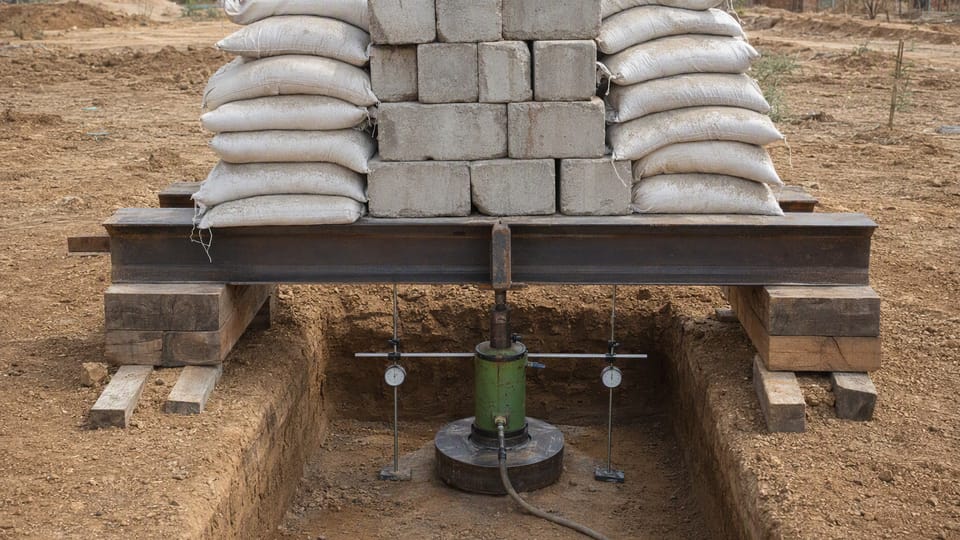
- Width. For a plate load test, IS 1888 notes that the result reflects only the soil within less than twice the width of the plate. Real footings are wider, so they load deeper soil. In clay the bearing capacity of a larger footing is about the same as the small plate, but in dense sand it rises with size.
This is why a value copied from a neighbour’s report or a website table can be wrong for your plot, even when the soil looks the same.
Where does the value come from?
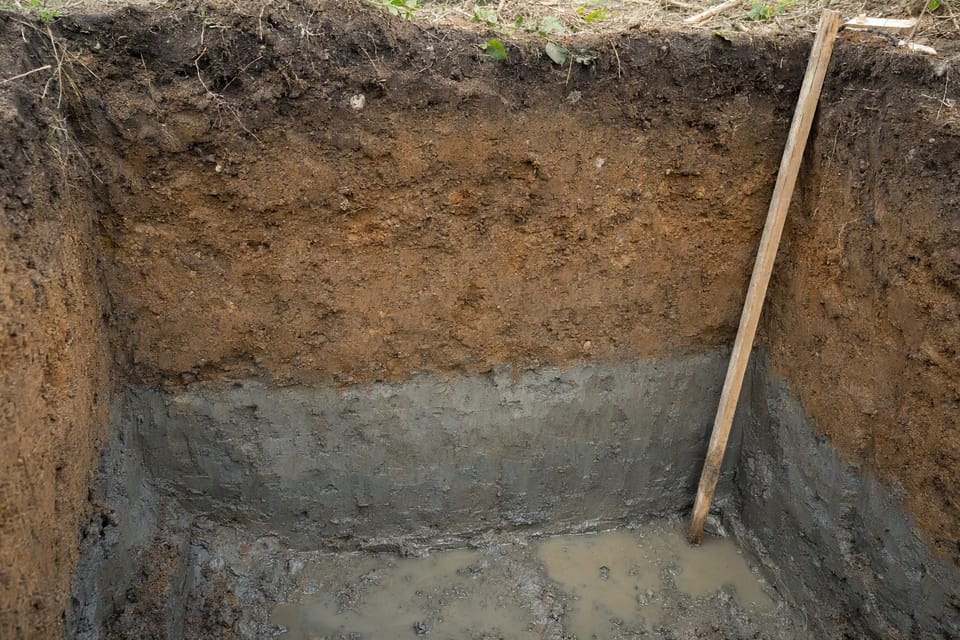
From the soil investigation on your plot. IS 1904 (the 1986 edition we read) says safe bearing capacity should be calculated from soil test data, following IS 6403. Only where no test data exists, and only for a first, preliminary design, may local values serve as a guide.
IS 1888 adds a useful line. Looking at the soil in trial pits, together with known data for that soil, may be enough for light or less important buildings in normal conditions. For unusual soils and for heavy or important buildings, lab or field tests are essential. Your engineer decides which case your house falls in.
The tests themselves, such as trial pits, borings, the standard penetration test and the plate load test, are explained in our guide to the soil test before building a house.
Even with good test data, IS 6403 says the calculation methods are aids to design and cannot replace the engineer’s judgement.
What should I look for in the soil report?
The 2026 National Building Construction Standards ask a soil investigation report to give the net allowable bearing pressure, considering both shear and settlement, for isolated footings, strip footings and rafts. When you read the bearing value in your report, check:
- Which term it uses: safe bearing capacity (strength only) or allowable bearing pressure (strength and settlement).
- Net or gross.
- The depth below ground the value is for.
- The footing type and width it assumes, if stated.
- The groundwater level found, and whether a seasonal high level was considered.
- The units. Current codes use kilonewtons per square metre (kN/m²). Older codes and reports may use kilograms per square centimetre or tonnes per square metre. Do not convert by guesswork: ask the agency or your engineer.
- The agency, the date and a signature.
If any of these is missing, ask the agency before your engineer starts the design.
What mistakes should I avoid?
These come from site practice and from what the codes warn against:
- Using a bearing value from a website, a book table or a neighbour’s report for the final design. IS 1904 (1986 edition) allows local values only as a guide for a preliminary design, when no soil test data exists.
- Treating safe bearing capacity as the design value and forgetting settlement.
- Assuming the factor of safety is the only thing between the ultimate value and the design value. Settlement can control.
- Reading one water level on a dry day as the groundwater level.
- Testing at a depth that is not the planned footing level. This is our practical reading of how the codes work, not a quoted rule.
- Accepting a report you cannot follow. Ask the agency to explain each term.
Frequently asked questions
What is the difference between safe bearing capacity and allowable bearing pressure?
Safe bearing capacity checks only that the soil will not give way. Allowable bearing pressure is the lower of that and the pressure that keeps settlement within limits. Your foundation is designed on the allowable value.
Can I find the safe bearing capacity of soil on site myself?
No reliable home method exists. The value comes from a soil investigation: field tests, lab tests and the engineer’s calculation following IS 6403. Looking at or squeezing the soil can tell you its type, not its bearing capacity.
What is the SBC of normal soil or black cotton soil?
There is no single value. It depends on the soil’s properties, the depth, the footing width and the groundwater level, all measured on your plot. This page gives no table on purpose.
What factor of safety is used for bearing capacity?
IS 6403 says only “suitable factor of safety”. The National Building Code 2016, and now the 2026 standards, set a value for safe bearing capacity. Your engineer applies it, and the settlement check can still give a lower allowable value.
Which IS code covers bearing capacity?
IS 6403 covers how to calculate the bearing capacity of shallow foundations. IS 1904 covers general requirements for foundations in soils (its current edition is IS 1904:2021). IS 1888 covers the plate load test. The National Building Construction Standards 2026 (SP 7:2026), which replaced the National Building Code 2016 on 30 April 2026, cover soils and foundations in Part C Section 2.
Related guides
- Soil test before building a house: what it is and why it matters
- Footing vs foundation: the difference and the common types
- Black cotton soil: why houses crack and what the engineer checks
This guide is general information. Read the disclaimer. The soil investigation agency and your structural engineer decide the bearing value and the foundation for your plot.
Sources
- National Building Code of India 2016 (SP 7:2016), Part 6 Section 2, Soils and Foundations (clauses 2.3.2 to 2.3.5, 7.2.2, 7.2.2.1, 7.2.2.3). Withdrawn on 30 April 2026 and replaced by SP 7:2026, National Building Construction Standards 2026, where soils and foundations are Part C Section 2.
- Gazette of India Extraordinary No. 299, Part III Section 4, 30 April 2026: BIS notice establishing SP 7:2026 and withdrawing SP 7:2016.
- IS 6403:1981, Code of Practice for Determination of Bearing Capacity of Shallow Foundations (First Revision, with Amendment 1). Clauses 0.2, 1.1, 2.1, 4.2, 5.1.2.4, 6.1.
- IS 1904:1986, Code of Practice for Design and Construction of Foundations in Soils: General Requirements (Third Revision). Clause 18.1 and Table 1. Superseded by IS 1904:2021, which we have not read.
- IS 1888:1982, Method of Load Test on Soils (Second Revision). Foreword 0.2 to 0.4.
- IS 2809:1972, Glossary of Terms and Symbols Relating to Soil Engineering (clauses 2.13, 2.30, 2.337). BIS lists a decision to reaffirm and archive it.
- IS 8009 (Part 1):1976, Code of Practice for Calculation of Settlements of Foundations, Part 1 (foreword 0.3). BIS lists a decision to reaffirm and archive it.
General information only. It is not a structural design or professional advice. Ask a licensed structural engineer or architect to check your plans and site.