
Short answer
Why do houses crack on black cotton soil, and what foundation is used? Black cotton soil is a clay that swells when wet and shrinks when dry, so the ground under a house moves with the seasons. Light buildings on shallow footings crack most. Indian Standards let the engineer take the foundation below the zone that moves, design it to cope with the movement, or load it enough to resist swelling. Under-reamed piles are one way to go deeper. Your engineer chooses after a soil investigation.
On this page (10)
In large parts of central and western India, the soil turns dark and sticky in the rains and splits into wide cracks in summer. Houses built on it often crack too. This page explains what black cotton soil is, why it damages houses, which tests your engineer uses to judge it, which foundation types the Indian Standards name for it, and what you can do as an owner. It gives no foundation depths, pile sizes or layer thicknesses: those depend on the test results for your plot.
What is black cotton soil?
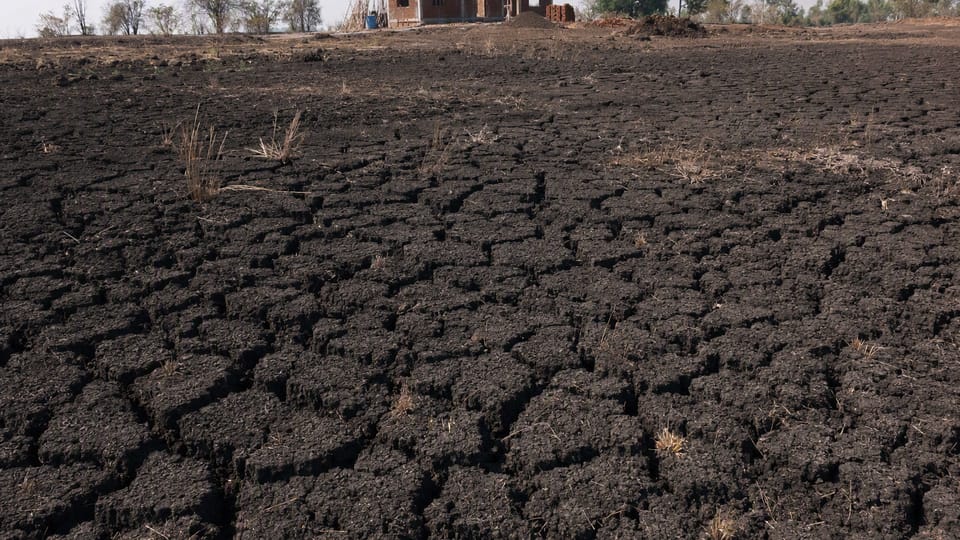
IS 2809, the Indian glossary of soil terms, describes black cotton soils as clays of medium to high compressibility that form a major soil group in India. They are mostly made of a clay mineral called montmorillonite, are black or blackish grey, and have “high shrinkage and swelling properties”.
The NCERT geography textbook says this black soil, also called regur, is typical of the Deccan basalt region. It covers the plateaus of Maharashtra, Saurashtra, Malwa, Madhya Pradesh and Chhattisgarh and extends along the Godavari and Krishna valleys. It develops deep cracks in hot weather and is sticky when wet.
Why do houses crack on black cotton soil?
Because the ground under them moves. IS 1904, the Indian code for foundations in soils, says clays like black cotton soil dry, shrink and crack in hot dry weather and swell in the wet weather that follows. How deep this movement goes depends on the clay and the climate of the region, so no single depth fits every place.
IS 2720 (Part 41), the code for measuring swelling pressure, puts it plainly: light structures built on these clays “experience severe structural damage due to the swelling of the subsoil.” A heavy load can hold the soil down. A light house often cannot.
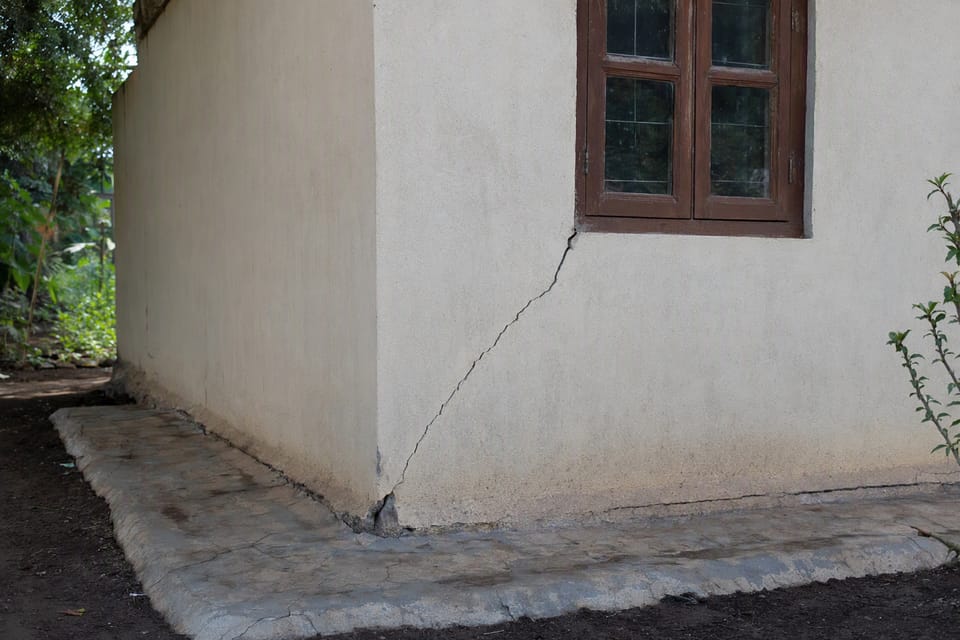
SP 25, the BIS handbook on cracks in buildings, describes the typical damage on shrinkable clay with shallow foundations:
- Diagonal cracks across the corners of a building, wider at the top and narrowing downwards, running through the damp-proof course to the foundation. Corners dry out more than the middle, which is why they crack first.
- Seasonal movement. In dry weather the outer walls settle and tend to tilt outwards. In the rains the soil swells and the movement reverses, but cracks once formed do not fully close.
- Floors that heave up and become uneven.
SP 25 also warns that such cracks should not be filled with rigid material until the cause of the movement has been dealt with.
What makes the movement worse?
IS 1904 names several things around a house that change the moisture in the soil:
- Trees and shrubs. Their roots dry the clay, especially fast-growing, water-seeking trees, and their reach grows in dry periods. If a large tree is cut down, the soil can swell. IS 1904:2021 says trees that grow to a large size should not be planted within 6 m of a building’s foundations. (The older 1986 edition said 8 m.)
- Leaking water mains and sewers. IS 1904 says leakage can cause large volume changes in the soil, so special care must be taken to prevent it.
- Heat sources such as boilers, furnaces and kilns, which dry the ground below.
SP 25 adds that large trees near a building on shrinkable clay that cause no problem are best left undisturbed; that if old trees must be removed, it should be done in stages, not all at once; and that on a plot cleared of trees, construction should wait until the soil has taken up moisture and stabilised.
Which tests tell the engineer how bad it is?
Colour alone is not enough. The soil investigation for your plot confirms the soil type, and two lab tests describe how much it can swell:
| Test | What it measures | Indian Standard |
|---|---|---|
| Free swell index | How much the soil swells in water with no load on it, compared with the same soil in kerosene | IS 2720 (Part 40) |
| Swelling pressure | The pressure the soil pushes with when it is stopped from swelling | IS 2720 (Part 41) |
IS 1498, the soil classification code, grades the degree of expansion from low to very high. The under-reamed pile code, IS 2911 (Part 3), notes that where the differential free swell is high or very high, conventional shallow strip footings may not be adequate. Our guide to the soil test before building a house explains how the investigation is done and what to tell the investigator.
Which foundations do the codes allow?
IS 1904 gives the engineer three routes for clays like black cotton soil:
- Go below the moving zone. Place the foundation where the effects of seasonal changes are not significant.
- Design for the movement. Make the foundation able to cope with the relative movement, for example with flexible construction or rigid foundations, in the words of the 2026 building standards.
- Hold it down. Provide enough load to counteract the swelling pressure.
Under-reamed piles are, in practice, a common way of doing the first. They are bored concrete piles with one or more enlarged bulbs. IS 2911 (Part 3) says they are used to avoid the effects of seasonal moisture changes in expansive soils, and that in black cotton soil the bulb anchors the pile against uplift from swelling pressure. SP 25 says under-reamed piles have proved effective for avoiding cracks on shrinkable soils.
You may also hear of a CNS layer (cohesive non-swelling soil) placed over black cotton soil. IS 9451, the Indian Standard that defines CNS, is a guideline for lining canals in expansive soils, not a code for house foundations. We found no Indian building code that requires a CNS layer under a house. If it is proposed, it is your engineer’s design choice.
Which route suits your house, how deep, and with what sizes, is a design decision from the test results. Our guide to footing vs foundation explains the foundation types in general.
What can I do as an owner?
The codes and the cracks handbook point to keeping water levels steady around the house:
- Drain water away. IS 1904 says that where surface water would drain towards a building, the land may be dressed or drains laid to divert it.
- Plinth protection. SP 25 says plinth protection around the building helps prevent rain and surface water seeping into the foundation, and that a water-proof apron all round reduces the change in moisture below. The 2026 building standards ask for plinth protection with a proper slope where piles carry the outer beams in expansive soil.
- Fix leaks quickly in water pipes, drains and tanks near the house.
- Keep large trees away from the house, and do not remove existing big trees all at once.
- Do not water garden beds right against the walls. This is our practical reading of the codes’ advice to keep water away from the foundation, not a code rule.
Our pre-monsoon checklist covers drains and water around the house in more detail.
What mistakes should I avoid?
These come from the codes above and from site practice:
- Building on a shallow footing because the neighbour did, without a soil test.
- Trusting a fixed depth quoted on a website or by a neighbour. IS 1904 says the depth of seasonal movement varies with the clay and the climate.
- Filling cracks with rigid material before the cause is fixed (SP 25).
- Letting rainwater, garden water or a leaking pipe soak the soil next to the walls.
- Cutting down a large old tree next to the house all at once.
- Using black cotton soil as filling under floors or in the plinth. SP 25 mentions granular fill such as moorum for trenches and plinth on shrinkable soils; ask your engineer which fill to use.
Frequently asked questions
Which foundation is best for black cotton soil?
There is no single best. IS 1904 allows a foundation below the zone that moves, a foundation designed to cope with the movement, or enough load to resist swelling. Under-reamed piles are a common way to go below the moving zone. Your engineer chooses after the soil test.
How deep should a foundation be in black cotton soil?
No single depth fits every plot. IS 1904 says the movement goes to a depth that depends on the clay and the climate. The soil investigation and your engineer decide the depth for your house.
Should black cotton soil be removed before building?
Not necessarily. Removing or replacing soil is an option some engineers use in practice; IS 1904 itself names deeper foundations, foundations designed for the movement, or enough load to resist swelling. It depends on how deep the soil goes and the test results.
How do I know if my plot has black cotton soil?
Dark, sticky soil that cracks deeply in summer is a sign, but colour alone is not proof. A soil investigation with a free swell index test confirms it.
Can trees near the house cause cracks?
Yes, on clay soils. IS 1904 says nearby trees and shrubs can increase shrinkage, and removing them can cause swelling. Its 2021 edition says large trees should not be planted within 6 m of foundations.
Is black cotton soil good for building a house?
Many houses stand on it, but it needs a foundation designed for it, based on a soil test of your plot.
Related guides
- Soil test before building a house: what it is and why it matters
- Hairline cracks in plaster: causes and what to do
- Pre-monsoon checklist for your house and your building site
- Safe bearing capacity of soil explained: SBC, ultimate and allowable
This guide is general information. Read the disclaimer. The soil investigation and your structural engineer decide the foundation type, depth and details for your plot.
Sources
- IS 1904:2021, General Requirements for Design and Construction of Foundations in Soils - Code of Practice (Fourth Revision). Clauses 6.3.3, 7.1, 7.5, 9, 16.1 and 19.3.
- IS 2911 (Part 3):2021, Design and Construction of Pile Foundations, Part 3: Under-reamed Piles (Second Revision). Foreword, clause 4.1 and Annex A.
- SP 25:1984, Handbook on Causes and Prevention of Cracks in Buildings (BIS). Sections 7, 8, 9 and 10.
- IS 2809:1972, Glossary of Terms and Symbols Relating to Soil Engineering. Clause 2.38 (black cotton soil).
- IS 1498:1970, Classification and Identification of Soils for General Engineering Purposes. Clause 3.6 and Table 8 (amendment).
- IS 2720 (Part 40):1977, Methods of Test for Soils: Determination of Free Swell Index of Soils.
- IS 2720 (Part 41):1977, Methods of Test for Soils: Measurement of Swelling Pressure of Soils.
- IS 9451:2022, Guidelines for Lining of Canals in Expansive Soils (Third Revision). Clause 4.2.1 (cohesive non-swelling soil).
- SP 7:2026, National Building Construction Standards 2026, Part C Section 2 Soils and Foundations: clauses 6.2.5 and 8.2.3.13.4 (read from an unofficial copy; replaced the National Building Code 2016 on 30 April 2026).
- NCERT, Contemporary India II (Class 10 Geography), Chapter 1 Resources and Development (black soil).
General information only. It is not a structural design or professional advice. Ask a licensed structural engineer or architect to check your plans and site.