
Short answer
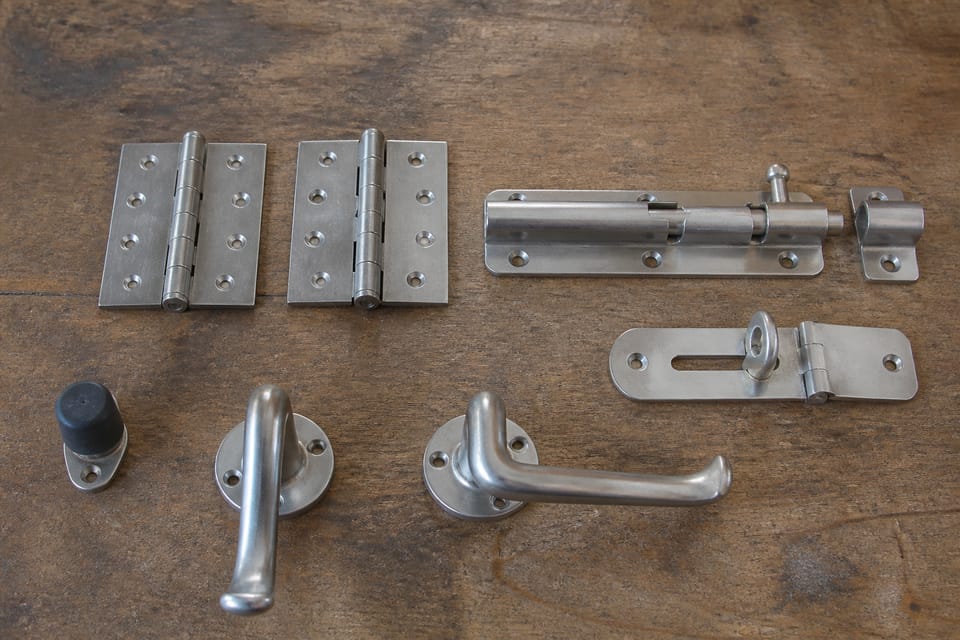
Which Indian Standards cover door hinges, tower bolts, aldrops, handles and stoppers? Steel butt hinges follow IS 1341, stainless ones IS 12817 and non-ferrous ones IS 205. Tower bolts follow IS 204 (Part 1) and IS 15833, aldrops IS 15834 and IS 2681, handles IS 208, floor stoppers IS 1823 and stainless stoppers IS 17296. Each standard gives sizes and marking, and says the Standard Mark may be used. The standards do not choose fittings for your door.
On this page (9)
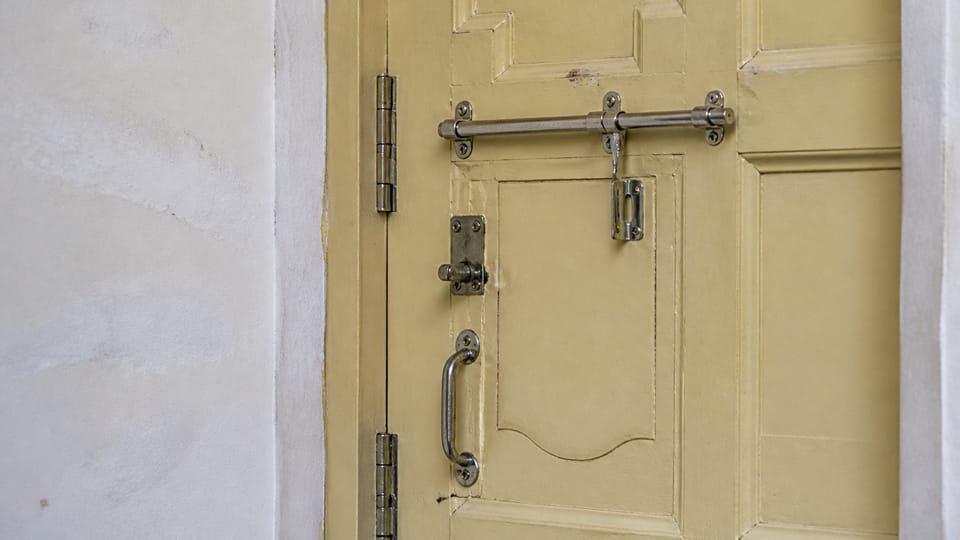
Door fittings are small, and a bad choice shows up every day: a door that sags, a bolt that rusts, a handle that loosens. This page lists the main fittings of a house door, the Indian Standard behind each, what the standard prints about sizes, finish and marking, and what to check at purchase and fixing. It gives no price, no brand and no ranking. Which fitting suits your door depends on the shutter, the room and the climate, and your architect or carpenter decides it. For the timber side of door problems, see doors jamming in the monsoon: why it happens and what to check.
Which standard covers which fitting?
| Fitting | Standard | What it covers |
|---|---|---|
| Steel butt hinges | IS 1341:2018 | Steel hinges in eight types: light weight, light unequal flap, medium weight and unequal flap, broad, square, and two heavy weight types |
| Stainless steel butt hinges | IS 12817:2020 | Light, medium and heavy weight stainless hinges; naturally bright finish |
| Non-ferrous butt hinges | IS 205:1992 | Aluminium alloy and brass hinges |
| Tower bolts, ferrous | IS 204 (Part 1):1991 | Barrel, semi-barrel, riveted or spot-welded, and skeleton types |
| Tower bolts, stainless | IS 15833:2009 | Barrel type only |
| Aldrops (sliding door bolts for padlocks) | IS 15834:2020 (stainless), IS 281:2009 (mild steel), IS 2681:1993 (non-ferrous) | Bolts that take a padlock |
| Door handles | IS 208:2020 | Cast, pressed oval, pressed half oval and fabricated handles up to 150 mm |
| Floor door stoppers | IS 1823:1980 | A spring tongue with a rubber end, fixed flush in the floor |
| Stainless stoppers | IS 17296:2020 | Rod type stoppers with a rubber end |
| Door closers | IS 3564 | Hydraulically regulated closers; the 2025 edition is in force |
In practice, names vary by region and shop. Several standards define types by construction or weight class, so ask the shop which standard the product is made to, rather than going by the name.
What do the standards print about sizes?
The sizes below are as tabulated in each standard. They tell you the range a fitting is made in; they do not choose the size for your door.
- Steel butt hinges (IS 1341). The size of a hinge is its length. For the medium weight type the lengths run from 20 mm to 150 mm, and the heavy weight types run from 50 mm to 200 mm. Annex B, marked for reference only, pairs door weight bands with hinge types and sizes, with heavier weight bands paired with heavier hinge types. The standard has no rule for the number of hinges per door.
- Stainless hinges (IS 12817). The medium weight type is made in 50, 65, 75, 100, 125 and 150 mm lengths.
- Tower bolts (IS 204 Part 1). The barrel type is made in lengths from 75 mm to 300 mm; the semi-barrel type up to 450 mm; the riveted type up to 900 mm. The stainless barrel type (IS 15833) is made in 100, 150, 200, 250 and 300 mm.
- Aldrops (IS 15834). Lengths run from 150 mm up to 450 mm, with the bolt diameter (12, 14, 16 or 19 mm) deciding the length range. IS 281 lists mild steel plate type bolts of 150 to 450 mm.
- Handles (IS 208). Cast handles are made in 75, 100, 125 and 150 mm sizes; pressed oval in 75, 100, 115 and 135 mm.
- Floor stoppers (IS 1823). Made to suit shutters 30, 35, 40 and 45 mm thick.
How many hinges does a door need?
IS 1341 does not say. IS 1003 (Part 1):2003, the standard for timber panelled and glazed door shutters, says in clause 8.2 that a single-leaf shutter 900 mm wide or less is fixed with three hinges; a wider single-leaf shutter with four; and a double-leaf door with six, three on each side. That is for timber panelled and glazed shutters only, and the standard says the type of hinge is specified by the purchaser. Other specifications and other door types differ, and the CPWD Specifications give a different count for some sizes. So the hinge count for your door is the carpenter’s or architect’s call, and the figure you read on a website is not a standard.
What do the standards say about finish and marking?
- Finish. Steel hinges are bright and smooth, with countersunk screw holes unless supplied without holes on request (IS 1341). Stainless hinges are naturally bright with no coating (IS 12817). Tower bolts, aldrops and handles come in bright, satin, plated, oxidised or enamelled finishes depending on the standard, and aluminium alloy parts are anodised.
- Corrosion. IS 15833 says stainless tower bolts are useful in coastal and high-humidity areas, and a corrosion test is made only if the purchaser asks. IS 208, as amended, requires no sign of corrosion after a salt spray test of 96 hours (not for aluminium handles, which get an anodizing test instead).
- Marking. Each standard asks for the maker’s name or trade mark, and some for the size or the words “Stainless Steel”. The Standard Mark (called the ISI mark in IS 1823) is optional: the standards say products “may” carry it.
- Compulsory certification. The BIS Scheme-I list of products under compulsory certification, read on 2026-10-29, lists hinges, door fittings (including door handles and closers) and bolts, with standard editions that in places differ from the current ones. Door bolts appear under a bolts, nuts and fasteners heading, so check whether an order covers them. We did not read the orders themselves, so we cannot say from which date each applies. Ask the supplier whether the product carries the BIS licence mark, and check the licence on the BIS site.
- Non-ferrous fittings. The forewords of IS 205 and IS 2681 say copper, zinc and their alloys were scarce and were kept in the standard for export. For indigenous use, the IS 205 foreword says the committee strongly recommends that hardware of these materials not be used, and the IS 2681 foreword recommends the same. This is a note in the foreword, not a requirement of the standard.
What should I check at purchase and fixing?
This is practice, unless a clause is named.
- Ask for the standard on the pack or product, and keep the same material and finish across hinges, bolts, aldrop, handle and stopper.
- Check the product against the standard’s sizes: the hinge size should suit the shutter weight and thickness (IS 1341 Annex B gives a reference guide by door weight).
- Use screws of the same metal and finish as the fitting, full length, countersunk and driven fully. The standards ask for countersunk screw holes.
- Hinge recesses are cut true and not too deep, and the hinge leaves line up with each other and with the frame.
- The shutter hangs without binding and with an even gap all round.
- A stopper is placed where the door or its handle will not strike the wall.
- In bathrooms, near the coast and in damp rooms, ask about a corrosion-resistant material and check it on delivery.
- After fixing, lubricate hinges and bolts, and tighten loose screws. Before planing a door that rubs, check the hinge screws first.
What mistakes should I avoid?
These are practice, not code rules.
- Choosing hardware by appearance or a catalogue photo alone.
- Mixing metals and finishes, or using screws of a different metal.
- Short screws, or screws not driven fully.
- Cutting the hinge recesses too deep or out of line.
- Using a hinge size that is too light for the shutter.
- Fitting a closer on every door, or fixing a stopper where the handle hits the wall.
- Believing “brass is best” or “stainless never rusts”: the standards do not say either.
- Not asking which standard the product is made to.
Frequently asked questions
What is the difference between a tower bolt and an aldrop?
Both are sliding bolts. IS 204 defines tower bolts by construction (barrel, semi-barrel and so on). IS 15834, IS 281 and IS 2681 cover sliding door bolts for use with padlocks, which many people call aldrops.
How many hinges should a door have?
IS 1003 (Part 1) gives three hinges for a timber panelled or glazed single-leaf shutter up to 900 mm wide and four above. IS 1341 gives no count. Ask your carpenter or architect.
Is a door closer needed on every door?
None of the standards read for this page says so. IS 3564 covers hydraulically regulated closers, and the choice depends on the door and its use.
Is the BIS mark compulsory on door fittings?
The standards say the mark may be used. A separate quality control order may make it compulsory for some fittings; check the order and the supplier’s licence.
Which hinge material is best for a bathroom door?
No standard ranks materials. The IS 12817 foreword says stainless hinges are especially useful where atmospheric moisture is high, and the IS 205 foreword strongly recommends that hardware of copper, zinc and their alloys, such as brass, not be used for indigenous use. Ask for a corrosion-resistant finish and check it.
Related guides
- Doors jamming in the monsoon: why it happens and what to check
- Snag list for a new house: what to check before final payment
- MS vs SS vs GI grills and railings: what SS 304 and SS 202 mean
This guide is general information. Read the disclaimer. Your architect or carpenter decides the door fittings for your house.
Sources
- IS 1341:2018 Steel Butt Hinges (sixth revision), with Amendment 1: clauses 3 to 9, Tables 2 to 9 and Annex B (page images read). BIS lists it as in force, valid to 2030-12-24.
- IS 12817:2020 Stainless Steel Butt Hinges (third revision): scope, Table 3, finish and marking clauses (page images read).
- IS 205:1992 Non-ferrous Metal Butt Hinges: foreword (page image read).
- IS 204 (Part 1):1991 Tower Bolts, Ferrous Metals, and IS 15833:2009 Stainless Steel Tower Bolts: scope, sizes, finish and marking (page images read).
- IS 15834:2020 Stainless Steel Sliding Door Bolts (Aldrops) for Use with Padlocks: sizes, finish and marking (page images read).
- IS 281:2009 Mild Steel Sliding Door Bolts for Use with Padlocks, and IS 2681:1993 Non-ferrous Sliding Door Bolts (Aldrops): sizes and forewords.
- IS 208:2020 Door Handles, with Amendment 1: types, sizes, corrosion test and marking (page images read).
- IS 1823:1980 Floor Door Stoppers (page images read), and IS 17296:2020 Stainless Steel Door Stoppers.
- IS 3564 Hydraulically Regulated Door Closers: the 1995 edition was read; the 2025 edition is in force per the BIS standards database and was not readable.
- CPWD Specifications 2019 Vol 1, clause 9.6.7, fixing of shutters (page image read).
- IS 1003 (Part 1):2003 Timber Panelled and Glazed Shutters, clause 8.2 on hinges (page image read). BIS Scheme-I list of products under compulsory certification, read on 2026-10-29.
Change log
- : Added Related guides link to newly published article(s): ms-vs-ss-vs-gi-grills-and-railings-what-each-metal-is-and-what-ss-304-and-ss-202-mean. No other text changed. Approved by the reviewing engineer.
General information only. It is not a structural design or professional advice. Ask a licensed structural engineer or architect to check your plans and site.