
Short answer
Why does a wooden door swell and jam in the monsoon? Wood takes up moisture from humid air and gives it off in dry air. IS 287 says a piece of wood will take on or give off moisture until it balances the air around it. IS 1141 says seasoning aims to remove shrinkage before the timber is used. A door can still jam if its timber, its finish or its fit was not right. A carpenter should check the door, the frame and the finish on site.

On this page (9)
A wooden door that closes well in the dry season can rub, stick or jam in the monsoon. The cause is the timber, which takes up moisture from humid air and gives it back in dry air. This guide explains what the Indian standards on timber moisture and seasoning say, what they do not say, and what to check on the door, the frame and the finish. It gives no brand, no polish and no repair price.
Why does wood move with the weather?
IS 287 is the Indian standard for the moisture content of timber for different uses. It says that “Any piece of wood will give off or take on moisture from the surrounding atmosphere until the moisture in wood has come to a balance with the existing atmospheric conditions” (clause 4). Wood is always trying to match the air around it.
The standard’s foreword explains the effect on a finished piece: “The moisture content of seasoned wood changes from season to season depending chiefly upon the fluctuations in atmospheric humidity”. It adds that “Seasonal changes in the moisture content of wood occur mostly in zones II and III, where a hot, dry summer is abruptly followed by a wet rainy season”. The standard names zones II and III for this. A house in those zones meets a monsoon after a dry summer, and the wood in a door takes up moisture then.
The foreword also says that “Timber shrinks on drying, and the shrinkage in fabricated stores leads to unsightly gaps between planks and loosening of joints besides deformation, cracks, etc.” A door is a fabricated store, so the same movement can affect its shape.
What does seasoning do?
IS 1141 is the code for seasoning timber. Its foreword says that “Timber shrinks during drying; the main objective of seasoning is to eliminate this shrinkage and the associated drying defects before use”. The standard also warns that several commercially important species of wood are “liable to develop defects during drying and in use, unless carefully seasoned”.
For frames, the code says that “Scantling as used for door and window frames may take from 6 months to a year to attain reasonable degree of seasoning” (clause 8.2.4). Timber that is not well seasoned may keep moving after the door is hung. This is an inference from the standards’ warnings, not a code rule.
What does IS 287 say about doors?
IS 287 sets permissible moisture limits for timber by use and by climatic zone. For doors and windows it gives a permissible moisture content for each zone, split by thickness. The table sets that figure for seasoned timber, aimed at the moisture the timber should reach to suit service conditions, and it is applied at inspection. It is not a reading for a door once it is hung. The standard also allows a tolerance on the figure, set in clause 5. The standard’s own scope is “permissible limits of moisture content … for different stores in each of the four climatic zones” (clause 1).
So a door can be made of timber within the supply limit and still swell in a damp season, because the air in the house changes. The table is a supply check, not a prediction of how a door will behave.
Does paint help?
The standard’s foreword says that “The application of a paint or varnish to the surface of timber reduces changes in moisture content with changes in humidity of the surrounding air.” It describes the effect and does not set a requirement. In practice, the coat should cover the whole door, including the top and bottom edges. This is practice, not a code rule.
What should I check?
This section is practice, not a code rule.
- The timber was seasoned before it was made into the door, and the frame timber was seasoned as the code describes.
- The door and the frame were stored under cover before fitting. IS 1141 says seasoned timber “should be stored under cover protected from rain and other forms of precipitation” (foreword).
- The finish covers all faces and edges, including the top and bottom, so that the moisture changes evenly.
- The gap at the top, sides and bottom is set for the season the door will see, and the hinges and the frame are square.
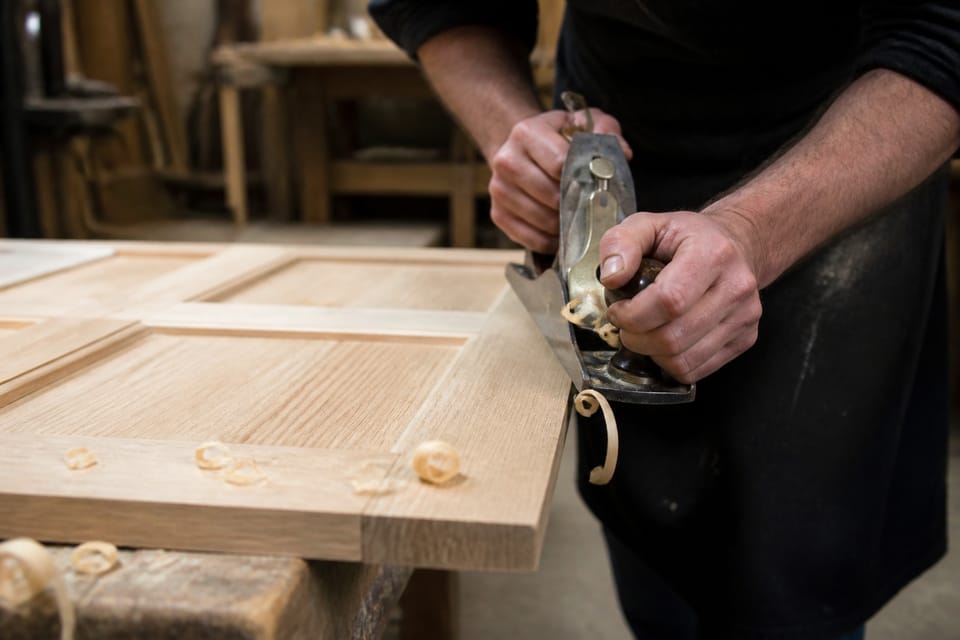
- The rubbing mark: where the door sticks, look for a worn edge, a swollen frame or a loose hinge before you plane the door.
What mistakes should I avoid?
This section is practice.
- Planing the door in the monsoon and then finding it too loose in the dry season.
- Painting only the face and leaving the edges and the top and bottom bare.
- Fitting timber straight from a wet store into a frame that is then sealed up.
- Storing the door in the open on site, where rain and sun change its moisture.
- Blaming the timber alone when the hinges, the frame or the floor have moved.
Frequently asked questions
Is the door timber always at fault?
Not always. The standards show that timber moves with the air, so a door can jam when the timber was within the supply limit and the finish, the frame or the fit was not right. Ask a carpenter to check the whole assembly.
Does IS 287 tell me how wet my door will get in the monsoon?
No. Its table gives permissible limits by use and zone. It does not give the moisture a door reaches in a house in the monsoon.
Can I repair a door that jams?
The standards do not give a repair method. A carpenter decides the repair on site. Ask for the cause to be checked first, because planing can hide a problem that comes back in the dry season.
Related guides
This guide is general information. Read the disclaimer. Your carpenter decides the repair for your door.
Sources
- IS 287:1993, Permissible moisture content for timber used for different purposes (third revision). Scope, clause 4 note, Foreword and Table 1 read from page images of a public copy. The table gives permissible moisture content for seasoned timber by use and zone, applied at inspection, not a reading for an installed door. BIS record: valid to 2027-10-31.
- IS 1141:1993, Seasoning of timber: code of practice (second revision). Foreword and clause 8.2.4 read from the text layer and page images of a public copy. BIS record: valid to 2030-04-30.
General information only. It is not a structural design or professional advice. Ask a licensed structural engineer or architect to check your plans and site.