
Short answer
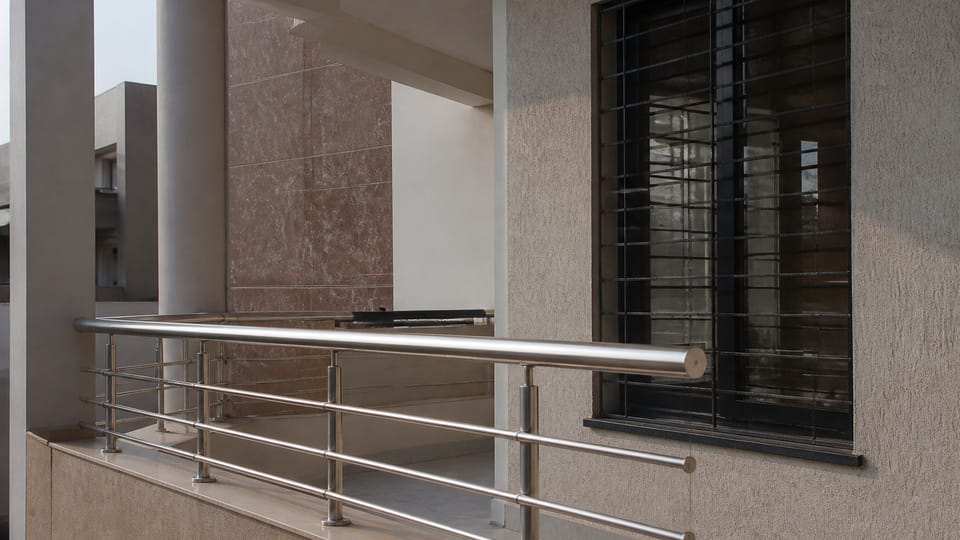
What is the difference between MS, SS and GI for grills and railings? MS is mild steel: it is strong but rusts, so it needs paint. GI is steel with a zinc coating. SS is stainless steel, and it needs no paint, but it is not maintenance free. SS 304 and SS 202 are grades: 304 has more nickel, and 202 has more manganese. A magnet cannot tell them apart, so ask for the grade in writing.
On this page (10)
The fabricator quotes one rate for “MS”, another for “GI”, and two for “SS”. This page explains what each of these metals is, what SS 304 and SS 202 mean, why a magnet does not settle the question, and what to ask before you pay. It gives no prices or rates, names no brands, and does not call one metal the best. The choice depends on exposure and upkeep. For gap and height rules, see railings for balconies and stairs.
What are MS, GI and SS?
| Point | MS | GI | SS |
|---|---|---|---|
| What it is | Plain carbon steel. “Mild steel” is the everyday name | Steel with a zinc coating | Steel alloy with chromium, and usually nickel, manganese or both |
| Rust protection | Paint | Zinc coating, then paint if wanted | The metal itself forms a protective film |
| Upkeep (practice) | Repainting | Watch cut ends and welds | Cleaning. It is low maintenance, not free of it |
| Weak spot (practice) | Paint failure, and water in joints | Welds where the zinc has burnt off | Welds that are not cleaned, and low grades in harsh air |
| Indian text we read | CPWD item for M.S. grills | No grill item found | CPWD item for stainless steel railing |
MS. IS 2062, the structural steel standard, does not use the word “mild”. It names grades, such as E 250. We read the 2011 edition, and BIS has replaced it with IS 2062 (Part 1):2025. IS 15911, for ordinary quality steel, says in its foreword that it is intended for uses such as “door and window frames, window bars, grills, steel gates, hand railing”. CPWD says of its grills: “Priming coat with red oxide primer to grill must be done”. See painting MS grills.
GI. Despite the name “galvanised iron”, the base is steel. IS 4736 says the tubes “shall be manufactured from mild steel”, unless otherwise ordered. For handrails, CPWD says “G.I. pipes used for Hand rail to be conforming to IS 1239-Part I for medium grade”, although IS 1239 itself is written for water, gas, air and steam tubes. We found no Indian Standard or CPWD item for a “GI grill”. So ask exactly what is being sold. See GI pipe vs MS pipe.
SS. Stainless is not one metal. It is a family of grades, and the grade matters.
What do SS 304 and SS 202 mean?
They are grade numbers. They come from the American AISI system, and IS 6911 lists them as numerical symbols. We read Table 1 as revised by Amendment 2 to the 2017 edition. BIS withdrew that edition in August 2026 for IS 6911:2026, which we have not read, so check the current table.
| Element | SS 304 (percent) | SS 202 (percent) |
|---|---|---|
| Chromium | 17.5 to 19.5 | 17.0 to 19.0 |
| Nickel | 8.0 to 10.5 | 4.0 to 6.0 |
| Manganese | Up to 2.00 | 7.5 to 10.0 |
So the plain difference is less nickel and much more manganese in 202. CPWD says 304 is “still sometimes referred to by its old name 18/8”, from about 18 percent chromium and 8 percent nickel.
CPWD’s item for stainless railing says: “The stainless steel of 304 grade of as per IS 6911 : 2017 shall be used for further fabrication of railing”. That is for CPWD works, not a rule for your home. We found no Indian standard that sets a grade for a house railing.
Watch one gap. IS 6911 covers plate, sheet and strip, not tube. IS 17876, for welded stainless tubes, lists 304 in the table we read, but no 202. And a shop’s “202” may not match the table at all, so ask for the certificate.
Can a magnet tell SS 304 from SS 202?
No. A magnet cannot separate 304 from 202, because both are normally not attracted. The Australian Stainless Steel Development Association says “magnetism has no relationship to corrosion resistance”. It also says that “cold worked austenitic stainless steels can develop a magnetic response”. So a bent or drawn 304 tube may pull a magnet slightly, and a steel that does not pull may still be 200 series. Appearance does not help either.
What does help is paperwork and testing. That body names “drop test kits to detect Mn (CrMn vs CrNi) or Mo (304 vs 316)”, which are chemical spot tests for manganese and molybdenum. It warns that “All of these spot tests will mark the surface”, so test an off-cut. A material certificate covers the sheet or coil it was issued for, so ask how it traces to your tube. This last point is practice.
Which metal suits which place?
No Indian text we read picks a metal for a house. These are practical points, not rules.
- Indoors or a sheltered balcony. Any of the three can work if it is finished and kept well.
- Near the sea. Salt air is hard on all of them. For stainless, NBCS 2026 says, for glazing and frame systems and not for railings: “For external applications like in coastal regions where maximum resistance to corrosion is required, stainless steel shall be of Type 316.” So ask your fabricator about 304 near the sea. Australian guidance says 304 “will probably become tea stained or even suffer more severe corrosion in a marine environment.”
- Where water stands. The NBCS text on structural steel says “Standing pool of water, moisture accumulation and rundown of water for extended duration shall be avoided”. The same logic applies at the base of a post, by our reasoning.
Brown marks on stainless are not always a failure. Australian guidance calls tea staining “a cosmetic issue that does not affect the structural integrity or the lifetime of the material”. The same body says bad results more often come from “inadequate surface finish or errors in design or fabrication” than from the grade.
What goes wrong at the welds?
Each metal needs care at the welds.
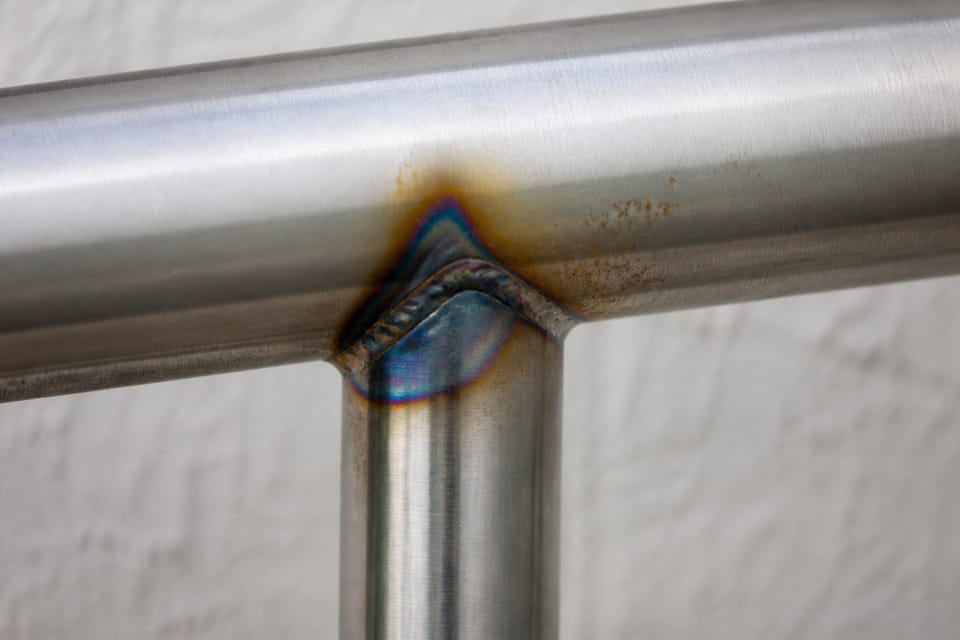
- Stainless. Australian guidance says welding heat destroys the protective layer locally, so the heat tint must be removed. Ask how the welds will be cleaned.
- MS. NBCS, for structural steel, says “after welding, appropriate protective coatings shall be applied in the region”.
- GI. A weld burns off the zinc. The UK Galvanizers Association says repair is “usually by using a suitable zinc-rich paint or paste”, and calls it best practice to do the fabrication before galvanizing.
- Mixing metals. Stainless can be welded to mild steel, but not “directly”: Australian guidance says the filler matters. When welding GI to stainless, it calls it “essential to remove the zinc from the heated zone”.
Tools matter too. CPWD says: “Use only stainless steel wire brushes and use these brushes only on stainless steel.” It adds: “Do not use brushes or tools previously used on galvanized steel.” Australian guidance names contamination by “particles of steel or grinding debris” as a cause of staining. Using a shared grinder is the common way it happens on site, which is practice.
What should I ask the fabricator?
This list is practice.
- Which metal and grade, in writing on the quote?
- Can I see the material certificate, and how does it trace to this tube?
- Will you allow a spot test on an off-cut?
- How will welds be cleaned or repaired?
- Are the fixings stainless, and of which grade?
- For GI: is it dipped after fabrication, or is galvanised tube cut and welded?
- For MS: how will rain be kept out of hollow sections?
What mistakes should I avoid?
These are practice points unless a source is named.
- Accepting “SS” on a bill with no grade.
- Trusting a magnet test.
- Assuming one grade across tube, brackets and fixings.
- Cleaning stainless with mortar or tile acid. Australian guidance says hydrochloric acid “must not be used on stainless steel”.
- Grinding mild steel beside a stainless rail.
- Choosing the metal first, and forgetting the gap and fixing rules.
- Skipping the zinc repair on a welded GI grill.
Frequently asked questions
Does SS 202 rust?
It can, and so can other stainless grades in the wrong place. Australian guidance says a 200 series grade “has slightly less corrosion resistance than a 300 series grade with the same chromium level”. The real result depends on exposure, finish and welding.
Is SS 304 magnetic?
It is not meant to be strongly magnetic, but cold-worked 304 can respond to a magnet. A magnet does not prove the grade.
Is GI the same as MS?
GI is steel with a zinc coating. MS has no zinc coating, and relies on paint.
Does a stainless railing need painting?
No, but it does need cleaning. The Australian body says it “is not generally maintenance free”.
Which is better, MS or SS?
We do not rank them. Compare exposure, upkeep and the skill of your fabricator.
Related guides
- Painting MS grills, gates and railings: rust, primer, enamel
- Railings for balconies and stairs: when needed, the 100 mm gap rule
- GI pipe vs MS pipe: galvanising and the light, medium, heavy classes
This guide is general information. Read the disclaimer. Your engineer and fabricator decide the metal, sections and fixing for your house.
Sources
- IS 6911:2017, Stainless steel plate, sheet and strip, with Amendment 2 (2018): Table 1 (page images read). Withdrawn 18 August 2026 in favour of IS 6911:2026, which we have not read.
- IS 2062:2011, Hot rolled structural steel. Withdrawn June 2026 in favour of IS 2062 (Part 1):2025, which we have not read.
- IS 6911:1992, Stainless steel plate, sheet and strip: Foreword (numerical symbols in line with AISI). Withdrawn.
- IS 1239 (Part 1):2004, Steel tubes: scope.
- IS 15911:2010, Structural steel (ordinary quality): Foreword. BIS shows validity to 30 November 2026.
- IS 4736:1986, Hot-dip zinc coatings on mild steel tubes: clause 4.1.
- IS 17876:2022, Stainless steel welded pipes and tubes for general services: scope and grade table.
- CPWD Specifications 2019, Volume 1: clauses 9.31, 9.31.1.3, 10.18.2.2, 10.20 and 10.20.1. For CPWD works, used here as a reference.
- SP 7:2026, National Building Construction Standards (NBCS) 2026: Part C Section 6 clauses 21.2.1 and 21.2.4.5; Section 8 clause 8.2.3.2. From an unofficial archive.org copy.
- Australian Stainless Steel Development Association: Technical FAQ 4 (testing for grade confirmation). An Australian industry body, not an Indian standard.
- Australian Stainless Steel Development Association: 200 series stainless steels (article 262).
- Australian Stainless Steel Development Association: Technical FAQ 6 (coastal corrosion and tea staining).
- Australian Stainless Steel Development Association: Technical FAQ 9 (welding dissimilar metals).
- Australian Stainless Steel Development Association: alternative stainless steel grades, part 1 (article 109).
- Galvanizers Association (UK): welding galvanized steel. A UK trade body.
General information only. It is not a structural design or professional advice. Ask a licensed structural engineer or architect to check your plans and site.