
Short answer
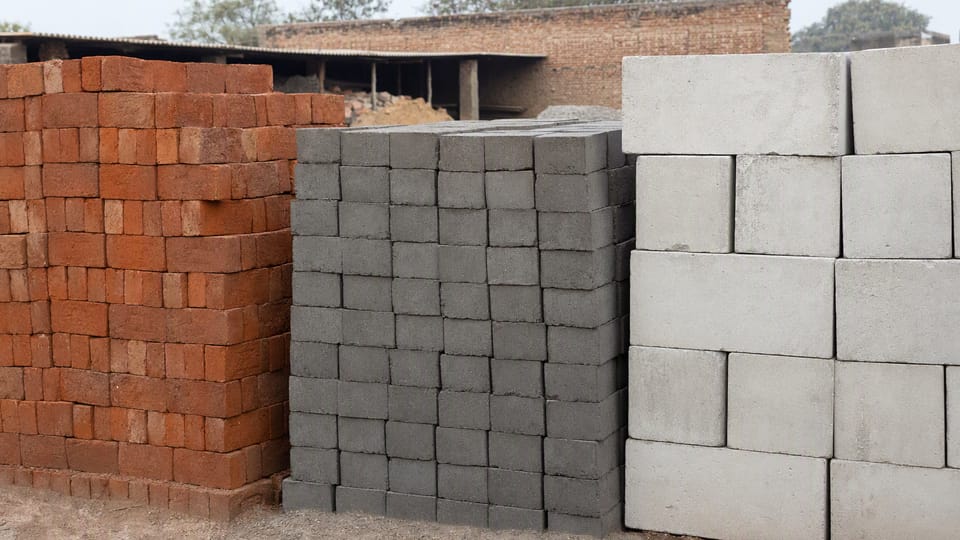
What are the sizes of red bricks, fly ash bricks and AAC blocks? Traditional red clay bricks are 230 × 110 × 70 mm and modular clay bricks 190 × 90 × 90 mm. Fly ash bricks in the Indian Standards are 230 × 110 × 70 mm or 190 × 90 × 40 mm. AAC blocks in IS 2185 are 400, 500 or 600 mm long, 200, 250 or 300 mm high and 100 to 250 mm wide. Sizes vary by maker, so check the one you buy.
On this page (9)
- What are the common sizes of bricks and blocks?
- How do red bricks, fly ash bricks and AAC blocks differ for walling?
- How many AAC blocks do I need for 100 sq ft of wall?
- Why does the joint matter in the size?
- Where do I find counts for clay bricks?
- Frequently asked questions
- Related guides
- Work out your quantities
- Sources
Need quantities? Brick and mortar quantity calculator
Bricks and blocks are sold by size, and every quantity you work out depends on the size you assume. A brick that is 5 mm taller changes the number of courses. An AAC block is more than three times the face of a brick. This page lists the common sizes of red clay bricks, fly ash bricks and AAC blocks in India, shows how they differ in use, and gives a count for AAC blocks.
What are the common sizes of bricks and blocks?
| Material | Common size (length × width × height) | Notes |
|---|---|---|
| Traditional clay brick | 230 × 110 × 70 mm (240 × 120 × 80 mm with mortar joints) | Counted at the nominal size with its joint |
| Modular clay brick | 190 × 90 × 90 mm (200 × 100 × 100 mm with joints) | Common in newer work and in some states |
| Fly ash brick | 230 × 110 × 70 mm (non-modular) or 190 × 90 × 40 mm (modular), as listed in IS 12894 and IS 13757 | Market sizes vary by maker, and a height of 75 mm is common, so measure what you receive |
| AAC block | IS 2185 (Part 3) nominal sizes: length 400, 500 or 600 mm, height 200, 250 or 300 mm, width 100, 150, 200 or 250 mm | Actual blocks are about 10 mm smaller than nominal, and thicknesses of 100, 150 and 200 mm are common for walls (market sizes vary by maker) |
These sizes vary between makers and regions. Measure a few units from your delivery and use those sizes when you work out quantities. The clay brick sizes are the ones used by the brick quantity calculator.
How do red bricks, fly ash bricks and AAC blocks differ for walling?
- Red clay bricks are widely available, and their quality varies between kilns, so check the size and the strength of what arrives.
- Fly ash bricks are made from fly ash, usually with cement or lime, and are generally more uniform in size than clay bricks. They are laid with mortar in the same way. Check the maker’s test certificate, because the standard that applies depends on how the brick is made.
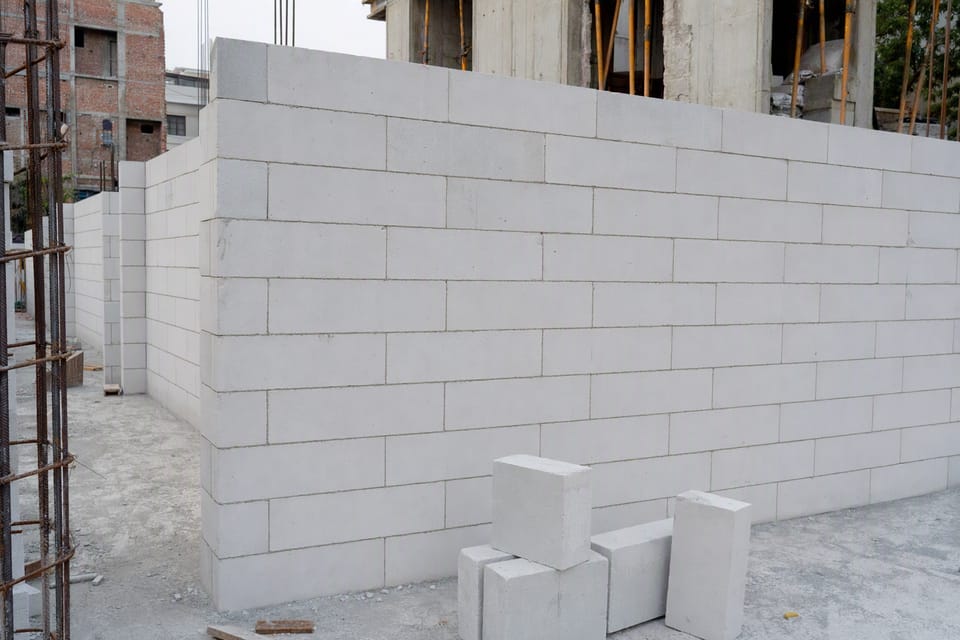
- AAC blocks are large, light blocks made of autoclaved aerated concrete. A wall goes up faster because each block is large and light, they are usually laid with a thin layer of adhesive instead of thick mortar, and they need plaster and fixings suited to them. Ask your supplier and your engineer.
Which one suits which wall is a design decision. Cost differs by place and by season, so this page gives no prices.
How many AAC blocks do I need for 100 sq ft of wall?
A 600 × 200 mm block has a face of 0.12 m². 100 sq ft of wall is 9.29 m², so it needs about 77 blocks before wastage, ignoring the thin joints. The count depends only on the face of the block, not on its thickness, because thickness runs through the wall. Add wastage for breakage, as you would for bricks, and ask your supplier what percentage to allow.
Why does the joint matter in the size?
Bricks are counted at the nominal size, which includes the mortar joint. A traditional brick of 230 × 110 × 70 mm with a 10 mm joint takes up 240 × 120 × 80 mm in the wall. AAC blocks are laid with thinner joints, so their nominal size is close to the block size. This is why the same wall needs a different count when you change the material, and why you should not use a brick count for a block.
Where do I find counts for clay bricks?
Use How many bricks for 100 sq ft of wall? for traditional clay bricks and the mortar that goes with them, and Which walls can be 4.5 inch? for where the thinner wall is used.
Frequently asked questions
What is the size of a fly ash brick?
The Indian Standards list 230 × 110 × 70 mm and 190 × 90 × 40 mm. A height of 75 mm is common in the market, and sizes vary by maker, so measure the bricks you receive.
What is the size of an AAC block?
IS 2185 (Part 3) lists lengths of 400, 500 or 600 mm, heights of 200, 250 or 300 mm and widths of 100, 150, 200 or 250 mm. Market sizes vary by maker, and widths of 100, 150 and 200 mm are common for walls.
Is a fly ash brick the same size as a red brick?
Often close, but not always. The common fly ash brick is a little taller than the traditional clay brick.
How many AAC blocks are in 100 sq ft of wall?
About 77 blocks of 600 × 200 mm before wastage.
Can I use a brick count for AAC blocks?
No. Count blocks from their own face size.
Related guides
- How many bricks for 100 sq ft of wall? Assumptions shown
- Which walls can be 4.5 inch? Load-bearing and partition walls
- Mortar ratio for brick walls: 1:4, 1:5 or 1:6?
This guide is general information. Read the disclaimer. Sizes vary between makers, and the material for each wall is set by your design.
Work out your quantities
- Brick and mortar quantity calculator: Estimate the number of bricks and the cement and sand for mortar for a wall, from its length, height and thickness.
Sources
- IS 1077:1992, Common Burnt Clay Building Bricks - Specification
- IS 12894:2002, Pulverized Fuel Ash-Lime Bricks - Specification (lime-fly ash bricks)
- IS 2185 (Part 3):1984, Concrete Masonry Units - Autoclaved Cellular Aerated Concrete Blocks
Change log
- : Corrected the AAC block and fly ash brick sizes to follow IS 2185 (Part 3), IS 12894 and IS 13757 exactly, and noted that market sizes vary by maker. Approved by the reviewing engineer.
General information only. It is not a structural design or professional advice. Ask a licensed structural engineer or architect to check your plans and site.