
Short answer
How many bricks are needed for 100 sq ft of wall? A 9 inch wall of traditional bricks (240 × 120 × 80 mm with mortar) takes about 968 bricks per 100 sq ft by physical count, and a 4.5 inch wall about 484, before wastage. The brick calculator, which takes the wall as 230 mm and 115 mm thick, gives 927 and 464. Add about 5 percent for wastage.
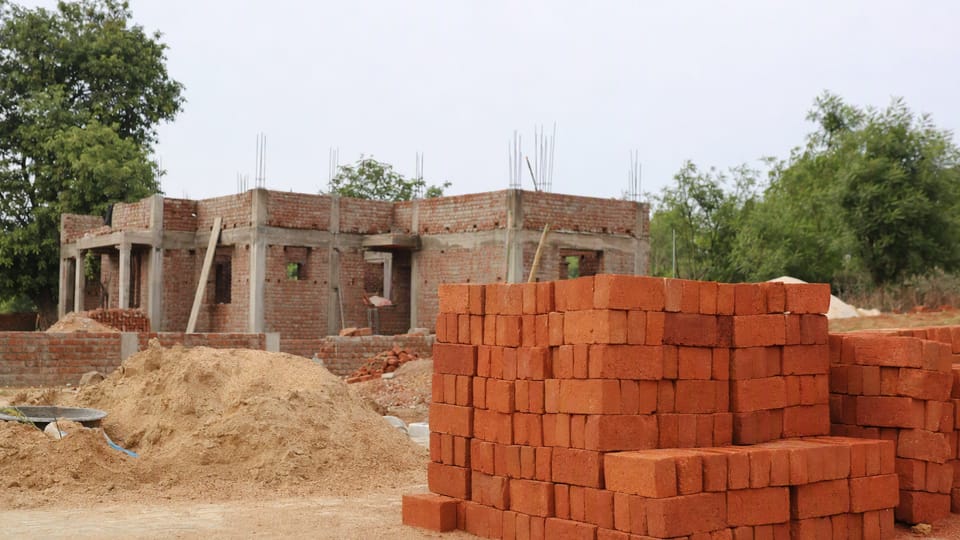
On this page (14)
- How many bricks go in 100 sq ft of wall?
- What assumptions are behind the number?
- Why does the calculator give about 4 percent fewer than a physical count?
- Why are there 434 bricks per cubic metre for traditional bricks and 500 for modular?
- Worked example: a 10 × 12 ft room with a door and two windows
- Should I deduct openings?
- How much mortar goes with it?
- What are the common counting mistakes?
- How do I use the calculator?
- What do ‘9 inch wall’ and ‘4.5 inch wall’ mean?
- Frequently asked questions
- Related guides
- Work out your quantities
- Sources
Need quantities? Brick and mortar quantity calculator
Ask for the number of bricks in 100 sq ft of wall and you will hear 500, 550, 900 or more than 1,000. The numbers are not all wrong. They describe different walls, different bricks and different ways of counting. This page shows the assumptions so you can see which number matches your wall.
How many bricks go in 100 sq ft of wall?
It depends on the thickness of the wall and the size of the brick. For the traditional brick, which measures 230 × 110 × 70 mm and is counted as 240 × 120 × 80 mm with its mortar joints:
- a 9 inch (one-brick) wall takes about 968 bricks per 100 sq ft;
- a 4.5 inch (half-brick) wall takes about 484 bricks per 100 sq ft.
These are physical counts with no wastage. They come from dividing the wall volume by the volume of one brick with its joints, 240 × 120 × 80 mm.
What assumptions are behind the number?
The count above rests on four assumptions:
- Brick size. The traditional brick, 230 × 110 × 70 mm. Modular bricks, 190 × 90 × 90 mm, are counted with a 200 × 100 × 100 mm nominal size and give a different number.
- Wall thickness. 9 inches means one brick wide and 4.5 inches means half a brick wide. Brick walls are named by these round numbers, but the real thickness depends on the bricks and the plaster. Common burnt clay bricks are specified in IS 1077.
- Joints. The 240 × 120 × 80 mm size already includes the mortar joint, so it is not added again.
- Wastage. Bricks break in handling, so add about 5 percent when you order.
Why does the calculator give about 4 percent fewer than a physical count?
The brick quantity calculator works from the volume of the wall. If you enter the wall as 230 mm thick (a 9 inch wall) it gets 927 bricks per 100 sq ft, and if you enter 115 mm it gets 464. The physical count uses the nominal 240 mm and 120 mm thickness, which is why it is about 4 percent higher. The calculator’s volume method gives about 4 percent fewer than a course-by-course count, because it takes the wall as 230 mm thick against a 240 mm nominal brick. For ordering, use the higher figure.
| Wall and basis | Bricks, no wastage | Bricks, 5% wastage |
|---|---|---|
| 9 inch wall, physical count (nominal 240 mm) | 968 | 1,017 |
| 9 inch wall, calculator (230 mm entered) | 927 | 974 |
| 4.5 inch wall, physical count (nominal 120 mm) | 484 | 509 |
| 4.5 inch wall, calculator (115 mm entered) | 464 | 487 |
To order, use the physical count, the higher figure, so you do not run short, and tell the supplier the basis you used. If you use the calculator, remember that its figure runs about 4 percent below the physical count for the same wall.
Why are there 434 bricks per cubic metre for traditional bricks and 500 for modular?
Each brick, with its joint, takes up a fixed volume. A traditional brick at 240 × 120 × 80 mm takes 0.002304 m³, so a cubic metre of brickwork holds about 434 of them. A modular brick at 200 × 100 × 100 mm takes 0.002 m³, so a cubic metre holds exactly 500. To find the bricks in a wall, multiply the wall’s volume in cubic metres by the figure for your brick.
Worked example: a 10 × 12 ft room with a door and two windows
These sizes are an example, not a design. The room is 10 ft by 12 ft inside the walls, 10 ft high, with 9 inch walls, one door of 7 × 3 ft and two windows of 4 × 4 ft.
- Wall length: 2 × (10 + 12) = 44 ft. Wall area: 44 × 10 = 440 sq ft.
- Openings: door 21 sq ft plus windows 32 sq ft is 53 sq ft. Net wall: 387 sq ft.
- By physical count: about 3,745 bricks, or about 3,933 with 5 percent wastage.
- By the calculator (230 mm): about 3,589 bricks, or 3,769 with 5 percent wastage.
Corners, where two walls meet, are counted twice if you measure each wall to its outside face, so the real total is a little lower. Treat the number as an order quantity and not as a count of bricks you will use.
Should I deduct openings?
Yes, deduct doors and windows from the wall area, as the example does. Many builders deduct only the larger openings to leave a small margin. The calculator has a field for the total area of doors and windows.
How much mortar goes with it?
For 100 sq ft of wall with mortar mixed 1 part cement to 6 parts sand, the calculator gives about 2.7 bags of cement and 0.57 m³ of sand for a 9 inch wall, and 1.4 bags and 0.28 m³ for a 4.5 inch wall, with 5 percent wastage. For the room above the calculator gives about 10.5 bags, which you buy as 11 bags, and 2.19 m³ of sand.
What are the common counting mistakes?
- Mixing up the basis, a physical count of 968 against a calculator figure of 927, and not knowing which one a quote uses.
- Forgetting wastage, or adding it twice.
- Counting the 4.5 inch walls with the 9 inch figure.
- Using modular brick numbers for traditional bricks.
- Counting the wall area from the outside of the building, which counts the corners twice.
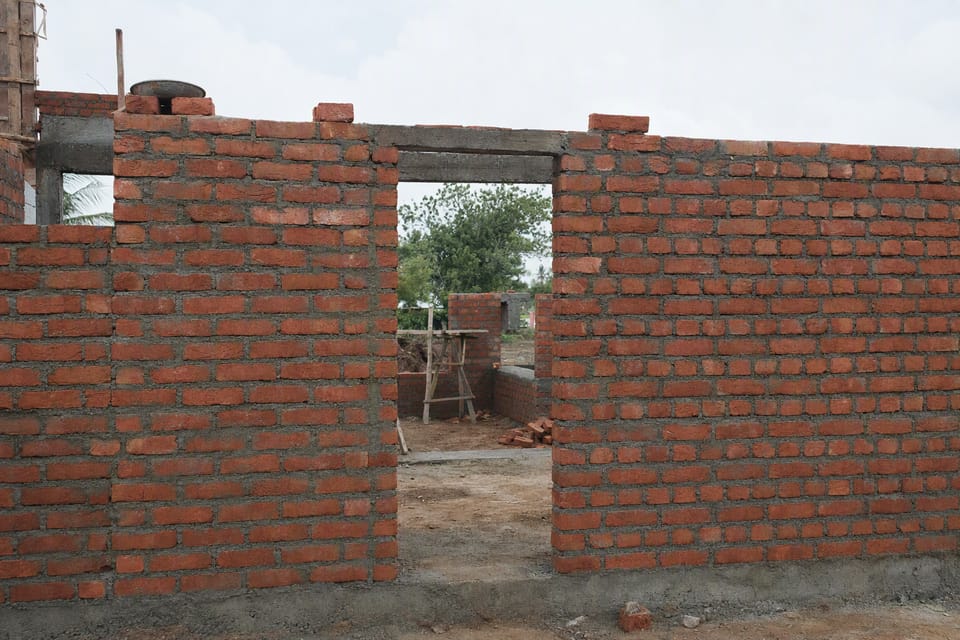
How do I use the calculator?
Open the brick quantity calculator, enter the length, height and thickness of the wall, the area of doors and windows, the brick size and the mortar. It shows the bricks, cement and sand and rounds the cement to whole bags.
What do ‘9 inch wall’ and ‘4.5 inch wall’ mean?
A 9 inch wall is one brick wide, and a 4.5 inch wall is half a brick wide. This page only counts bricks and gives no advice on which thickness suits which wall.
Frequently asked questions
How many bricks are in 1 cubic metre?
About 434 traditional bricks counted at 240 × 120 × 80 mm, or 500 modular bricks counted at 200 × 100 × 100 mm.
How many bricks per sq ft of wall?
About 9.68 bricks per sq ft for a 9 inch wall and about 4.84 for a 4.5 inch wall, by physical count.
Do I deduct door and window openings?
Yes. Deduct their area from the wall area before you count.
How much wastage should I add?
About 5 percent is common. Ask your supplier and contractor what they include.
How much cement does the mortar need?
About 2.7 bags per 100 sq ft of 9 inch wall with 1 : 6 mortar and 5 percent wastage.
Related guides
- Which walls can be 4.5 inch? Load-bearing and partition walls
- Mortar ratio for brick walls: 1:4, 1:5 or 1:6?
This guide is general information that shows a counting method under stated assumptions. Read the disclaimer. Brick size and wall thickness come from your drawing.
Work out your quantities
- Brick and mortar quantity calculator: Estimate the number of bricks and the cement and sand for mortar for a wall, from its length, height and thickness.
Sources
- IS 1077:1992, Common Burnt Clay Building Bricks - Specification
General information only. It is not a structural design or professional advice. Ask a licensed structural engineer or architect to check your plans and site.