
Short answer
Which is better for walls: red brick, fly ash brick or AAC block? None is best for every wall. Red clay and fly ash bricks are strong, familiar and laid with mortar. AAC blocks are much lighter and larger but weaker per unit, and external walls need protective plaster. The strength class on the supplier's test certificate matters more than the material name, and your designer decides what suits each wall.
On this page (13)
- What are the three materials?
- How do they compare?
- Is AAC stronger than brick?
- How much lighter is AAC?
- What about heat?
- What are the practical differences on site?
- Do I have to use fly ash bricks?
- What should I ask the supplier?
- Which one should I use for which wall?
- Frequently asked questions
- Related guides
- Work out your quantities
- Sources
Need quantities? Brick and mortar quantity calculator
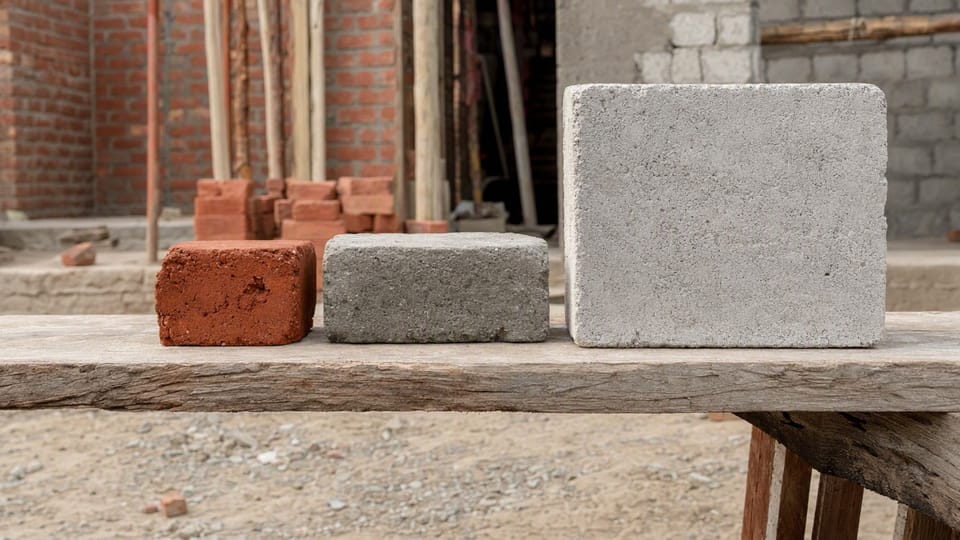
Walls are built from three common units in Indian houses: red clay bricks, fly ash bricks and AAC blocks. Dealers and websites make big claims for each. This page sticks to what the Indian Standards say, shows where they differ, and lists what to ask before you buy. It gives no prices, because prices change by place and season.
What are the three materials?
- Red clay bricks are made of burnt clay. IS 1077 covers them.
- Fly ash bricks are not one product. Three different kinds are sold under the name:
- burnt clay fly ash bricks, fired like clay bricks and covered by IS 13757;
- lime and fly ash bricks, cured under controlled temperature and pressure rather than burnt like clay bricks, covered by IS 12894 (titled Pulverized Fuel Ash-Lime Bricks);
- cement and sand bricks that use fly ash, for which we found no dedicated brick standard. Ask the maker which standard and which test certificate apply.
- AAC blocks are autoclaved aerated concrete blocks. They are large, light and full of tiny air cells. IS 2185 (Part 3) covers them.
How do they compare?
| Point | Red clay brick (IS 1077) | Fly ash brick (IS 13757, IS 12894) | AAC block (IS 2185 Part 3) |
|---|---|---|---|
| Strength | Classes from 3.5 to 35 N/mm² (average compressive strength) | Classes from 3.5 to 30 N/mm² | Minimum 1.5 to 7.0 N/mm², depending on grade and density; 3.0 to 4.0 for 551 to 650 kg/m³ blocks |
| Water absorption limit | Not more than 20 percent up to class 12.5, and 15 percent for higher classes | The same limits | The 1984 standard sets no limit, so ask the maker for test results |
| Weight of masonry | About 18.85 kN/m³ (about 1,920 kg/m³) in IS 875 | No verified standard figure, so ask the maker | Dry density 451 to 1,000 kg/m³ by grade; 551 to 650 kg/m³ is the common range |
| Joints | Mortar joints, about 10 mm in usual practice | Mortar joints, as for clay bricks | 10 mm mortar joints in IS 6041. Makers of thin-bed adhesive specify their own thinner joint, so follow their data sheet |
| Protection | Usually plastered or pointed | Usually plastered or pointed | IS 6041 expects external walls to be rendered; pointing alone is allowed only in scarce-rainfall areas |
Is AAC stronger than brick?
No. At the usual 551 to 650 kg/m³ densities, the standard asks for about 3.0 to 4.0 N/mm² per block, while brick classes run from 3.5 to 35 N/mm². Denser AAC grades reach up to 7.0 N/mm², which is still only the lower part of the brick range. A claim that AAC is “three times stronger” is not supported by the standards. AAC is lighter, not stronger. AAC is used for panel and partition walls and for infill in framed buildings, where its low weight is the benefit. IS 2185 (Part 3) allows it in external walls of framed buildings when protected from weather by rendering.
How much lighter is AAC?
Using the weights above (plaster, mortar and moisture left out):
- A 230 mm brick wall at 18.85 kN/m³ weighs 0.23 × 18.85 = 4.34 kN/m², about 440 kg per sq m.
- A 200 mm wall of AAC blocks of 551 to 650 kg/m³ dry density (about 5.4 to 6.4 kN/m³) weighs about 1.08 to 1.28 kN/m², about 110 to 130 kg per sq m.
So a 200 mm AAC wall is roughly a quarter to under a third of the weight of a 230 mm brick wall when dry. The real weight on site is higher because blocks hold some moisture and the walls are plastered. The lower weight can reduce the load on beams and foundations, but your structural engineer works that out.
What about heat?
The only verified figure we have is for AAC. IS 2185 (Part 3) sets maximum thermal conductivity values between 0.21 W/m·K for the lightest blocks and 0.42 W/m·K for the densest, and 0.24 for the 551 to 650 kg/m³ range. A lower number means less heat gets through. We could not verify standard values for brick, so this page does not give a heat comparison between the materials. Be careful of claims such as “saves 60 percent energy”: we found no source for them.
What are the practical differences on site?
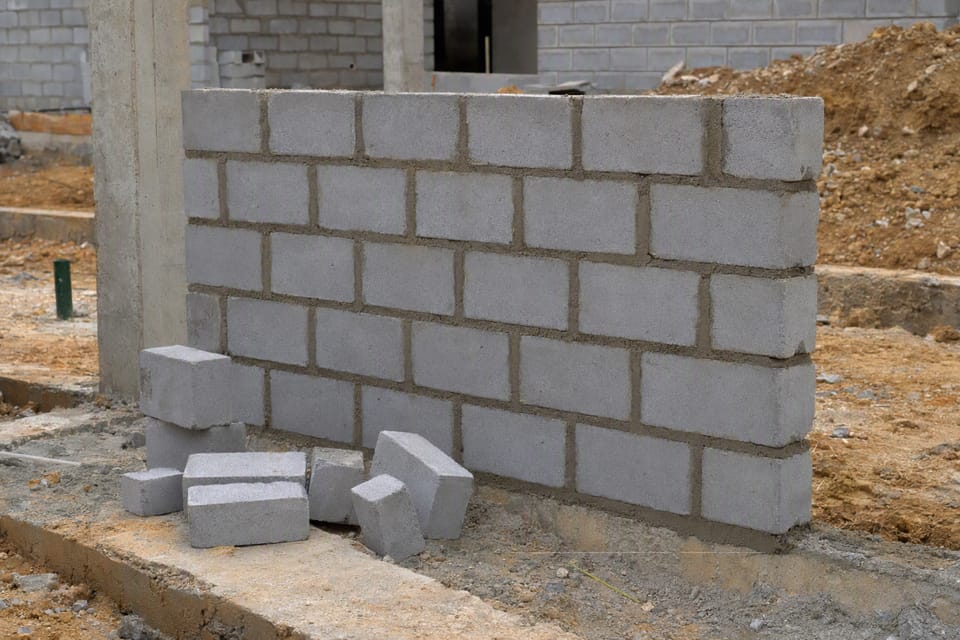
AAC blocks
- Store them off the ground and covered, so they do not get wet.
- They need not be wetted before laying.
- IS 6041 expects external walls to be rendered, after the walls are fully dry, and says not to render in the monsoon. In heavy rain or near the sea, it describes two coats. In scarce-rainfall areas it allows pointing alone, and it also allows exposed block with two coats of an approved cement-based paint.
- Cracks tend to appear at the corners of door and window frames and where blocks meet concrete. IS 6041 suggests joint reinforcement in the bed joints at regular heights, and a slip joint or cut at the top of the wall.
- Ask the maker how to fix heavy items such as cabinets and water heaters, and which adhesive and plaster they approve.
Fly ash bricks
- They are usually more uniform than clay bricks, but check which of the three kinds you are buying.
- The lime and fly ash kind has a drying shrinkage limit in IS 12894, and your supplier should show it.
Red clay bricks
- IS 1077 itself notes that quality varies a lot with the clay and the process. Check the class, the size and the efflorescence rating, which shows as white salts on the wall.
Do I have to use fly ash bricks?
A national notification (Ministry of Environment, Forest and Climate Change, S.O. 5481(E) of 31 December 2021, amended in December 2022 and January 2024) says that building projects within a radius of 300 km of a coal or lignite power plant shall use ash bricks, tiles, sintered ash aggregate or other ash-based products. The duty applies provided they are available at a price not more than the CPWD or State PWD Schedule of Rates or, where the Schedule does not list them, the price of alternative products. Check the current text and ask your State Pollution Control Board how it applies to your plot.
What should I ask the supplier?
- The strength class or grade, with a test certificate for the lot you are buying.
- The BIS licence number and the standard the product is made to.
- The actual size and tolerance. Measure a few units yourself.
- For fly ash bricks, which of the three kinds it is.
- For AAC, the dry density, how old the blocks are, and the adhesive and plaster system the maker recommends.
- For a price comparison, ask for quotes for the same wall thickness, including mortar or adhesive, plaster and labour.
Which one should I use for which wall?
That is a design decision. In a load-bearing building, the strength class matters most, and your engineer decides it. In a framed building, the walls are infill, and the lighter AAC or the heavier bricks may suit different walls. The thickness of each wall is covered in Which walls can be 4.5 inch?, and the quantities are in How many bricks for 100 sq ft of wall? and the brick quantity calculator.
Frequently asked questions
Is AAC better than red brick?
It is lighter and larger, so it can speed up building and reduce load. It is weaker per unit and needs protective plaster on external walls. Neither is better for every wall.
Is a fly ash brick the same as a red brick?
No. It is made differently, and it can be one of three kinds. Check which standard applies.
How strong is an AAC block?
About 3.0 to 4.0 N/mm² minimum for 551 to 650 kg/m³ blocks, and 1.5 to 7.0 N/mm² across all grades and densities, against 3.5 to 35 N/mm² for clay brick classes.
Do AAC walls need plaster?
IS 6041 expects external AAC walls to be rendered. Internal walls are usually plastered with a mix suited to AAC, though the standard also allows flush pointing and paint.
Do I have to use fly ash bricks?
A national notification asks for ash-based products within a 300 km radius of a coal or lignite power plant, subject to a price condition. Check the current notification and your State Pollution Control Board.
Related guides
- Brick and block sizes in India: red, fly ash and AAC
- Mortar ratio for brick walls: 1:4, 1:5 or 1:6?
- Hairline cracks in plaster: causes and what to do
This guide is general information. Read the disclaimer. The unit, strength class and thickness for each wall of your house are decided by your designer.
Work out your quantities
- Brick and mortar quantity calculator: Estimate the number of bricks and the cement and sand for mortar for a wall, from its length, height and thickness.
Sources
- IS 1077:1992, Common Burnt Clay Building Bricks - Specification
- IS 13757:1993, Burnt Clay Fly Ash Building Bricks - Specification
- IS 12894:2002, Pulverized Fuel Ash-Lime Bricks - Specification
- IS 2185 (Part 3):1984, Concrete Masonry Units: Autoclaved Cellular (Aerated) Concrete Blocks
- IS 6041:1985, Construction of Load Bearing and Non-Load Bearing Walls with Autoclaved Cellular Concrete Blocks
- IS 875 (Part 1):1987, Dead Loads: Unit Weights of Building Materials
- Ministry of Environment, Forest and Climate Change, Fly Ash Utilisation Notification, S.O. 5481(E), 31 December 2021
General information only. It is not a structural design or professional advice. Ask a licensed structural engineer or architect to check your plans and site.