
Short answer
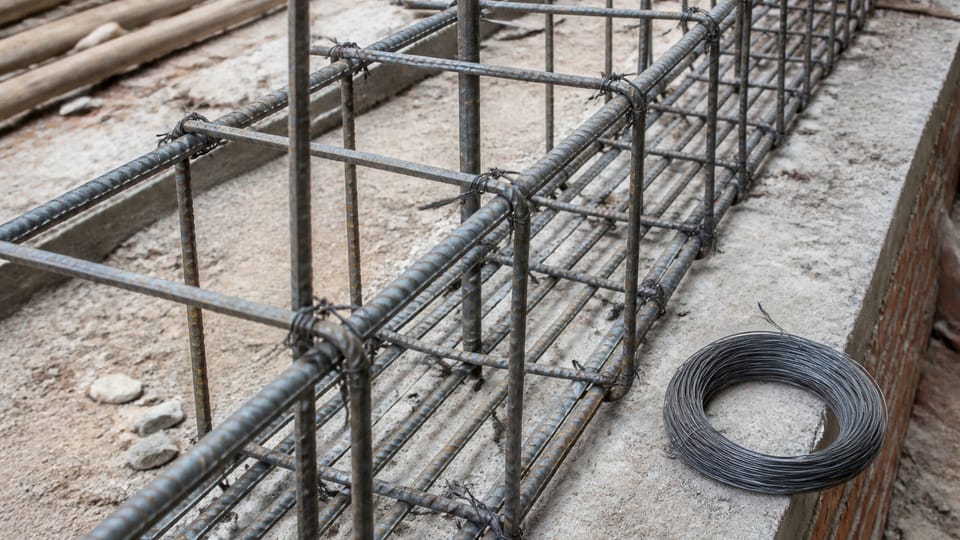
What is binding wire used for, and what does IS 2502 say about it? Binding wire is soft annealed steel wire that ties crossing reinforcement bars so the cage does not slip while concrete is placed. IS 2502:1963 clause 7.2 asks for annealed wire of size not less than 0.90 mm, where required, and gives no gauge number. The ties hold position; cover blocks set the cover. No standard we read gives a quantity per tonne.
On this page (10)
Binding wire is the thin soft wire that fixers twist around bars where they cross. It looks like a minor item, but a loose cage can shift while concrete is placed and vibrated, and the shift can change the cover over the steel. This page reads what IS 2502, IS 456, CPWD and the SP 34 handbook say about it. It does not give a quantity of wire per tonne of steel, because we found no source that does, and it gives no prices or brands. For the bars themselves, see TMT bars: full form and grades.
What is binding wire?
IS 2502:1963 clause 7.2 says: “Bars crossing each other, where required, shall be secured by binding wire (annealed) of size not less than 0.90 mm and conforming to IS: 280-1962 Specification for Mild Steel Wire (Revised), in such a manner that they will not slip over each other at the time of fixing and concreting.” The standard prints the size as 0.90 mm. The word “gauge” does not appear in IS 2502, so a gauge number is a trade description that does not come from this standard.
IS 280 is the standard for “mild steel wire for general engineering purposes”, covering wire of 0.125 to 12.5 mm diameter. It does not mention binding wire or reinforcement. It lists annealed as one of the finishes a purchaser may specify, alongside galvanized and others, and it gives sizes in mm. The link between IS 280 and tying reinforcement is made by IS 2502. Note that IS 2502:1963 cites the 1962 edition of IS 280, while BIS now lists IS 280:2006.
“Annealed” means the wire has been softened by heat treatment so that it bends and twists easily. Neither standard says why it asks for annealed wire; that explanation is ours, from general practice.
What is binding wire for?
IS 2502 asks that bars be secured “in such a manner that they will not slip over each other at the time of fixing and concreting”, and says the precautions in clauses 7.2 to 7.5 (tying, cover blocks, spacers and column reinforcement) are to prevent displacement of reinforcement during shuttering and concreting (clause 7.1.3). The tie holds position while the cage is handled and the concrete is placed. IS 456 clause 13.2 says “Care should be taken to avoid displacement of reinforcement or movement of formwork.” Our reading, not a quote from a standard, is that the wire is a positioning aid and does not replace the lap or anchorage lengths in the design.
What do the standards and guides say about tying?
| Source | What it says | What kind of source |
|---|---|---|
| IS 2502:1963 cl 7.2 | Bars crossing each other, “where required”, secured by annealed binding wire of size not less than 0.90 mm | Indian Standard |
| IS 2502 cl 7.2.1 | Every compression bar tied at least in two perpendicular directions | Indian Standard |
| IS 2502 cl 7.2.3 | Three methods of tying are illustrated in Fig. 6; method 6A is preferred to 6B, and 6B to 6C | Indian Standard |
| IS 2502 cl 7.1.1 | Reinforcement is secured in the position on the drawing; if there is a delay before concreting, its position is checked before concreting | Indian Standard |
| IS 456 cl 12.2.1 | Crossing bars should not be tack-welded for assembly unless permitted by the engineer-in-charge | Indian Standard |
| CPWD 2019 cl 5.3.3.1 | Bars tied at every intersection with two strands of annealed steel wire 0.9 to 1.6 mm thick, twisted tight; tack welding may be permitted if approved | Government works specification (practice for CPWD contracts) |
| SP 34 cl 13.4.2 | For bars which touch while crossing, very tight annealed wire ties of 1 to 2 mm; direction of single knots alternated to stiffen the mesh | Handbook (guide) |
The sources differ, and they should not be merged. IS 2502 says “where required” and gives a minimum size of 0.90 mm. CPWD says every intersection, two strands and a range of thickness. SP 34 gives a different range, and says the share of crossings that must be tied “depends” on the type of tie, the bar diameter, the surface shape and the rigidity wanted, without giving a percentage. How many crossings to tie is for your engineer to say on the drawing or at the site. We found no separate Indian Standard for binding wire used on reinforcement.
How do cover blocks relate to binding wire?
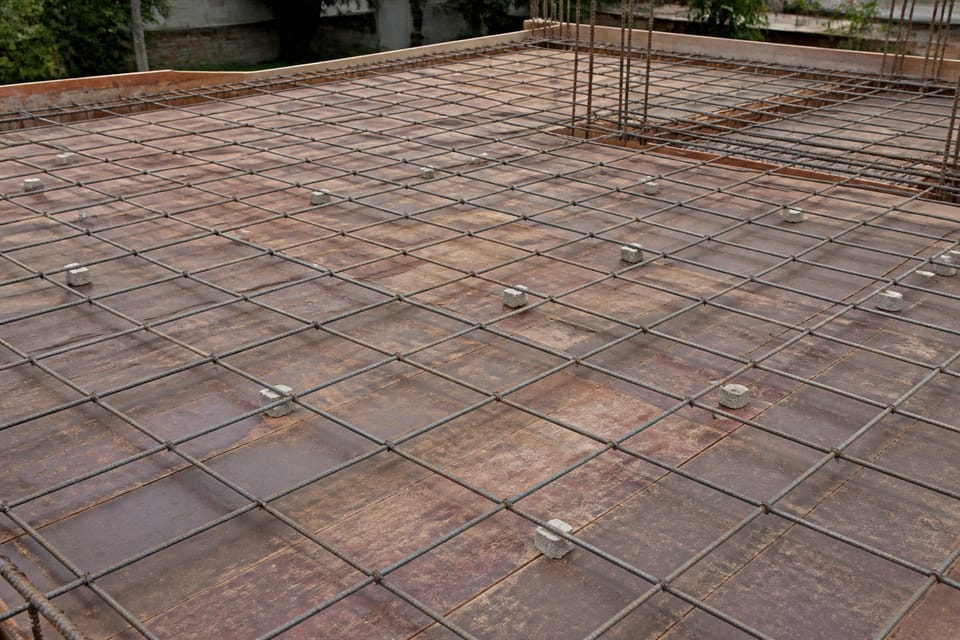
The ties keep the bars from slipping against each other, and the cover blocks keep the bars off the formwork. IS 456 clause 12.2 says all reinforcement “shall be placed and maintained in the position shown in the drawings by providing proper cover blocks, spacers, supporting bars, etc.” IS 2502 clause 7.3.1 says cover blocks, “generally of cement mortar, shall be used to ensure the required cover for reinforcement”, and that they may have binding wire embedded in them which is tied to the reinforcement when placed. Clause 7.3.3 says “only single cover blocks shall be used” to provide the cover at a section, and 7.3.2 says the block’s mortar or concrete shall not be leaner than the concrete around it. IS 456 clause 12.3.2 adds that “Spacers, cover blocks should be of concrete of same strength or PVC”. See the pre-pour checklist for the cover check.
What should I check at the site?
This is practice, not a standard, unless a source is named.
- The wire is soft, clean and not rusted through. A stiff or brittle wire breaks at the twist: ask for annealed wire, as IS 2502 does.
- Ties are tight and the cage does not move when stepped near. A loose tie lets the cage shift during the pour.
- Bars are tied where the engineer’s drawing and the site rule require. Do not ask the fixer for a count or a weight of wire.
- Cover blocks or spacers are in place under and beside the steel. The wire does not set the cover.
- Cut ends and offcuts are not left in the formwork. SP 34 says the bottom of the shuttering must be cleared of wire waste before concreting to prevent rust stains and corrosion paths on the face. It gives no rule for which way tails should point. Our practice view is that tails should not point into the cover zone, and your engineer decides the site rule.
- Ties are not cut or loosened by traffic over the steel. See compacting concrete with a needle vibrator for handling the vibrator near the steel.
Is there a standard quantity of binding wire?
No. We found no figure for the weight of binding wire per tonne of steel or per area in IS 2502, IS 456, IS 280, SP 34 or the NBC. CPWD 5.3.4 says “Annealed steel wire required for binding or tack welding shall not be measured, its cost being included in the rate of reinforcement.” Figures on web pages are unsourced and depend on bar spacing and detailing, so we do not repeat them. Ask your contractor to explain the arrangement in the written quote, not to quote a thumb rule.
What mistakes should I avoid?
These are practice, not code rules.
- Treating the wire as the means of keeping cover, and leaving out cover blocks.
- Loose ties, so that the cage shifts during pouring and vibration.
- Using hard, rusty or oily wire.
- Leaving wire offcuts and tails in the formwork.
- Assuming the wire adds strength to laps or replaces required lap lengths.
- Treating a web “gauge” or “kg per tonne” figure as a specification.
Frequently asked questions
What is the gauge of binding wire?
IS 2502 does not give a gauge. Clause 7.2 asks for annealed wire of size not less than 0.90 mm. CPWD gives 0.9 to 1.6 mm for its works and SP 34 gives 1 to 2 mm. We found no source that converts these to a gauge number.
Is binding wire the same as annealed wire?
IS 2502 asks for “binding wire (annealed)”. IS 280 lists annealed as a finish of mild steel wire. Whether a product sold as “black wire” meets IS 280 is not something the standards settle.
Should I use galvanised or black binding wire?
IS 2502 asks for annealed wire, and IS 280 lists galvanized as a separate finish from annealed, so the clause as written names annealed. Whether galvanised wire is acceptable is not settled by the standards we read; ask your engineer. NBC 2026 mentions galvanized iron binding wire only for bamboo reinforcement.
Does binding wire carry load?
Our reading, not a standard’s statement, is that the wire is a positioning aid and that the design relies on the bars and their laps and anchorage, not on the wire. IS 2502 says only that the tie keeps bars from slipping over each other.
How much binding wire do I need per tonne of steel?
No standard we read gives a figure, and CPWD does not even measure the wire separately. Ask your contractor to explain it in the written quote.
Related guides
- Before the slab pour: an owner’s checklist for formwork and steel
- Bar bending schedule explained
- TMT bars: full form and grades
This guide is general information. Read the disclaimer. Your structural engineer decides how the steel in your house is tied and held.
Sources
- IS 2502:1963, Code of Practice for Bending and Fixing of Bars for Concrete Reinforcement: clauses 7.1.1, 7.1.3, 7.2, 7.2.1, 7.2.3 and 7.3.1 to 7.3.3 (page images read). BIS lists it as not withdrawn; the 1963 text cites IS 280-1962.
- IS 280:2006, Mild Steel Wire for General Engineering Purposes (fourth revision): clauses 1, 7.1 and 10 (page images read). BIS lists it as not withdrawn; its listed validity date is 2026-11-30, so check the BIS portal for a newer edition.
- IS 456:2000, Plain and Reinforced Concrete: clauses 12.2, 12.2.1, 12.3.2 and 13.2 (page images read).
- CPWD Specifications 2019 Vol 1, Sub Head 5.0 RCC Work, clauses 5.3.3.1, 5.3.3.2 and 5.3.4 (page images read). A government works specification, used as practice.
- SP 34(S&T):1987, Handbook on Concrete Reinforcement and Detailing: clauses 13.4.2 and 13.4.2.1 (page images read). A handbook, not a code.
General information only. It is not a structural design or professional advice. Ask a licensed structural engineer or architect to check your plans and site.