
Short answer
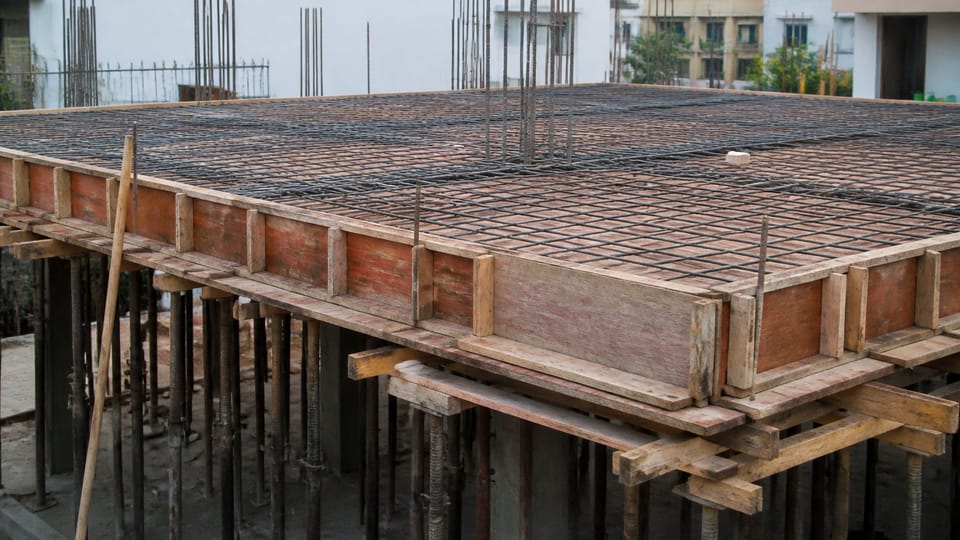
What should I check on the formwork and the steel before a slab is poured? Before the pour, the formwork should be rigid and tight enough to stop the slurry leaking, clean inside, and the steel should be clean, held in its drawn position with spacers, and checked by the engineer. IS 14687 lists the checks made before concreting. These are questions for the engineer and the contractor. IS 456 clause 11.3 requires strength before forms are released, and clause 11.3.1 gives minimum striking periods, which this guide does not reproduce. The engineer decides when the formwork is removed.
On this page (10)
A concrete slab is poured once, and what is wrong with the formwork or the steel is hard to correct after it has set. This guide is a checklist of what to look at before the pour, based on the Indian concrete code IS 456 and the falsework guideline IS 14687. It gives no times, no prop spacing, no bar size and no cover. Those are for the engineer’s drawing. The checks are written as questions for the engineer and the contractor, because neither standard puts these duties on the owner.
Is the formwork ready?
IS 456 says the formwork “shall be designed and constructed so as to remain sufficiently rigid during placing and compaction of concrete, and shall be such as to prevent loss of slurry from the concrete” (clause 11.1). It also says that for further details of design and detailing, reference may be made to IS 14687 (clause 11.1).
IS 14687 asks for the falsework to be designed, and for design information to be gathered first. The information “includes the site investigation report, expected loading scheme of load transfer, sequence of erection and releasing, procedure of concreting and time frame” (clause 7.2). It also says that the checks for safety and overall stability “shall be implicit in design” (clause 7.1).
Ask the contractor for the falsework drawing and the engineer’s sign-off before the pour.
Is the inside of the form clean?
IS 456 is firm on this. “All rubbish, particularly, chippings, shavings and sawdust shall be removed from the interior of the forms before the concrete is placed” (clause 11.2). The face of the form in contact with the concrete “shall be cleaned and treated with form release agent” (clause 11.2).
IS 14687 asks the same before the pour. It says the forms “shall be clean and free from wood shavings, grit, etc.” and that only approved coatings or release agents are applied (clause 9.4). Look inside the form before the pour, and ask the contractor to clear it.
Is the steel clean and in position?
The steel must be free of what would weaken the bond. IS 456 says that “All reinforcement shall be free from loose mill scales, loose rust and coats of paints, oil, mud or any other substances which may destroy or reduce bond” (clause 5.6.1).
The steel must also stay where the drawing puts it. The code says that “All reinforcement shall be placed and maintained in the position shown in the drawings by providing proper cover blocks, spacers, supporting bars, etc.” (clause 12.2). It also says that “Spacers, cover blocks should be of concrete of same strength or PVC” (clause 12.2).
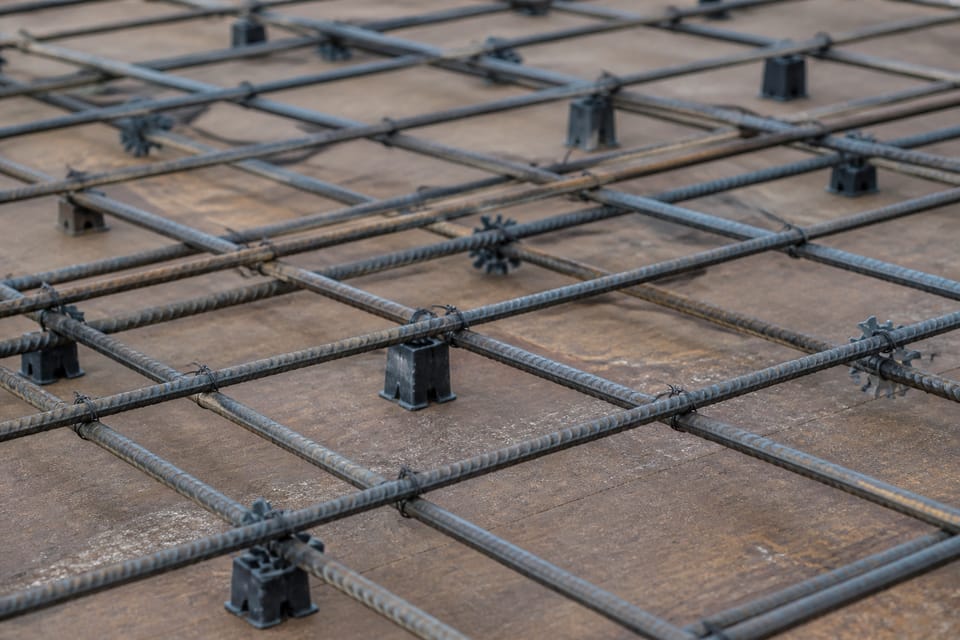
The standard asks that crossing bars “should not be tack-welded for assembly of reinforcement unless permitted by engineer-in-charge” (clause 12.2.1). The steel must be “secured against displacement outside the specified limits” (clause 12.3).
What must be checked before the pour?
IS 14687 lists the checks made before and during the pour. Among them: the reinforcement and the falsework have been checked and permission to commence the placement of concrete has been given, and the props and bracings are watched during the placing and the vibration (clause 9.4). IS 14687 clause 9.8.1 recommends formal checks of the falsework at set stages, including “Immediately prior to load being applied”.
IS 456 asks that the steel be placed and tied “in such a way that concrete placement be possible without segregation of the mix” (clause 12.6), and that care be taken “to avoid displacement of reinforcement or movement of formwork” during the pour (clause 13.2).
Who inspects, and when?
IS 456 does not say in terms that concreting must not start until the engineer has inspected. IS 14687 clause 9.4(g) does list, among the checks before concreting, that the reinforcement and falsework have been checked and permission to commence placement has been accorded. It does say that “Supervision is also of extreme importance to check the reinforcement and its placing before being covered” (clause 13.6). It also says that “Before any important operation, such as concreting or stripping of the formwork is started, adequate notice shall be given to the construction supervisor” (clause 13.6.1).
IS 456 says that “each step in concreting which will be covered by the next step is inspected as the work proceeds” (clause 10.1.2). So the inspection is part of the work, not only a final check.
IS 14687 clause 9.9 gives a checklist that may be used by foremen, supervisors and inspectors of falsework, and it asks that the scheme “should facilitate adequate and safe access to all areas for inspection” (clause 4.4.2).
What should I check?
This section is practice, not a code rule. The items below are questions to ask the engineer and the contractor, not duties the standards place on the owner.
- Is there a falsework and formwork drawing, signed off by the engineer?
- Is the inside of the form clean, and is the release agent the one the engineer approved?
- Is the steel clean, and is it held at the cover shown on the drawing by spacers?
- Have the engineer and the supervisor inspected the steel before it is covered?
- Has the contractor given notice of the pour, so that the supervisor can be present?
- Is there a person watching the props and bracing during the pour?
What mistakes should I avoid?
This section is practice.
- Pouring before the steel has been inspected, because the work is behind schedule.
- Tying the steel loosely so that it moves during the pour.
- Using bricks or stones as spacers that will not hold the cover.
- Welding the steel to hold it without the engineer’s permission.
- Leaving rubbish in the form from the carpentry work.
Frequently asked questions
When can I remove the formwork?
IS 456 clause 11.3 sets a strength test before forms are released, and clause 11.3.1 gives minimum striking periods. This guide does not reproduce them. The engineer decides when the formwork is removed.
Who is responsible for the falsework?
IS 14687 says that the responsibility for falsework should be allocated to cover the stages of concept, design, erection, inspection and release, so that no vital stage is missed. The standard does not name one person. Ask the engineer and the contractor who has each stage.
Does the owner have to inspect?
Neither standard puts an inspection duty on the owner. The owner’s protection is to ask the engineer and the supervisor for the inspection record before the pour.
Related guides
- Concrete grades M15 to M25 explained
- Hot weather concreting in Indian summer
- Compacting concrete without a vibrator: rodding and when it is allowed
- Stirrups vs ties: what each does in a beam and a column
- Chhat dhalai: what happens on slab casting day, from batch to curing
This guide is general information. Read the disclaimer. Your engineer decides the formwork, the steel and the pour for your house.
Sources
- IS 456:2000, Plain and reinforced concrete: code of practice (fourth revision). Clauses 5.6.1, 11.1, 11.2, 12.2, 12.2.1, 12.3, 12.6, 13.2, 13.6, 13.6.1, 17.1 read from page images of a public copy. The removal (stripping) time in clause 11.3 is referred to, not reproduced. BIS validity not re-checked.
- IS 14687:1999, Falsework for concrete structures: guidelines. Scope 1.1, clauses 4.4.2, 7.1, 7.2, 7.3.2.1, 9.2, 9.4, 9.8.1 and 9.9 and the Foreword read from a public copy. No removal time, prop spacing or load value is used. BIS validity not re-checked.
Change log
- : Added Related guides link to newly published article(s): compacting-concrete-without-a-vibrator-hand-rodding-and-when-it-is-allowed, stirrups-vs-ties-what-each-does-in-a-beam-and-a-column. No other text changed. Approved by the reviewing engineer.
- : Added Related guides link to newly published article(s): chhat-dhalai-what-happens-on-slab-casting-day-from-first-batch-to-curing. No other text changed. Approved by the reviewing engineer.
General information only. It is not a structural design or professional advice. Ask a licensed structural engineer or architect to check your plans and site.