
Short answer
What is the full form of TMT bar? TMT stands for thermo-mechanically treated. A hot-rolled steel bar is cooled quickly with water so that its surface becomes hard while its core stays softer and more ductile. In Fe500, the number is the minimum yield strength in N/mm², and D means ductile. Your structural drawing names the grade to buy.
On this page (11)
- What is the full form of TMT?
- What does the TMT process do to the bar?
- What do Fe500, Fe500D and Fe550D mean?
- How do Fe500 and Fe550D compare?
- Which grade should I buy?
- How do I check the bars I receive?
- Where do I find the weight of a bar?
- Frequently asked questions
- Related guides
- Work out your quantities
- Sources
Need quantities? Steel bar weight calculator
Walk into any steel yard and you will hear the same words: TMT, Fe500, Fe500D, Fe550D. Dealers use them as if everyone knew them. This page explains what TMT stands for, what the process does, and how to read a grade name, so you can read your drawing and check what is delivered.
What is the full form of TMT?
TMT stands for thermo-mechanically treated. It describes how the bar is made.
What does the TMT process do to the bar?
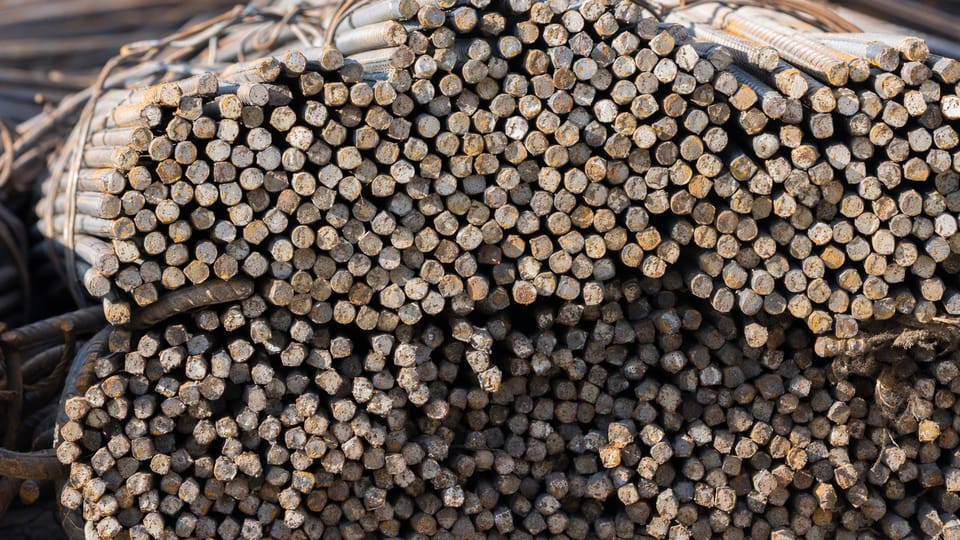
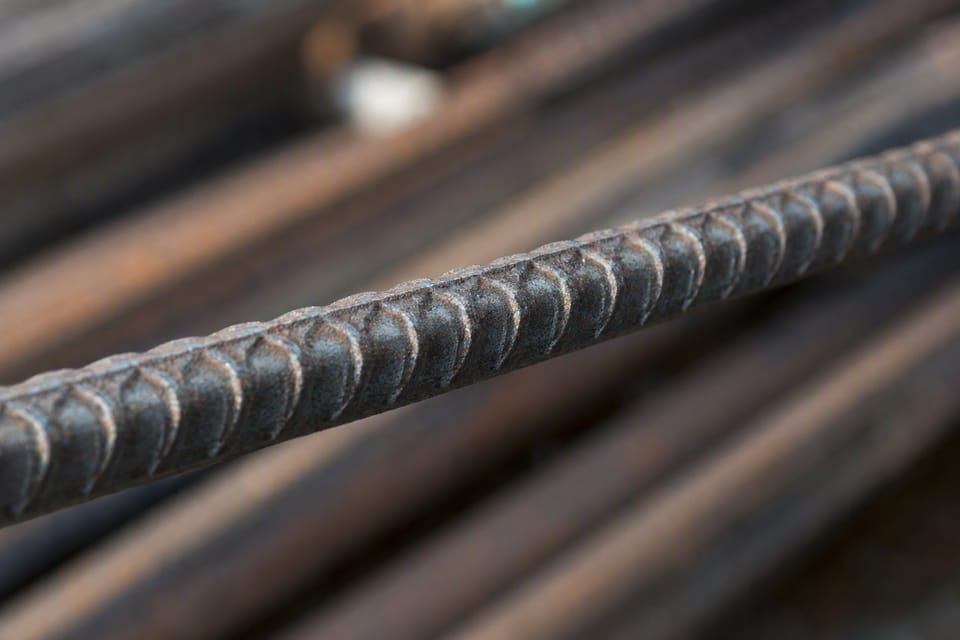
A steel bar is first rolled hot into its ribbed shape. It then passes straight through water sprays that cool its outer surface very fast, while the inside is still hot. The core then cools more slowly, and the heat flowing out of it tempers the surface. The result is a bar with a hard outer layer and a softer, more ductile core. Ductile means it can bend and stretch before it breaks, which is what you want from reinforcement in concrete.
What do Fe500, Fe500D and Fe550D mean?
The grade name has three parts.
- Fe is the chemical symbol for iron, and it marks the bar as steel.
- The number, such as 500 or 550, is the minimum yield strength of the bar in newton per square millimetre (N/mm²). Yield strength is the stress at which the steel begins to stretch permanently. A higher number means a stronger bar.
- The letter D means the bar is ductile, with more guaranteed stretch before it fails than the grade without a D. That extra ductility matters where a building must absorb movement, such as in an earthquake.
So Fe500 is a grade of 500 N/mm² minimum yield strength, Fe500D is the ductile version of it, and Fe550D is a stronger, ductile grade. IS 1786 is the Indian Standard that sets these grades.
How do Fe500 and Fe550D compare?
| Grade | Minimum yield strength | Ductile (D)? |
|---|---|---|
| Fe500 | 500 N/mm² | No |
| Fe500D | 500 N/mm² | Yes |
| Fe550D | 550 N/mm² | Yes |
This page gives no elongation or other test numbers, because those come from the current IS 1786 and from the maker’s test certificate for the bars you buy.
Which grade should I buy?
The one on your structural drawing. The designer picks the grade, and the size and number of bars on the drawing are worked out for that grade. Do not swap Fe500 for Fe550D, or any grade for another, to save money or because the dealer has it in stock, without the designer’s written approval. A stronger grade does not let you use fewer bars unless the designer says so.
How do I check the bars I receive?
- Genuine bars normally carry the maker’s mark and the grade rolled into their surface. Be wary of unmarked bars.
- Ask the supplier for the BIS licence number and the mill test certificate for the lot, and keep them.
- Check the bar diameter and the weight against your bill. The method is in How many 12 mm bars in 1 tonne?, which also has the weight per metre and the rod count for each bar size.
- Keep the bars off the ground and covered, so that they do not collect mud, oil or heavy rust.
Where do I find the weight of a bar?
Use the steel bar weight calculator, or the weight chart in the page linked above. This page does not repeat them.
Frequently asked questions
What is the full form of TMT?
Thermo-mechanically treated.
What does Fe500 mean?
Steel with a minimum yield strength of 500 N/mm².
What does the D in Fe500D mean?
Ductile. The bar is guaranteed to stretch more before it fails than the same grade without D.
Is Fe550D better than Fe500?
It is a higher strength, ductile grade, but better depends on the design. Use the grade your drawing names.
Can I use a different grade from the one on the drawing?
Only with the written approval of your structural engineer.
Related guides
- How many 12 mm bars in 1 tonne? Weight per metre and a check
- What is a plinth beam? Purpose, position and who designs it
This guide is general information. Read the disclaimer. The grade, size and number of bars for your building come from your structural design. For where reinforcement sits in the structure, see What is a plinth beam?
Work out your quantities
- Steel bar weight calculator: Find the weight of reinforcement bars by diameter, length and number of bars, using the standard D squared over 162 formula.
Sources
- IS 1786:2008, High Strength Deformed Steel Bars and Wires for Concrete Reinforcement - Specification
General information only. It is not a structural design or professional advice. Ask a licensed structural engineer or architect to check your plans and site.