
Short answer
What does 43 grade or 53 grade cement mean? In the 2013 editions, now withdrawn, the grade number was the minimum 28-day strength in megapascals of ordinary Portland cement in a standard mortar cube test (IS 4031 Part 6). It describes the cement, not your concrete. IS 269:2015 names the same three grades, and no standard we read says which grade suits which member: the engineer decides.
On this page (9)
The number on a cement bag, 43 or 53, is one of the most quoted and most misread numbers on a house site. It does not say how strong your slab will be, and it does not say which cement goes where. This page explains what the grade number measures, how the test is done, which standard now carries it, and what to ask your engineer. It gives no price, no brand, and no “use 53 for slabs, 43 for plaster” rule, because no standard we read gives one. The type of cement (OPC, PPC, PSC) is a different question: see OPC vs PPC vs PSC cement: which one for your house?.
What does the grade number mean?
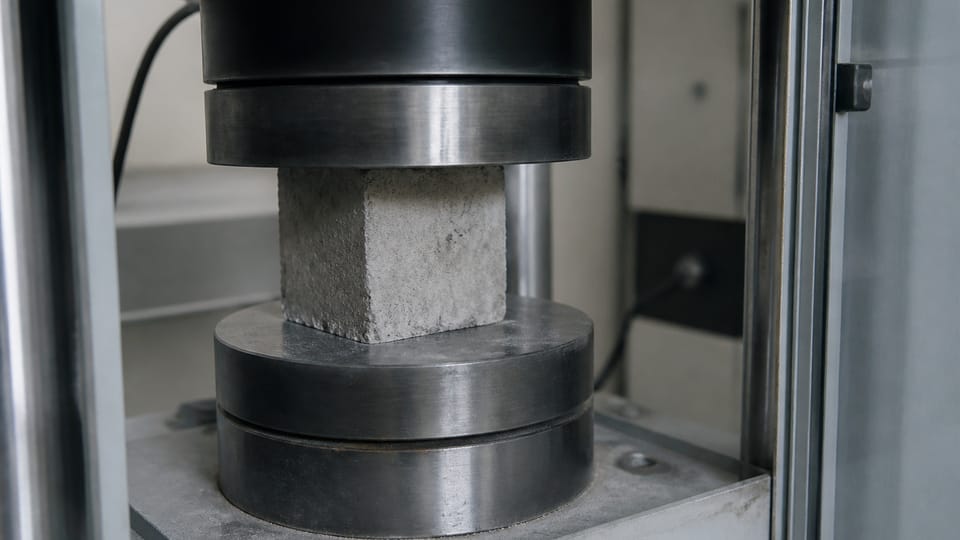
For ordinary Portland cement (OPC), the grade is a strength class. In the 2013 editions of the standards for 43 grade (IS 8112) and 53 grade (IS 12269), the compressive strength row of the table of physical requirements has a minimum at 3 days, at 7 days and at 28 days, and the 28-day minimum equals the grade number in megapascals: 43 for 43 grade and 53 for 53 grade. IS 8112 and IS 12269 do not define “grade” in a sentence (they refer to IS 4845 for terms, which we did not read); the meaning is read from the table. The test is on a small mortar cube of cement and standard sand, not on concrete.
Three points follow.
- It is a minimum. The standard sets a floor. The 2013 table also required the cement to show a progressive increase in strength from the 3-day value, and for 43 grade it gave an upper limit at 28 days as well (the 53 grade table in the copy we read has none). A bag’s real result can sit above the grade.
- It is the cement, not the concrete. Concrete strength comes from the mix, the water, the compaction and the curing. The concrete grade (M20, M25) is a different number: see concrete grades M15 to M25: what the number means on your drawing.
- It is not the type. Grade is a strength class; OPC, PPC and PSC are types. Ask for both on the bill.
Which standard carries it now?
BIS lists IS 8112:2013 (43 grade) and IS 12269:2013 (53 grade) as withdrawn, and IS 269:2015 (sixth revision) as in force. The BIS summary of IS 269:2015 says it “provides specifications for three grades of cement namely OPC 33, OPC 43 and OPC 53 based on their compressive strength”, and also covers sleeper-grade cement for railway sleepers. We could not read the full text of IS 269:2015, so we do not print its strength table or clause numbers here. The values we read are from the earlier editions. A web page that gives IS 8112 or IS 12269 as the current code is out of date. IS 456:2000, which BIS still lists as in force, in clause 5.1 lists 33, 43 and 53 grade OPC under the older standard numbers as acceptable. To see where this fits among all the cement types, see IS codes for house construction: which standard covers what.
How is the grade tested?
IS 4031 (Part 6):1988, in force, says in clause 1.1 that it “covers the procedure for determining the strength of cement as represented by compressive strength tests on mortar cubes compacted by means of standard vibration machine”.
| Step | What the standard says |
|---|---|
| Sand | Standard sand conforming to IS 650 (clause 4.1) |
| Mix | One part cement to three parts standard sand by mass, with the water worked out from the cement’s standard consistency (clause 6.1.2) |
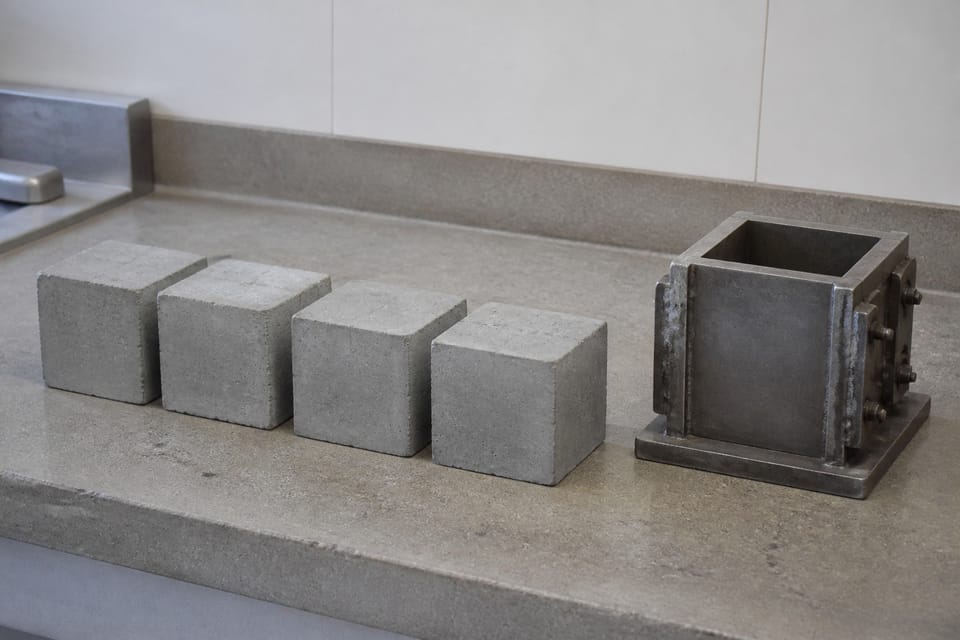
| Mould | A cube mould of 70.6 mm size (clause 5.3), so the cube is much smaller than the 150 mm concrete cube |
| Curing | A day in a moist closet, then demoulded and kept in water until just before it is broken (clause 6.3) |
| Test | Three cubes for each period of curing named in the cement standard, crushed on their sides (clauses 7.1 and 7.1.1) |
This test is made in a laboratory on a cement sample: a bag-site check cannot show the grade, as checking cement on site: bag marks, licence and lab tests explains. It is also not the concrete cube you see at a site: see concrete cube test: how cubes are made, tested and read. We print no loading rate, no mixing time and no strength limits other than the grade numbers themselves.
Is 53 grade better than 43 grade?
The standards do not say so. IS 456:2000 clause 5.1 lists 33, 43 and 53 grade OPC among the cements that may be used and adds that “the type selected should be appropriate for the intended use”. NBCS 2026 uses the same words for the type of cement. Neither maps a grade to a footing, a column, a slab or plaster, and no standard we read does. Maker pages and blogs give such tables, and they contradict each other, so we do not repeat them. The engineer selects the cement type and grade with the concrete grade, the member, the exposure, the curing plan and the weather. What follows from the grade is general and is not a rule: the 2013 tables set higher 3-day and 7-day minimums for 53 grade than for 43 grade, so it is generally expected to gain strength sooner. How soon the shuttering comes off is the engineer’s decision, not the cement’s grade alone.
IS 456:2000 clause 5.1.3 also says that trade names or special features claimed on bags or in advertisements “have no relation whatsoever with the characteristics guaranteed by the Quality Marking”, and that consumers are advised to go by the characteristics in the standard or seek specialist advice. A “premium” label is not a grade.
What should I ask?
This is practice.
- Which cement type and grade the drawing or specification names. Ask the engineer to name both.
- That the bag and the bill show the same type and grade, with the Standard Mark and the IS number.
- Before any change of grade or type between plan and site, ask the engineer.
- For early shuttering removal, hot or cold weather, or a thick pour, ask the engineer: see how many days to cure a concrete slab?.
- For an important pour, ask for the maker’s test certificate for the batch.
A higher-grade cement does not excuse extra water or short curing: see water-cement ratio: why extra water weakens concrete.
What mistakes should I avoid?
These are practice unless a standard is named.
- Assuming 53 grade is “better” and using it everywhere, or paying for it when the drawing does not ask for it.
- Confusing cement grade (43, 53) with concrete grade (M20, M25).
- Confusing grade with type, and ordering by grade name alone.
- Taking the bag’s grade as a guarantee of the strength of your concrete.
- Using IS 8112 or IS 12269 as the current code.
- Trying to test the grade with a float or temperature test or by hand.
- Trusting a dealer’s “53 for slab, 43 for plaster” rule instead of the drawing.
- Changing grade or type on site without asking the engineer.
Frequently asked questions
What does 43 grade cement mean?
In the 2013 editions, now withdrawn, it was OPC with a minimum of 43 MPa at 28 days in the standard mortar cube test (IS 4031 Part 6). IS 269:2015 names the 33, 43 and 53 grades.
Is 53 grade cement stronger than 43 grade?
As cement, 53 grade has a higher minimum strength class. That says nothing about the strength of your concrete, which depends on the mix, water, compaction and curing, and no standard we read says which grade to use for which member.
Is IS 8112 still the code for 43 grade?
No. BIS lists IS 8112:2013 and IS 12269:2013 as withdrawn. IS 269:2015 is in force, although IS 456:2000 still cites the old numbers.
Can I test the grade at the site?
No. The grade needs the laboratory test in IS 4031 (Part 6) on a cement sample. A site check can only look at the bag and the cement’s condition.
Is PPC 43 or 53 grade?
PPC and PSC have their own standards, IS 1489 and IS 455, and are a different type. For what they must reach at 28 days, see the OPC, PPC and PSC page linked above; we did not read how they are graded, so we say nothing more here.
Related guides
- OPC vs PPC vs PSC cement: which one for your house?
- Concrete grades M15 to M25: what the number means on your drawing
- Concrete cube test: how cubes are made, tested and read
This guide is general information. Read the disclaimer. Your engineer decides the cement type and grade for each part of your house.
Sources
- IS 8112:2013 (43 grade ordinary Portland cement, second revision; the copy linked) and IS 12269:2013 (53 grade, first revision; archive.org id gov.in.is.12269.2013): Foreword, clause 1, Table 3 (physical requirements) and clause 10.1 marking (page images read; clause 10.1 of IS 8112 from the text layer). Both editions are withdrawn: BIS lists them as withdrawn, with IS 269:2015 (sixth revision) in force to 2030. IS 269:2015 itself was not readable; the one-page BIS summary of it was read.
- IS 4031 (Part 6):1988, Methods of Physical Tests for Hydraulic Cement, Part 6, Determination of Compressive Strength of Hydraulic Cement Other Than Masonry Cement (first revision, with Amendments 1 to 3): clauses 1.1, 4.1, 5.3, 6.1.2, 6.3 and 7.1 (page images read). BIS lists it as in force, valid to 2029-03-31.
- IS 456:2000, Plain and Reinforced Concrete, Code of Practice: clauses 5.1 and 5.1.3 (page images read). It still cites IS 269, IS 8112 and IS 12269 by those numbers.
- SP 7:2026, National Building Construction Standards (NBCS) 2026, Part C Section 5, Structural Concrete, Annex A clause A-2.1 (page image read). From an unofficial archive.org copy.
- BIS one-page summary of IS 269:2015, Ordinary Portland Cement, Specification (sixth revision), services.bis.gov.in: the statement of the three grades OPC 33, OPC 43 and OPC 53 (text layer read).
General information only. It is not a structural design or professional advice. Ask a licensed structural engineer or architect to check your plans and site.