
Short answer
Is M-sand as good as river sand? Neither is best for every job. The Indian Standards accept crushed stone sand (M-sand) as well as river sand, for concrete, plaster and brickwork. What matters is clean, well-graded sand with few fines, clay and silt. Ask for washed and graded M-sand with a test report, because raw quarry dust is not the same thing.
On this page (13)
- What is M-sand?
- Is quarry dust the same as M-sand?
- What do the standards say?
- Why does the standard allow more fines in crushed sand?
- What problems do each type of sand cause?
- What should I ask the supplier?
- What simple checks can I do on site?
- Does the sand change my mix?
- Which sand should I choose?
- Frequently asked questions
- Related guides
- Work out your quantities
- Sources
Need quantities? Cement, sand and aggregate calculator
People argue a lot about M-sand and river sand. Some say river sand is always better. Others say M-sand is stronger. The Indian Standards say neither. This page explains what the standards allow, what to check before you buy, and a few simple checks you can do on site. It gives no prices, because prices change by place and season.
What is M-sand?
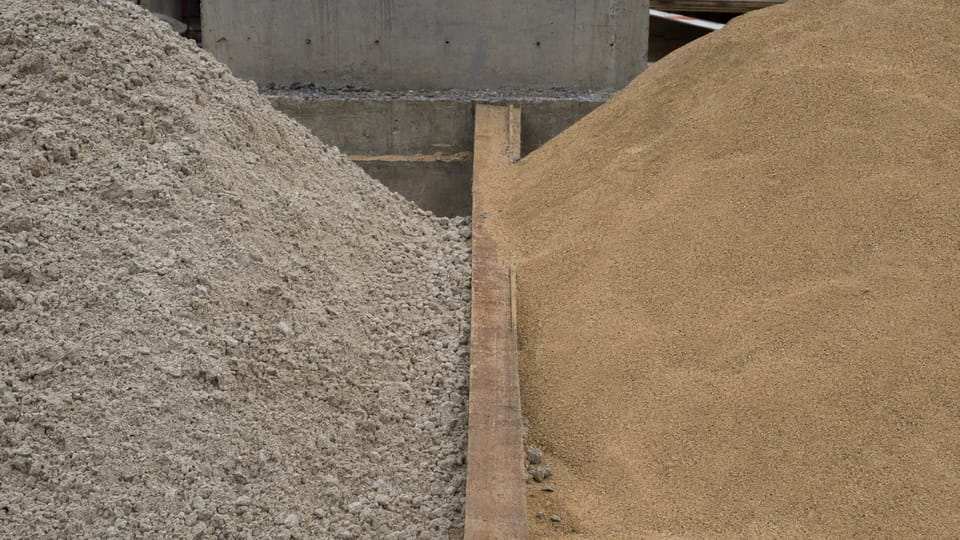
M-sand is sand made by crushing hard rock at a plant. The Indian Standard for concrete aggregate, IS 383, calls it crushed stone sand. River sand, which the standard calls natural sand, is formed when rock breaks down naturally and is carried and left by rivers.
One word to watch: IS 383 uses the term “manufactured sand” for something different. It means sand made from other materials, such as slag or recycled concrete. It does not mean crushed rock sand. So when a supplier says “manufactured sand”, ask what it is made from.
Is quarry dust the same as M-sand?
No. IS 383 says that crusher dust or quarry dust, which comes from the fine screening of a quarry, cannot be called crushed sand. It may not meet the standard and is not expected to perform as well as properly crushed sand, unless it is processed to meet the requirements. So ask whether you are buying washed, graded M-sand or raw quarry dust.
What do the standards say?
Three standards cover sand, one for each use. Each lists the types of sand it accepts.
| Use | Standard | Sand it accepts | Key limit on fine material |
|---|---|---|---|
| Concrete | IS 383 (2016 edition) | Natural (river) sand, crushed stone sand, crushed gravel sand and mixed sand | Material finer than 75 micron: not more than 3% for natural sand, 15% for crushed sand and 12% for mixed sand |
| Plaster | IS 1542 (1992 edition) | Natural sand, crushed stone sand and crushed gravel sand | Clay, silt and dust: not more than 5% by weight |
| Brickwork mortar | IS 2116 (1980 edition) | Natural sand, crushed stone sand and crushed gravel sand | Clay, fine silt and fine dust: not more than 5% by mass |
The 3% and 15% limits for concrete and the 5% limit for plaster and mortar come from different standards and different tests, so do not compare them directly. Edition years above are the ones we read, and your engineer should check the current edition.
Why does the standard allow more fines in crushed sand?
Crushing rock makes some very fine powder along with the sand grains. Fines can fill gaps in a mix, but too much can raise the water the mix needs and lower its strength, so the limit is not open-ended. This is general engineering knowledge, not a clause. IS 383 allows more material finer than 75 micron in crushed sand (15%) than in river sand (3%). For plaster and mortar, the standards allow a higher dust level in crushed stone sand only if the supplier and buyer agree on it.
What problems do each type of sand cause?
River sand can bring in clay, silt, organic matter and salts. These weaken the bond between cement and sand. IS 1542 asks for sand that is hard, durable and clean, and free from adherent coatings and organic matter.
M-sand can have too much fine dust, poor grading (too many fine or too many coarse grains) or flaky particles. A good plant washes and grades its sand and checks it regularly. A poor one sells whatever comes off the crusher.
Both types can fail a test. A good supplier of either type gives you a test report.
What should I ask the supplier?
- Is it washed and graded M-sand, or quarry dust?
- Can I see a recent test report against the standard that fits my job: IS 383 for concrete, IS 1542 for plaster, IS 2116 for brickwork?
- Does every truckload come from the same plant, and is the sand the same as the sample?
- For plaster, is it suitable for plaster? Plaster sand is finer than concrete sand.
Keep a small sealed sample from the first delivery. If a later load looks very different, compare it with the sample.
What simple checks can I do on site?
These are rough checks from practice. They are not methods from the Indian Standards, and they give no numbers.
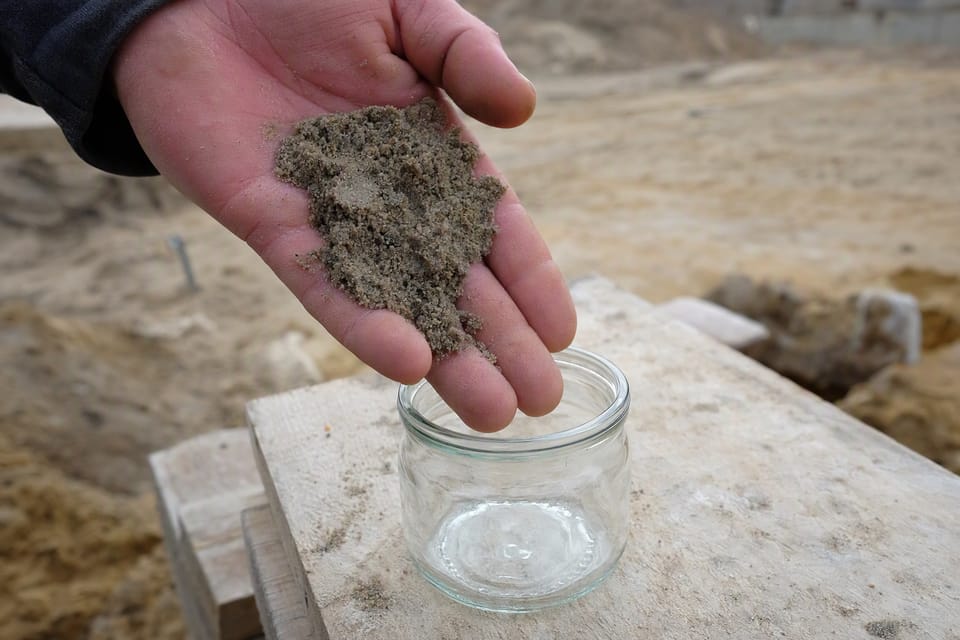
- Look and feel. Good sand feels gritty, and the grains are clean. Rub a pinch in your palm. If your hand is left stained or dusty, there may be too much clay or fine dust.
- The jar check. Put a little sand in a clear jar of water, shake it and let it settle. A thick layer of fine mud on top of the sand points to a lot of silt or clay. This is a rough guide only.
- Dust. If a pile throws up a cloud of dust when you scoop it, it is probably carrying a lot of fine powder.
If a check worries you, send a sample to a laboratory. Your engineer can arrange the tests.
Does the sand change my mix?
Do not change the cement, the water or the mix on your own because you changed the sand. The way the sand is graded and how much fine material it has can change how a mix behaves, so your engineer should check the mix for the sand you will really use. The cement and sand quantities for a mix are in Cement, sand and aggregate per cubic metre. Damp sand also takes up more space than dry sand, which is explained in Sand bulking.
Which sand should I choose?
Choose the sand that meets the standard for your job and has a test report, whatever it is called. Supply rules for river sand differ from state to state, so check what is sold near you. If your plans or specification name a kind of sand, follow them. If you want to change it, ask your engineer first.
Frequently asked questions
Is M-sand better than river sand?
Not always, and not always worse. The standards accept both. Good washed and graded M-sand can meet the limits, and poor river sand or poor M-sand can fail them.
Can I use M-sand for plaster?
IS 1542, the standard for plaster sand, includes crushed stone sand. It limits clay, silt and dust to 5% by weight, and it allows a higher dust level in crushed stone sand only by agreement between supplier and buyer. Plaster sand is also finer than concrete sand, so ask whether the M-sand is suited to plaster.
Can I use M-sand for brickwork?
IS 2116, the standard for masonry mortar sand, includes crushed stone sand, with a 5% limit on clay, fine silt and fine dust.
Is M-sand stronger than river sand?
The standards do not say so. Strength depends on the cement, the mix, the water and the grading of the sand.
Is quarry dust the same as M-sand?
No. IS 383 says crusher or quarry dust is not crushed sand, unless it is processed to meet the standard.
How do I test sand at home?
You can look, rub and do the rough jar check above, but only a laboratory test tells you if the sand meets the standard.
Related guides
- Sand bulking: why damp sand gives you less sand
- Cement, sand and aggregate per cubic metre: M5 to M20
- Mortar ratio for brick walls: 1:4, 1:5 or 1:6?
This guide is general information. Read the disclaimer. The sand and mix for your building are decided by your engineer.
Work out your quantities
- Cement, sand and aggregate calculator: Estimate cement bags, sand and aggregate for a nominal-mix concrete slab, footing or beam from its size and mix grade.
Sources
General information only. It is not a structural design or professional advice. Ask a licensed structural engineer or architect to check your plans and site.