
Short answer
What is the difference between the overall width and the cover width of a corrugated roof sheet? Overall width is the full width of the sheet as made. Cover width, also called effective width, is what one sheet covers once the side overlap is taken off. IS 277:2018 gives only the overall width before and after corrugation and uses no term cover width, so take the cover width from the maker. Count sheets by cover width along the roof and by slope length up it.
On this page (13)
- What does IS 277 say about the size of a corrugated sheet?
- What is cover width, then?
- The terms side by side
- What are end lap and side lap?
- What does “pitch” mean?
- How do I count sheets? (practice)
- What do the standards not say?
- What should I ask the supplier? (practice)
- What mistakes should I avoid? (practice)
- What can I check at delivery? (practice)
- Frequently asked questions
- Related guides
- Sources
Roof sheet orders go wrong on numbers that sound alike: overall width, cover width, pitch, lap. This page sets out what the Indian standards print for corrugated galvanised steel sheet, what they leave to the maker, and how to count sheets for a roof. It gives no purlin spacing, fastener detail, leak repair, thickness choice, price or brand; for the material choice, see metal roof sheets: GI vs galvalume vs colour-coated, and TCT and BMT.
What does IS 277 say about the size of a corrugated sheet?
IS 277:2018 covers plain and corrugated galvanised sheets, “intended to be used for purposes such as paneling, roofing, applications requiring lock forming” (clause 1). Its own definitions (clause 3, which also points to IS 1956 Part 4, not read) cover only black sheet, cold-rolled sheet, thickness of sheet and spangle; they do not define overall width, cover width, pitch, depth or lap. For corrugated sheets, clause 15.1.2 and Table 7 give four profile types, A to D, each with a depth and a pitch of corrugation, and allow other profiles by agreement. Clause 15.1.3 says “the number of corrugations shall be as per the Table 8, depending on the width of the sheet”, and that the overall width “before and after corrugation” is as in Table 8. For example, Table 8 gives an overall width before corrugation and a smaller width after corrugation: 8 corrugations of type A go from 750 mm flat to 660 mm formed, and 10 corrugations go from 900 mm flat to 810 mm formed in type A but 830 mm in type B, so the profile type changes the formed width (read on the page image of the 2018 edition).
That “after corrugation” width is the width of the formed sheet. IS 277 does not call it a cover width and does not say how much the side lap takes off. The standard also does not name trapezoidal or box-profile sheets. It asks (clause 17.1) that the length, width, thickness and number of corrugations be marked on each sheet or on the bundle tag, so read the tag.
What is cover width, then?
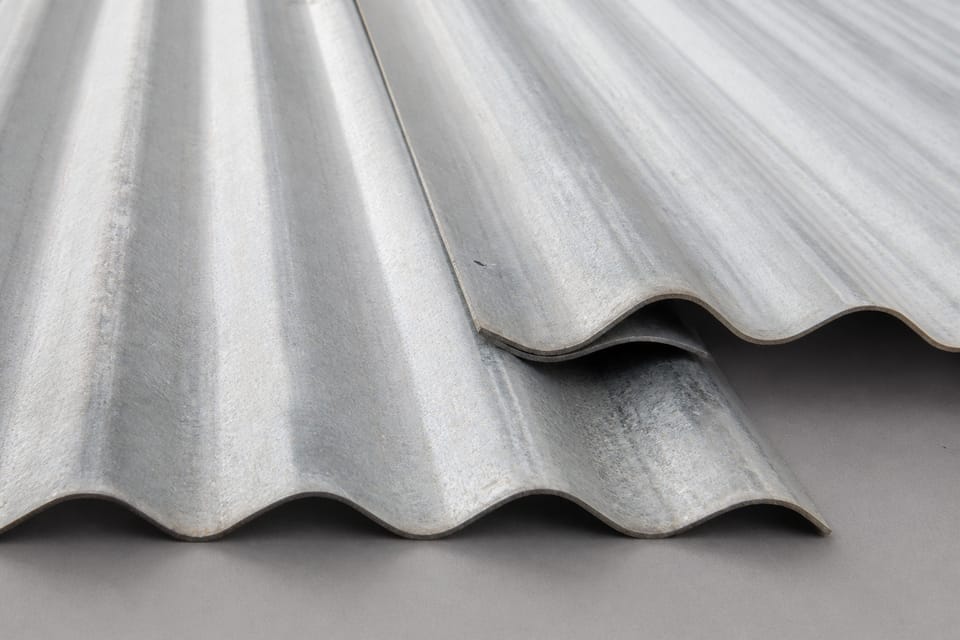
Cover width, or effective width, is the width one sheet adds to the roof once it overlaps its neighbour. IS 277 has no such term for galvanised sheet. IS 14871:2000, the standard for fibre cement sheets, defines it by method (Annex B, clause B-2.3): take two sheets and place one over the other so that the down lap of one is in lap with the up lap of the other, then measure at both edges. Its Figure 4 labels the effective width and the overall width, and clause 5.4.1 lists length, overall width, effective nominal thickness, and depth and pitch of corrugations as the dimensions of a standard sheet. In practice, the cover is the overall width less what the side lap uses up. We did not find a published cover width for GI sheet in the standard, so take it from the maker, in writing. IS 459, the standard for asbestos cement sheets, also labels an overall and an effective width; we do not use its figures here.
The terms side by side
| Term | Meaning | Where the standards print it |
|---|---|---|
| Overall width | The whole width of the sheet as made | IS 277 Table 8 (before and after corrugation); IS 14871 Figure 4 |
| Cover (effective) width | What one sheet covers once the side lap is taken off | IS 14871 Annex B, clause B-2.3, by method; not named in IS 277 |
| Corrugation pitch | The spacing of the waves | IS 277 Table 7 |
| Side lap | Overlap across the width between neighbouring sheets | IS 12093 clause 4.3 and Figure 2 |
| End lap | Overlap up the slope between one row and the next | IS 12093 clause 4.3 and Figure 1 |
What are end lap and side lap?
IS 12093:1987 clause 4.3 says sheets are laid “with minimum end lap of 150 mm and side lap of two corrugations”, and that the laps may be increased to avoid cutting sheets. Its Figure 1 shows the end lap measured along the slope, and Figure 2 shows the side lap across the sheet width. These figures are quoted here as definitions only; the standard’s edition is 1987 and it cites older editions of the sheet standard. How laps cause or cure leaks is not covered on this page.
What does “pitch” mean?
Two different things:
- Corrugation pitch: the spacing of the waves across the sheet. IS 277 Table 7 and the fibre cement figure use “pitch” this way.
- Roof pitch: the slope of the roof. None of IS 277, IS 12093 or IS 14871 defines it; IS 12093 lists only “provision for slope and other requirements for drainage” as information needed.
How do I count sheets? (practice)
This is practice, not from the standards; take every number from the maker’s data sheet.
- Along the roof, divide the roof width by one sheet’s cover width and round up.
- Up the roof, measure the slope length, not the length on the plan, and add the end lap and any overhang at the eave.
- Ask the supplier for the count in writing and how it was made.
- Ordering by the plan area or by the overall width will leave you short.
What do the standards not say?
- A standard cover width for GI sheet, or a standard sheet size: the maker’s sheet and the Table 8 widths govern.
- A thickness list for corrugated sheets: IS 277 lists thicknesses for plain sheets (clause 14.1) and none in its corrugated-sheet clause 15. It carries a note recommending a base steel thickness and coating class for roofing, which this page does not print; take the thickness from the maker’s data sheet.
- A roof slope for a sheet roof: not in IS 277 or IS 12093.
- Anything about price or brand.
What should I ask the supplier? (practice)
- What are the overall width and the cover width of this sheet, and its length and profile?
- What thickness and coating, from the maker’s data sheet in writing, in mm and whether it is base steel or coated?
- How many sheets, and how was the count made: slope length, cover width, laps, overhang?
- What end lap and side lap will be used?
- Which Indian Standard and edition is the sheet made to, and where is it marked?
What mistakes should I avoid? (practice)
- Counting sheets by overall width.
- Ordering by the plan area or plan length.
- Leaving out the end lap and the overhang.
- Mixing profiles or lots.
- Cutting sheets on site.
- Confusing a gauge number with a thickness: a higher gauge number usually means a thinner sheet, so ask for the thickness in mm.
- Mixing up roof pitch and corrugation pitch.
What can I check at delivery? (practice)
Sheets from one lot and one profile; the marking on the sheet or tag matching the order; straight edges; no damaged or cut ends.
Frequently asked questions
What is the standard size of a roof sheet?
IS 277:2018 prints a table of widths by number of corrugations and a list of lengths, with other sizes by agreement. Use the maker’s sheet.
What is the difference between overall width and cover width?
Overall width is the whole sheet as made; the cover width is what it covers once the side lap is taken off.
What is end lap?
The overlap of one sheet over the next up the slope. IS 12093 clause 4.3 gives a minimum of 150 mm.
Is pitch the roof slope?
Not in the sheet standards, which use pitch for the wave spacing.
Should I order by plan area?
No. Count by cover width across the roof and slope length up it.
Related guides
- Metal roof sheets: GI vs galvalume vs colour-coated, and TCT and BMT
- Roof tiles vs metal sheets vs RCC slab: choosing a roof for a house
This guide is general information. Read the disclaimer. Your engineer and roofer decide the sheet, laps and fixing for your house.
Sources
- IS 277:2018, Galvanized Steel Strips and Sheets (Plain and Corrugated), Specification (seventh revision): clauses 3, 14.1, 15.1.2, 15.1.3, 17.1 and Tables 7 and 8 (page images read). Amendment 1 (December 2023) changes only clause 8.1.1. BIS lists it as in force, valid to 2031-03-18. The 2003 edition is withdrawn.
- IS 12093:1987, Code of Practice for Laying and Fixing of Sloped Roof Covering Using Plain and Corrugated Galvanized Steel Sheets: clause 4.3 and Figures 1 and 2 (page images read). BIS lists it as in force, valid to 2028-03-31. It cites older editions of IS 277 and IS 730.
- IS 14871:2000, Products in Fibre Reinforced Cement, Long Corrugated or Asymmetrical Section Sheets and Fittings for Roofing and Cladding, Specification, with Amendment 2 (2021): clause 5.4.1, Annex B clause B-2.3 and Figure 4 (page images read). BIS lists it as in force, valid to 2030-08-01.
General information only. It is not a structural design or professional advice. Ask a licensed structural engineer or architect to check your plans and site.