
Short answer
What does IS 1128 say about kota stone, and what should I check when the slabs arrive? Kota is generally described as a limestone, but IS 1128 does not name Kota; it is the Indian standard for limestone slabs and tiles for flooring and face work. It sets requirements for dimensions, a standard size table, thickness tolerances and physical properties such as water absorption. As a practice check, look for cracks and flaws on delivery, and ask the supplier for a test report against the standard for the batch.
On this page (10)
Kota stone is a name that many owners hear for a floor. The name is generally used for a limestone, and the Indian standard for limestone slabs and tiles is IS 1128. This page explains what that standard covers, what it asks of the stone, and what an owner can check when the slabs arrive. It does not give a size, a thickness, a price or a supplier.
The page gives no size, tolerance, absorption figure or strength value. The standard sets them, and the supplier’s test report shows what the batch achieved.
What does IS 1128 cover?
IS 1128 lays down the requirements for dimensions and physical properties of limestone slabs and tiles for use in flooring and face work (clause 1.1). It gives the requirements the stone is checked against when a buyer or supplier specifies it.
The foreword says limestone is found more or less in every part of India, that size and quality of the finished product vary considerably, and that standardising sizes and properties would help raise quality and speed of construction (foreword 0.2). Clause 1.1 covers the dimensions and physical properties of the stone.
What does the standard ask of the stone?
| Point | What IS 1128 says (paraphrased) | Clause |
|---|---|---|
| Stone quality | Free of soft veins, cracks and flaws, with a uniform texture | 2.1 |
| Curvature | The curvature in any direction is limited | 2.2 |
| Dimensions | A table of standard sizes for slabs and tiles; other sizes only for special purposes, by mutual agreement | 3, Table 1, 3.1.2 |
| Thickness | Tolerances apply to the thickness of the slab or tile | 3.1.3 |
| Physical properties | Water absorption, transverse strength and durability are tested | Clause 4 |
Source: IS 1128:1974, as listed. The figures for the limits and the tolerances are in the standard and are not repeated here.
Inline image
Is Kota stone covered by IS 1128?
IS 1128 does not name Kota. The standard covers limestone slabs and tiles, and the stone sold as Kota is generally described as a limestone (general usage, not a statement of the standard). Whether a particular Kota stone meets the standard is a question for the supplier’s test report for the batch, not for the name. Ask for the report by the standard’s name and year.
What should I check on delivery?
These checks are practice, not steps in the standard:
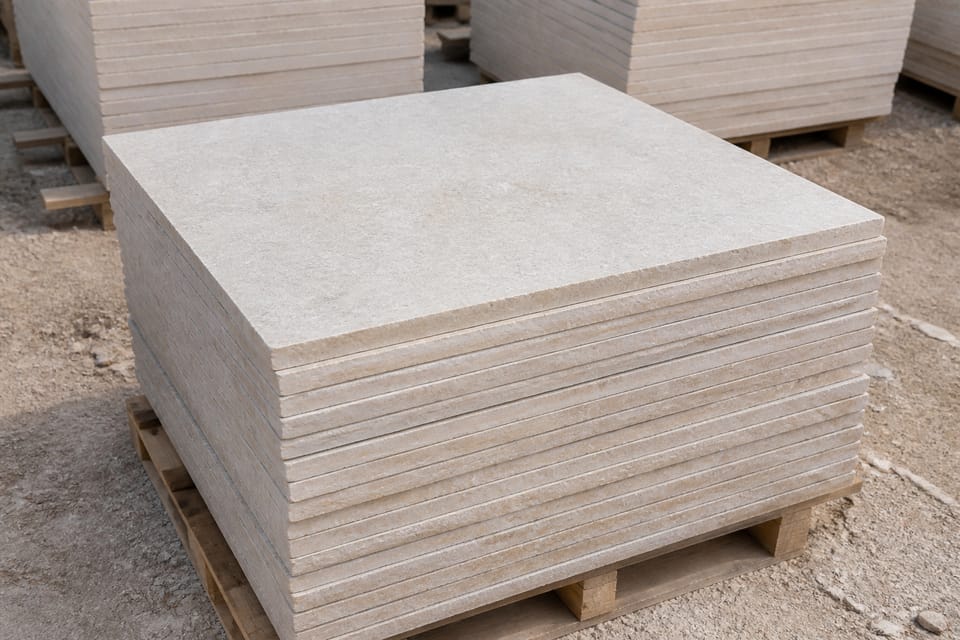
- Look for cracks and flaws. The standard asks for stone free of cracks and flaws (clause 2.1). Check each slab in good light before it is unloaded.
- Check the texture and colour. The standard asks for a uniform texture (clause 2.1). Look for the same texture across the batch.
- Check the sizes against the order. Compare the sizes and the thickness with the order and the standard’s table.
- Check the curvature. Lay two or three slabs on a flat surface and look for rocking on a flat surface or a gap under the edges (the limit is in clause 2.2, not repeated here) (practice).
- Ask for the batch report. Ask for the test report for the physical properties, named against IS 1128 with its year.
What should I ask the fitter?
These questions are practice, not steps in the standard:
- Who laid the floor, and who polished it? Ask for the names of the people responsible.
- What was used for cleaning? Ask for the cleaner by its name, and check it is one the supplier allows for limestone.
- Was the bedding and the joint filling done as the plan shows? Ask the fitter to show the detail.
What mistakes should I avoid?
These are practice points:
- Buying by the name alone. The name does not show the standard or the batch.
- Laying slabs with cracks. A crack in a slab is unlikely to close on its own.
- Using a strong acid to clean a limestone floor. Limestone reacts with acid.
- Accepting a report that is not for the batch. A report for another batch does not cover yours.
Frequently asked questions
Is kota stone the same as limestone?
Kota stone is generally described as a limestone. IS 1128 covers limestone slabs and tiles, and the standard does not use the word Kota.
Does IS 1128 say how thick a kota slab must be?
The standard sets a table of standard sizes, with a thickness column, and thickness tolerances (clause 3 and Table 1). The figures are in the standard, and this page does not repeat them.
Is the standard still current?
The copy read here is the 1974 first revision, reaffirmed in 2003 per its cover. Its current status is not confirmed on this page; check the BIS portal before you rely on it.
Related guides
- Anti-skid tiles: what IS 13712 says about slip resistance
- Standard tile sizes in India: modular and non-modular sizes in IS 15622
- Floor tiles popping up or cracking: causes, standards, fixes
This guide is general information. Read the disclaimer. Your supplier, your fitter and your engineer decide the stone and the work for your floor.
Sources
General information only. It is not a structural design or professional advice. Ask a licensed structural engineer or architect to check your plans and site.