
Short answer
Why do floor tiles pop up or crack, and how are they fixed? A lifted tile has usually lost its bond, and the reason varies: poor contact with the bed, the wrong adhesive for the tile, a dusty or weak base, water, or a base that moves. Tap to find hollow tiles, find the cause before re-fixing, and ask the engineer if cracks run across many tiles. No standard we read gives a tile-floor movement-joint rule.
On this page (9)
A floor tile that rises, rings hollow or cracks is a common complaint within a year or two of laying. This page explains the causes that the standards and the CPWD Specifications support, says plainly what they do not cover, and gives a way to diagnose the problem and decide what to do. It gives no repair product, no brand and no joint spacing. If cracks run across several tiles or come with wall cracks or leaks, ask your engineer before anyone refixes anything.
What does “popping” mean?
Three different things get called popping, and the cause differs. The descriptions below are practice, not standard wording.
- A hollow tile. It sounds drummy when tapped and looks fine. The bond under it has been lost. It may stay put or may loosen later.
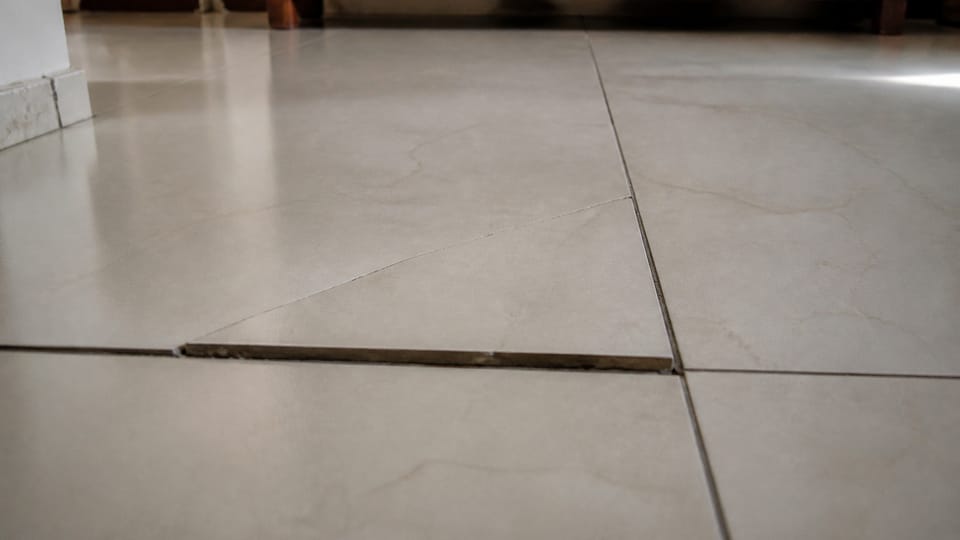
- A lifted tile or a ridge. A tile or a row rises above its neighbours, and the edges chip against each other.
- A cracked tile. The tile itself has cracked, either alone or in a line that continues across several tiles.
Whether it is one tile or many, near a wall or mid-room, and when it began, tells you more than the tile does. Those are practice points, not standard wording.
What causes it?
The table separates what a standard says from CPWD practice and from practice in general.
| Cause | What supports it | Type |
|---|---|---|
| Poor contact between tile and bed | IS 15477 foreword says tiles should achieve 100 percent contact with the substrate, with minimums of 95 percent for demanding conditions and 85 percent for normal ones to be used for designing the adhesive (not a site acceptance figure and not a hollowness allowance); CPWD 11.15.5 says the finished floor “shall not sound hollow when tapped with a wooden mallet” | Standard foreword (not a requirement clause) and CPWD |
| Adhesive that does not suit the tile or place | IS 15477 clause 4: Type 1 is for small, non-vitrified tiles in dry interiors; Type 2 for vitrified, dense or large tiles and wet areas, and for interior and exterior floors. The standard says which type is meant for which use. That a mismatch makes tiles lift is an inference | Standard (types) and practice (link to popping) |
| Adhesive used after its open time | IS 15477 defines open time as the longest interval after application at which a tile can be embedded, and the maker states it | Standard (concept); the link to popping is inference |
| Back of the tile | CPWD 11.15.1: the underside shall not have glaze on more than 5 percent of the area “in order that the tile may adhere properly to the base” | CPWD |
| Dusty, weak or uncleaned base | CPWD 11.15.4.1: base cleaned, wetted and mopped before the bedding mortar | CPWD |
| Bed too thick, too thin or uneven | IS 15477 defines fine thin, thin and medium thick beds (2, 6 and 6 to 12 mm average) as terms for the adhesive types, not as a rule for your floor, and notes that where the surface varies by more than an average of 12 mm in 3 m it should be prepared first; CPWD 11.15.4.1 gives a mortar bed with an average and a minimum thickness | Standard (terms) and CPWD |
| Mortar bed disturbed or not cured | CPWD 11.15.4.2 lets the bed harden to a fairly rigid cushion, and 11.15.5 keeps the finished floor wet for a period; that a disturbed or uncured bed causes lifting is practice | CPWD (steps) and practice (cause) |
| Tile not soaked or slurry dried (cement bed) | CPWD 11.15.4.3: tiles soaked, washed and fixed in the grout, tapped with a mallet until bedded; that skipping a step causes lifting is practice | CPWD (steps) and practice (cause) |
| Tile quality | IS 15622 lists surface flatness (curvature and warpage), moisture expansion, thermal expansion, thermal shock and crazing resistance among the properties; CPWD 11.15.1 asks for tiles flat and free from blisters, crazing and chips | Standard (names) and CPWD |
| Water under the tile | Leaks, damp bases and missing waterproofing in wet areas; see bathroom waterproofing: steps, wall height and the ponding test | Practice |
| A base that cracks or moves | A crack in the slab or screed shows up as a line of cracked tiles above it | Practice |
| Heat and moisture movement | Tiles, bed and base expand and shrink by different amounts | Practice |
IS 15477 gives the type for each use but no on-site method for preparing a base, spreading adhesive or checking coverage, and no joint layout; it asks that the adhesive be mixed and spread as the maker instructs, and used only on the backgrounds the maker recommends (clause 7). The marking clause asks for the type, the batch, the month and year of manufacture, the open and adjustment times and the mixing instructions on the pack (8.2.1), which is the owner’s check.
What do the standards not say?
This matters, because many websites state rules the standards do not.
- No movement-joint rule. We read IS 15477, IS 15622 and CPWD 11.15 to 11.17 and found no rule on movement or expansion joints in tile floors, no joint spacing and no joint width for that purpose. The CPWD joint widths we read are limits on how wide the joints between tiles may be, not movement joints. Whether your floor needs movement joints, and where, is the engineer’s decision. For joints in the structure, see expansion joints in a house: where walls and slabs need a gap.
- No hollowness allowance. CPWD says a finished floor “shall not sound hollow”. No standard we read gives a percentage of hollow tiles that is acceptable.
- No laying code for ceramic or vitrified floor tiles. A search of the BIS standards database found none. IS 1443:2018 is a laying code for cement concrete tiles, not ceramic ones. Ceramic tiles have product standards (IS 15622, and IS 15477 for adhesives) and CPWD practice.
- No repair method. The standards read give no repair procedure for ceramic tiles.
How do I diagnose it?
This is practice. Make a note of these before anyone touches the floor.
- One tile or many? A single raised tile, or a ridge?
- Where: along walls, at doorways, mid-room, in sunlit areas, near bathrooms or kitchens, over a beam line?
- When it started: first weeks, first summer, first monsoon, or years later?
- Does it sound hollow? Tap with a mallet or a knuckle and outline the hollow area with a pencil, with the date. Repeat after the summer and the monsoon.
- Is the crack in the tile only, or does a line run across several tiles, which points to the base?
- Is there a crack in the wall or the slab, damp, or a stain on the ceiling below?
- Was the floor new, and was the slab and base cured and dry before tiling?
- Did anything change: a leak, heavy furniture moved, a new wall nearby?
What should I do?
These are practice, not code rules.
- Photograph and date the tiles and cracks, with a coin or scale. Mark a crack across with a pencil line, as for a wall crack: see hairline cracks in plaster: causes and what to do.
- Tell the contractor in writing. Check the contract for the defect period, since the terms belong to the contract: see snag list for a new house: what to check before final payment.
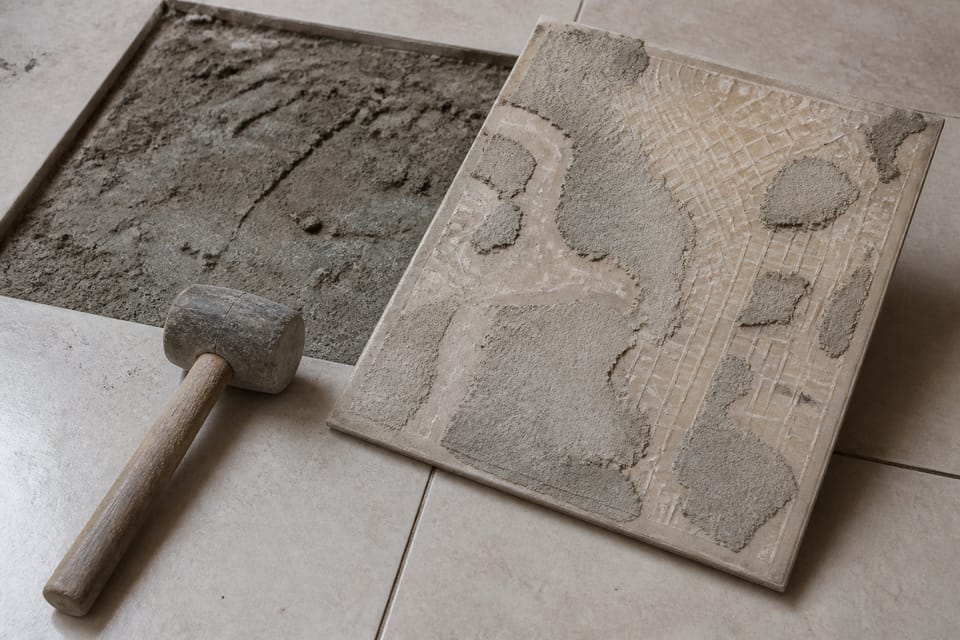
- Ask the contractor or engineer to lift one hollow tile and look at the back and the bed: is there full contact, dust, a thin or thick bed, which kind of bed (mortar or adhesive), and what is the base like? The lifted tile often shows the cause. Keep it for the engineer to see.
- Fix the cause before the tile: a leak, a loose or cracked base, or the wrong adhesive for the tile. A tile re-fixed over the same fault will lift again.
- Re-fix or replace the tile, and check the pack of adhesive for the type and the open time. Keep spare tiles from the same lot.
- Ask the engineer first if a crack runs across tiles, widens, or comes with wall cracks or leakage.
Do not press a lifted tile back, fill the gap with an unknown compound, or grout over a hollow tile. A grout joint does not make a hollow tile bond. For the tap test on tiles and the screed requirement, see epoxy flooring vs tiles for a house: where each works.
What mistakes should I avoid?
These are practice, not code rules.
- Treating a spreading problem as one tile and replacing only that one.
- Ignoring a hollow tile because it looks fine now.
- Using any adhesive or any sand-cement bed for any tile, without checking the type against the tile and place.
- Laying over a dusty, cracked or hollow base.
- Leaving the cause (a leak, a moving base) unfixed.
- Accepting a verbal promise instead of a written defect period.
- Quoting a joint spacing, a bed thickness or an adhesive brand from a website.
Frequently asked questions
Why are my floor tiles popping up in summer?
Heat is one possible factor, but a lifted tile has lost its bond and the reason varies. The standards we read give no rule on expansion joints in tile floors, so ask the engineer.
Does a hollow sound mean the tile will pop?
It means the bond is lost under that tile. In practice it may stay stable or may loosen. CPWD says a finished floor shall not sound hollow.
Can a lifted tile be pressed down again?
Not safely. Lift it, look at the bed and the base, fix the cause, and re-fix it with the right adhesive or bed.
Is it the tile or the adhesive?
Either, or the base. IS 15477 says which adhesive type is meant for which tile and place, and IS 15622 lists the tile properties; a lifted tile can show which failed.
Do tile floors need expansion joints?
We found no rule on this in the standards or CPWD text read. Ask your engineer or installer to show where any movement joint is planned.
Related guides
- Epoxy flooring vs tiles for a house: where each works
- Expansion joints in a house: where walls and slabs need a gap
- Snag list for a new house: what to check before final payment
- How to regrout floor and bathroom tiles: raking out and refilling
This guide is general information. Read the disclaimer. Your engineer or contractor decides how your floor is repaired.
Sources
- IS 15477:2019, Adhesives for Use with Ceramic, Mosaic and Stone Tiles: foreword, clauses 3.1 to 3.5, 4.1 to 4.5, 5.3, 7 and 8.2 (page images read). BIS lists it as in force, valid to 2030-12-29.
- IS 15622:2017, Pressed Ceramic Tiles: scope, foreword and list of properties in Tables 5 to 9 (text layer read, not page images; no numbers used). BIS lists it as in force, valid to 2030-12-29.
- CPWD Specifications 2019 Vol 1, Sub Head 11.0 Flooring, clauses 11.15.1 and 11.15.4 to 11.15.5 and 11.16 to 11.17, printed pp 549 to 552 (page images read). A departmental specification for government works, not an Indian Standard.
Change log
- : Added Related guides link to newly published article(s): how-to-regrout-floor-and-bathroom-tiles-raking-out-old-grout-and-refilling. No other text changed. Approved by the reviewing engineer.
General information only. It is not a structural design or professional advice. Ask a licensed structural engineer or architect to check your plans and site.