
Short answer
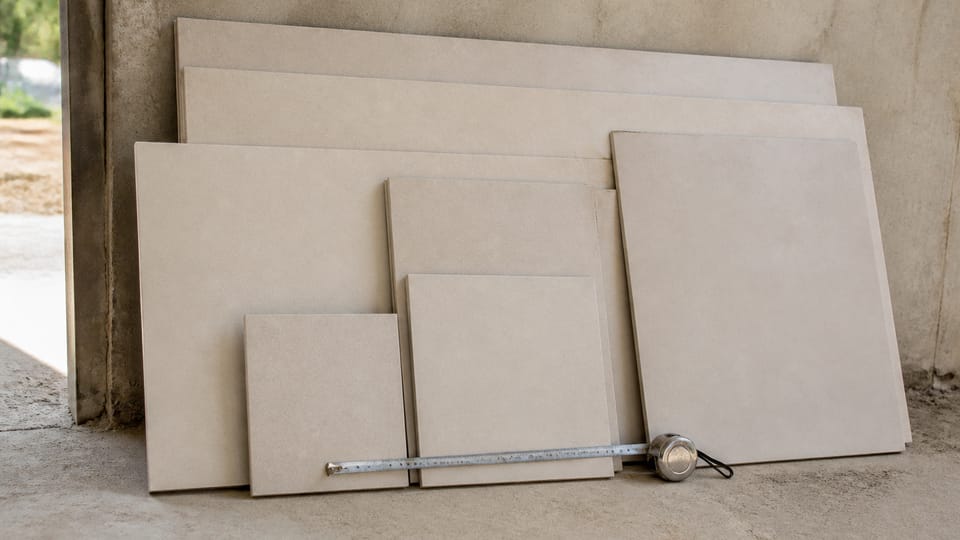
What are the standard tile sizes in India, and what is the standard thickness? IS 15622:2017 lists the most common sizes in four tables, split into modular and non-modular sizes for two sets of tile groups, and allows other sizes with a work size declared by the maker. It fixes no thickness: every table says the manufacturer specifies it. So no mm thickness is standard. Sizes are in centimetres, and the box size is a nominal name.
On this page (10)
- Which tiles does IS 15622 cover?
- What do modular, non-modular, work size and rectified mean?
- What are the sizes in the tables?
- What is the standard thickness?
- How is a tile described and marked?
- What should I check before ordering?
- What mistakes should I avoid?
- Frequently asked questions
- Related guides
- Sources
A tile box shows a size such as “600 x 600”, and shops talk about thickness as if it were fixed. The Indian Standard for pressed ceramic tiles is more careful than that. It lists the “most common” sizes in tables, separates the size that describes the tile from the size it is made to, and leaves the thickness to the maker. This page reads those tables. It gives no prices, brands, tile counts or wastage. For where tile types suit and how a tiled floor fails, see epoxy flooring vs tiles for a house.
Which tiles does IS 15622 cover?
IS 15622:2017 is titled “Pressed Ceramic Tiles”. Its scope covers pressed glazed or unglazed tiles “of first quality” for use as both floor and wall coverings, and clause 1.3 says it does not cover tiles made by other processes, such as extrusion. It sorts tiles into groups by water absorption: B Ia, B Ib, B IIa, B IIb and B III. IS 13712:2019 names them: B Ia are fully vitrified tiles, B Ib are porcelain tiles, B IIa and B IIb are floor tiles, and B III are wall tiles. So vitrified and porcelain tiles are covered. The standard has no separate table for anti-skid tiles.
What do modular, non-modular, work size and rectified mean?
- Nominal size: “The size used to describe the product” (IS 13712 clause 3.11). It is the name on the box.
- Work size: “The size of a tile specified for manufacturing to which the actual size has to conform within specified permissible deviations” (clause 3.12). It is what the tile is made to.
- Modular size: sizes based on M, which is 100 mm, and its multiples and sub-divisions (IS 13712 clause 3.17.1, which refers to IS 10316 for M). A modular size is a coordinating size, which is the work size plus the joint (IS 15622 Fig. 1).
- Non-modular size: “The sizes excluding those that are based on M” (clause 3.17.2).
- Rectified and unrectified: IS 15622 clause 4.3 says rectified tiles are tiles “whose edges have been cut or ground to a precise dimension after the tiles have been fired”, and that unrectified tiles “undergo no further dimensional processing”. The tolerances for the two are different.
In plain words, a modular “60 x 60 cm” tile is a 60 x 60 cm grid cell that includes the joint, so the tile itself is a little smaller. A non-modular size describes the tile roughly. Our own arithmetic from the standard: a joint of a few millimetres is why a “600” tile can measure less than 600 mm.
What are the sizes in the tables?
IS 15622 gives four tables of the “most common” sizes, in centimetres. Tables 1 and 2 are for group B III (wall tiles); Tables 3 and 4 are for groups B IIb, B IIa, B Ib and B Ia (floor, fully vitrified and porcelain tiles). Modular sizes are listed with an M in front. Notes 2 and 3 to clause 5.1 call them “the most common” sizes, and clause 5.2 allows others.
| Group | Modular sizes (cm) | Non-modular nominal sizes (cm) |
|---|---|---|
| B III (wall tiles): Tables 1 and 2 | M 10 x 10, M 15 x 15, M 20 x 10, M 20 x 15, M 20 x 20, M 20 x 30, M 20 x 40, M 25 x 25, M 30 x 15, M 30 x 30, M 30 x 45, M 30 x 60, M 30 x 75, M 30 x 90, M 40 x 80, M 45 x 90, M 60 x 90, M 60 x 120 | 10.8 x 10.8, 15 x 7.5, 15.2 x 7.6, 15.2 x 15.2, 21.6 x 10.8, 25 x 33, 31.5 x 42, 32 x 32, 25 x 38, 32 x 40, 32 x 48, 32 x 60, 33 x 33, 33 x 48, 33 x 60, 33 x 90 |
| B IIb, B IIa, B Ib, B Ia (floor, fully vitrified and porcelain tiles): Tables 3 and 4 | M 10 x 10, M 15 x 15, M 15 x 10, M 20 x 10, M 20 x 15, M 20 x 20, M 25 x 25, M 30 x 30, M 30 x 45, M 40 x 30, M 40 x 40, M 45 x 45, M 40 x 80, M 45 x 90, M 50 x 50, M 60 x 60, M 60 x 90, M 80 x 80, M 90 x 90, M 60 x 120, M 100 x 100, M 90 x 120, M 120 x 120 | 15 x 7.5, 15.2 x 7.6, 15.2 x 15.2, 30.6 x 30.6, 31.5 x 31.5, 32 x 32, 33 x 48, 40.6 x 40.6, 60.5 x 60.5, 81.5 x 81.5 |
What the work size is, in each table:
- Modular sizes: the maker chooses the work size to allow a nominal joint width between 1.5 mm and 5 mm for group B III (Table 1), and between 2 mm and 5 mm for the floor groups (Table 3).
- Non-modular sizes: the maker chooses the work size so that it differs from the nominal size by not more than 2 percent or 5 mm, whichever is lower (Tables 2 and 4).
- Other sizes (clause 5.2): tiles may be made in dimensions other than those in the tables. The work size is then as declared by the maker, and the requirements for work size and thickness in the respective tables still apply.
Our reading, not the standard’s: a box named “600 x 600” usually corresponds to the modular size M 60 x 60 in Table 3, but it could also be a non-modular or other size (Table 4 has 60.5 x 60.5), and a “2 x 2 ft” tile is a trade name: 2 ft is 609.6 mm, which is not in the tables as such. Check the work size on the box or data sheet.
What is the standard thickness?
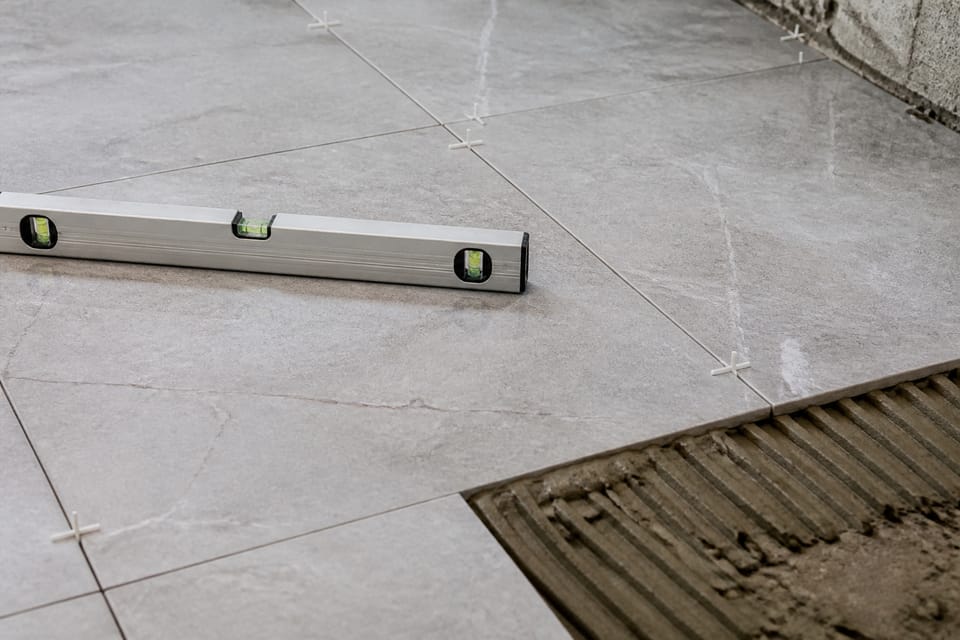
There is none. In each of Tables 1 to 4 the thickness cell reads: “The thickness shall be specified by the manufacturer. It includes the profile on the visible face and on the rear side.” The standard sets a tolerance on how far the thickness may deviate from the maker’s work-size thickness, and its strength limits change at a thickness of 7.5 mm, but it does not say any tile has to be a particular number of millimetres thick. A figure such as “8 mm” or “10 mm” as “the standard” has no basis in IS 15622. Thickness differs by product, and the difference shows as a step at a doorway where a thicker tile meets a thinner one (practice).
How is a tile described and marked?
Clause 8 gives a designation that states the group, whether glazed, the surface and the edge type (rectified R or unrectified UR), whether the size is modular (M) or non-modular (NM), the nominal size and then the work size. The example in the standard is “B III, GL UP UR M 15 cm x 15 cm (W 148 mm x 148 mm)”. Marking also carries the maker’s name, a batch number or date and the designation. IS 15622 gives no numeric limit for floor friction: for floor tiles the coefficient of friction is to be declared by the maker “where required”.
What should I check before ordering?
This is practice, not a standard.
- Ask for the work size and the thickness in mm, not only the nominal or feet-and-inches name.
- Ask whether the tile is rectified or unrectified, and for the joint width the maker recommends.
- Order enough of one batch, and keep to one batch for a floor: sizes and shades can differ between batches. We give no quantity.
- Decide the finished floor levels room by room before the base is laid, so that different tile thicknesses do not leave steps. See the snag list.
- For wet areas, the tile is the last layer. See bathroom waterproofing.
What mistakes should I avoid?
These are practice, not code rules.
- Believing there is one standard thickness for all tiles.
- Ordering by “2 x 2” or “600 x 600” and not checking the work size.
- Leaving out the joint when planning the layout.
- Mixing batches or sizes on one floor.
- Treating “anti-skid” as a size or as a standard: IS 15622 has no anti-skid size, and gives no friction limit.
- Using wall tile sizes or thickness for a floor because the nominal size matches.
Frequently asked questions
What is the standard size of a floor tile in India?
There is no single size. IS 15622 lists many common sizes for floor groups in Tables 3 and 4, including M 30 x 30, M 40 x 40, M 60 x 60, M 80 x 80 and M 60 x 120 cm, and allows others.
Is 600 x 600 mm a standard tile size?
It usually corresponds to the modular size M 60 x 60 cm in Table 3 (our reading of the trade name). The actual tile is smaller by the joint allowance, and the box should state the work size.
What is the standard thickness of tiles?
IS 15622 fixes none. The manufacturer specifies it. The standard gives only a tolerance on thickness.
What is the difference between rectified and non-rectified tiles?
Rectified tiles have their edges cut or ground to a precise size after firing. Unrectified tiles are not processed further. The standard gives different tolerances for each, and does not call one a higher grade.
Are all floor tiles the same thickness?
No. The standard leaves thickness to the maker, so different products differ.
Related guides
- Epoxy flooring vs tiles for a house
- Bathroom waterproofing: steps, wall height and the ponding test
- Snag list for a new house: what to check before final payment
- IS 13630 explained: the tile test methods and what a report shows
This guide is general information. Read the disclaimer. Your architect or engineer decides the tiles for your house.
Sources
- IS 15622:2017, Pressed Ceramic Tiles, Specification (first revision): clauses 1.1 to 1.3, 4.1, 4.3, 5.1 to 5.3 and Tables 1 to 4 (page images read). BIS lists it as in force with an Amendment 2 that we could not read; the copy read is the base text with Amendment 1. The 2006 edition is withdrawn.
- IS 13712:2019, Ceramic Tiles, Definitions, Classification, Characteristics and Marking (second revision): clauses 3.11, 3.12, 3.15, 3.17 and 4.2 (page images read).
- BIS titles and status only, not read: IS 13630 (Parts 1 to 16):2019, the test-method series for ceramic tiles, whose Part 1 covers dimensions.
Change log
- : Added Related guides link to newly published article(s): is-13630-explained-the-tile-test-methods-and-what-a-report-shows. No other text changed. Approved by the reviewing engineer (owner report, 2026-10-31).
General information only. It is not a structural design or professional advice. Ask a licensed structural engineer or architect to check your plans and site.