
Short answer
What does IS 1130 say about marble used for flooring? IS 1130:1969 is a product standard for marble blocks, slabs and tiles. It has two classes, white and coloured, three finishes, preferred tile sizes, and three physical limits: water absorption at most 0.4 percent, hardness at least 3 on the Mohs scale and specific gravity at least 2.5. It says nothing about laying or polishing, which are practice.
On this page (10)
- What does IS 1130 cover?
- What are the classes, finishes and sizes?
- What are the three property limits?
- What should I check before buying and at delivery?
- What should I check at laying and afterwards?
- Is marble suitable for bathrooms and kitchens?
- What mistakes should I avoid?
- Frequently asked questions
- Related guides
- Sources
Marble is the stone most Indian owners picture when they hear “natural stone floor”. Many websites rank marbles by name and price. The Indian Standard is quieter: it describes what marble is, what sizes and finishes it comes in, and three simple limits on the stone. This page reads IS 1130:1969, says plainly what it does not cover, and lists checks for delivery and laying. It prints no price and ranks no marble. For the other floor types, ask your architect for the specification; marble is one choice among several.
What does IS 1130 cover?
IS 1130:1969, “Marble (blocks, slabs and tiles)”, covers “sizes, physical properties, quality and workmanship” of marble blocks, slabs and tiles (clause 1.1). It is a product specification. It is an old standard (1969, reaffirmed 2003) but BIS lists it as in force, valid to 2027-12-31, and NBCS 2026 lists it among the stone flooring standards. It does not cover laying, bedding, curing, polishing, stains, slip resistance or wet areas. Everything on those below is practice, and we say so each time.
The foreword calls marble a natural product, so it is impossible to guarantee uniformity of colour, veining or other characteristics, and a sample indicates only an average. It adds that the properties vary considerably from place to place and within one place, which makes proper selection when buying necessary. Marble is used for flooring, stairs, facing and table tops; tiles are used in floors, dados and skirtings.
What are the classes, finishes and sizes?
| Item | What IS 1130 says |
|---|---|
| Classes (3.1, Appendix A) | Two only: white and coloured. Appendix A lists quarry varieties under each as a trade guide and ranks none |
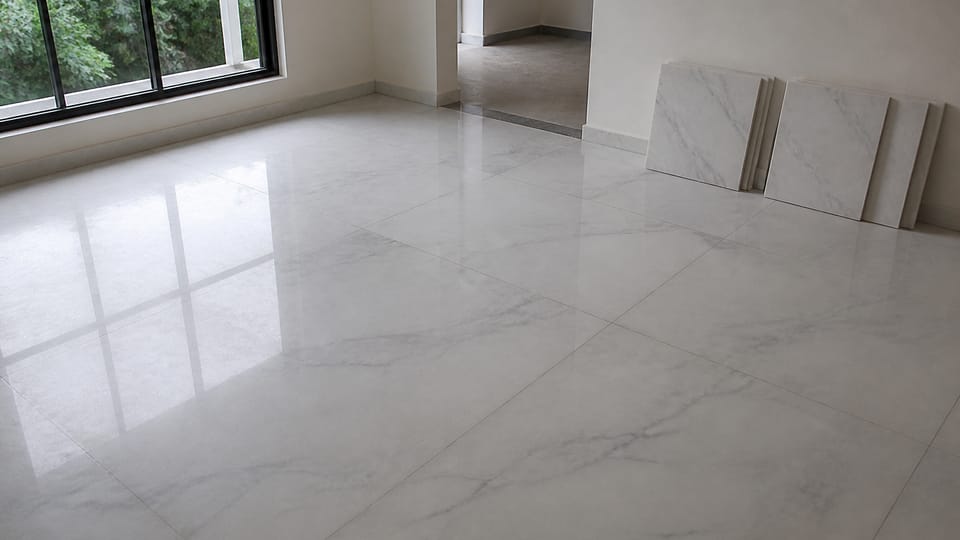
| Finishes (2.1 to 2.3) | Sand or abrasive finish (flat, non-reflective); hone finish (velvety smooth, little or no gloss); polished finish (highly polished and glossy) |
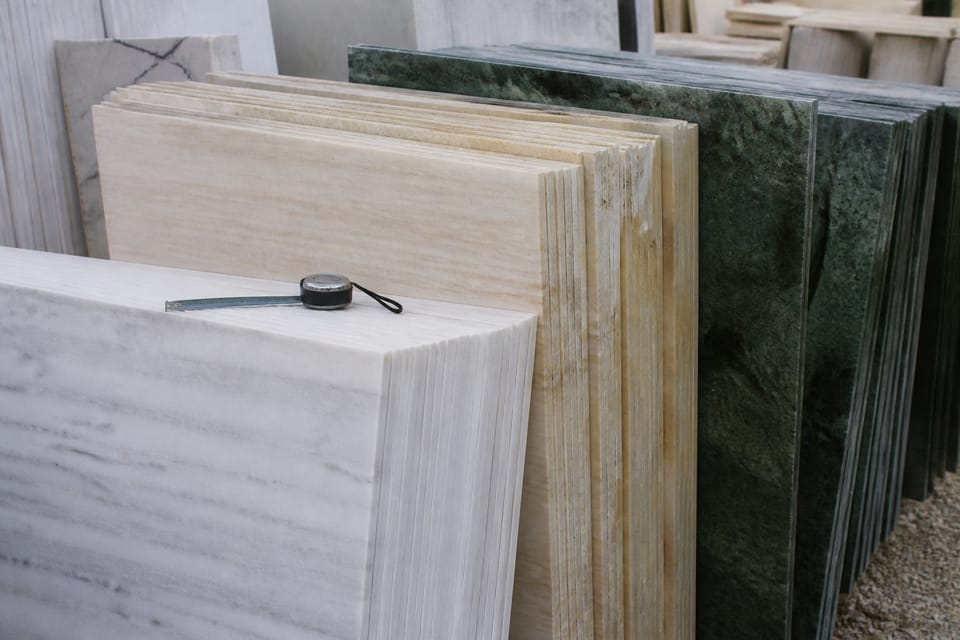
| Preferred tile sizes (5.3) | 60 x 60, 50 x 50, 40 x 40, 30 x 30, 20 x 20 and 10 x 10 cm, thickness 18 to 24 mm in the same piece; other sizes as agreed with the supplier (5.3.1) |
| Tolerances (6.1) | Given in percent for blocks, slabs and tiles; we print none, because the sign printed against most lines in our copy of the page (a plus, or a plus-minus) is not clear |
| General quality (4.1) | “as far as possible, shall be free from foreign inclusions and prominent cracks” |
| Edges (8.1) | Edges of slabs and tiles shall be true |
| Marking (9) | The maker’s mark, and the Standard Mark, are optional |
The standard gives no tolerance or definition for veins or pits, and no rule on shade. It also gives size ranges for blocks (5.1) and slabs (5.2), not given here because floors are usually tiles or cut slabs. Note that the 18 to 24 mm thickness range is for the preferred tile sizes; some websites quote it for all marble.
What are the three property limits?
Table 1 of IS 1130 (clause 7.1) sets three limits:
| Property | Limit | Test method named |
|---|---|---|
| Moisture absorption after 24 hours in cold water | Not more than 0.4 percent by weight | IS 1124 |
| Hardness | Not less than 3 on the Mohs scale | None named |
| Specific gravity | Not less than 2.5 | IS 1122 |
The table cites the 1957 editions of those test methods; BIS now lists IS 1124:1974 and IS 1122:2023, and we did not check whether the limits were retested. The standard does not require a compressive strength, an abrasion test or a slip test for marble. It also has a sampling scheme for lots (clause 10) and says the buyer may inspect before despatch and that the supplier shall give a certificate of compliance (clause 11). That is the tool for a bulk buyer; for a house, ask the supplier for the certificate and the standard the slabs are sold to.
What should I check before buying and at delivery?
These are practice, unless a clause is named.
- Ask which standard the stone is sold to. Marble is IS 1130; granite, limestone and sandstone have other standards, and Kota stone is not named in the standards we read. NBCS 2026 lists IS 1128, IS 1130, IS 3316, IS 3622 and IS 14223 (Part 1) for stone flooring.
- Look at the exact lot, not only a small sample, since the standard says a sample shows only an average (foreword).
- Keep one room to one lot, and set the approved sample aside to compare.
- Thickness: measure several pieces, since thickness decides the bed level.
- Check each piece for cracks, pits and chips, holding it at an angle to the light (IS 1130 4.1 asks for no prominent cracks).
- Edges true and square: check a few diagonals (8.1).
- Finish: the polish is even, with no saw or knife marks, and matches the finish you ordered.
- Colour and veining are acceptable to you before laying, not after.
- Set rejected pieces aside before laying starts.
What should I check at laying and afterwards?
IS 1130 does not cover laying. The following is practice. The CPWD Specifications 2019 have a marble flooring item for government works; we do not print its figures, and your engineer decides the method.
- The base is sound and cured. Wet areas are waterproofed and ponding-tested before any stone goes down: see bathroom waterproofing: steps, wall height and the ponding test.
- The slope to the drain in wet areas is set before the stone.
- Pieces are bedded fully, with no hollow patches, and joints kept narrow and even.
- Tap every piece with a mallet or knuckle: a hollow sound means it is not bonded, so relay it before the floor is polished. See epoxy flooring vs tiles for a house: where each works for the same tapping check on tiles.
- Agree in writing who grinds and polishes, and when, and check the polish when the trade has left.
- Keep steel wool, rusting nails and iron wedges away from white marble, and ask the supplier which cleaner to use. In practice marble can be attacked by acids, so avoid acid-based bathroom cleaners until the supplier says otherwise.
- Do not walk on or drag furniture over a fresh floor.
Is marble suitable for bathrooms and kitchens?
No standard read for this page says either yes or no. In practice a polished surface is smooth when wet, so wet places, steps and balconies need a finish chosen for grip and a waterproofed base. IS 1130 defines the three finishes (clause 2) and lists them for supply (8.3), but does not say which suits wet areas. Ask the supplier about a hone or abrasive finish and test a wet sample underfoot.
What mistakes should I avoid?
These are practice, not code rules.
- Choosing by a “best marble” list instead of by sample, lot and supplier standard.
- Assuming “marble” on the bill means IS 1130, or even marble.
- Mixing lots or shades in one room.
- Skipping the tap test, then finding hollow patches after polishing.
- Laying before the wet-area waterproofing is tested.
- Using polished marble in wet places with no grip option.
- Cleaning with acid cleaners, or using steel wool.
- Treating a 1969 standard as a quality guarantee. It sets three limits and a few workmanship rules, and nothing about how the floor performs.
Frequently asked questions
Which marble is best for flooring?
The standard does not rank marbles. It lists white and coloured classes, with quarry names for each. The right choice is the one you have seen in the exact lot and that suits the room and its use.
Is marble the same as granite?
No. Marble is a metamorphic rock covered by IS 1130; granite has its own standards, for example IS 14223 (Part 1) for polished granite and similar stones.
Does marble stain?
IS 1130 sets a water absorption limit but says nothing on stains. In practice marble can mark and etch, so ask the supplier about care.
How thick should marble tiles be?
For the preferred tile sizes IS 1130 gives 18 to 24 mm; other sizes and slabs by agreement. Your engineer decides what suits your floor.
Is IS 1130 marking compulsory?
No: the standard says marking with the maker’s mark and the Standard Mark is optional.
Related guides
- Bathroom waterproofing: steps, wall height and the ponding test
- Epoxy flooring vs tiles for a house: where each works
This guide is general information. Read the disclaimer. Your architect or engineer decides the floor finish and the laying method for your house.
Sources
- IS 1130:1969, Marble (blocks, slabs and tiles), fifth reprint 1998, reaffirmed 2003: foreword, clauses 1.1, 2, 3.1, 4.1, 5.3, 7.1 and Table 1, 8, 9, 10, 11 and Appendix A (page images read for the numbers). BIS lists it as in force, valid to 2027-12-31.
- SP 7:2026, National Building Construction Standards (NBCS) 2026, Part 5 Building Materials, list of stone flooring standards (text read). From an unofficial archive.org copy.
General information only. It is not a structural design or professional advice. Ask a licensed structural engineer or architect to check your plans and site.