
Short answer
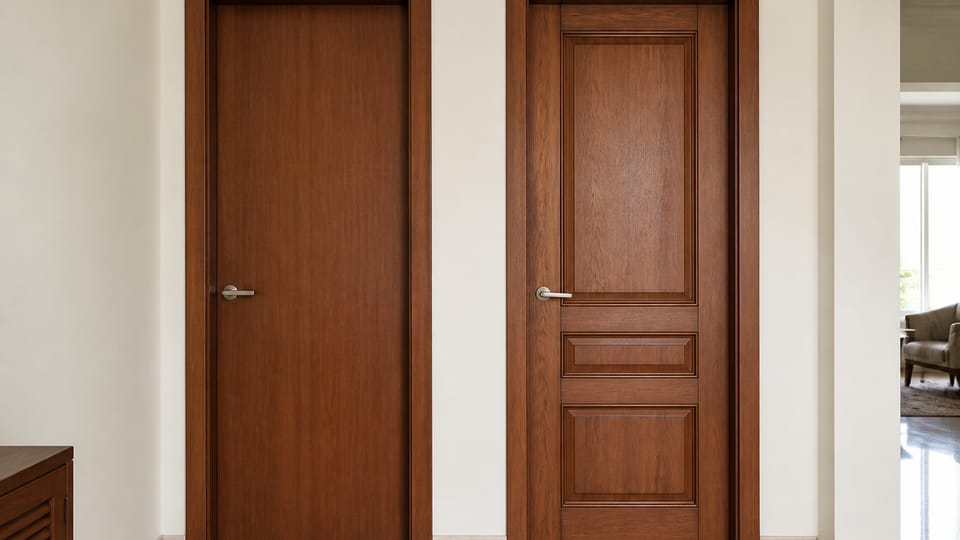
What is the difference between a flush door and a panel door? A flush door shutter is a frame with a core, faced on both sides with plywood or veneer: solid cores are in IS 2202, cellular and hollow cores in IS 2191. A panel door is stiles and rails with panels set in grooves, covered by IS 1003. The BWP or MR grade, marked on a flush shutter, says where it may be used.
On this page (10)
A carpenter’s quotation says “flush door” or “panel door”, and the choice is usually made on looks. The Indian standards treat them as two different built-up products, with different standards, different materials and different marking. This page explains how each is made, what the grade and mark on a flush shutter tell you and what they do not, and what to check on delivery. It gives no size, thickness, price or brand, and no verdict on which door suits a bathroom. For why wooden doors swell and stick in the rains, see doors jamming in the monsoon: why it happens and what to check.
What is a flush door shutter?
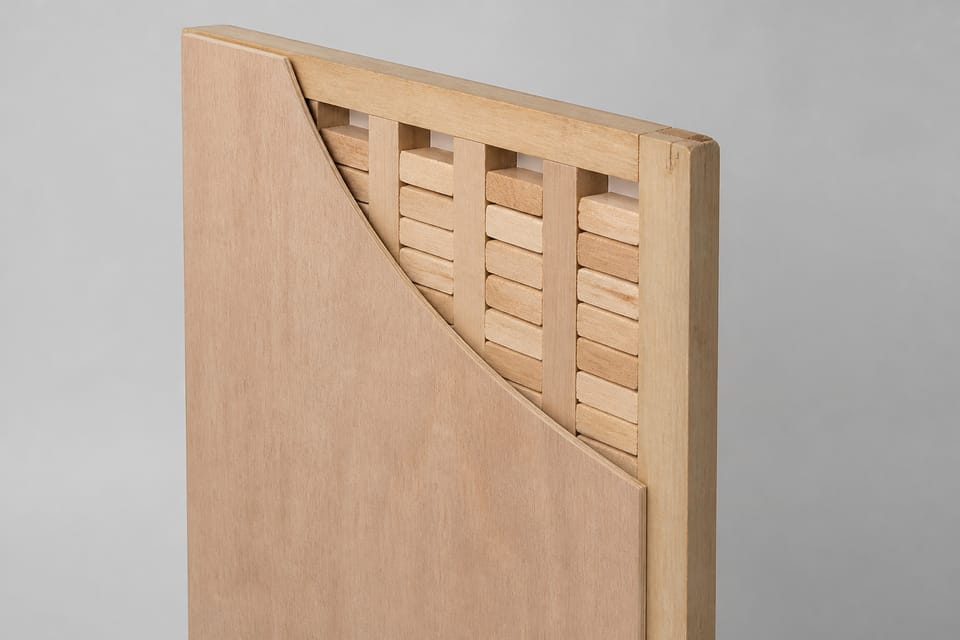
A flush shutter has a flat face. It is a timber frame of stiles and rails holding a core, with face panels glued on both sides. Which standard applies depends on the core:
| Standard | Core | Face |
|---|---|---|
| IS 2202 (Part 1):2023 | Solid core: blockboard, particle board or medium density fibre board | Plywood, or cross-band and face veneers |
| IS 2202 (Part 2):2022 | Solid core | Particle board, fibre board or hardboard faces |
| IS 2191 (Part 1):2022 | Cellular, hollow or tubular core | Plywood, or cross-band and face veneers |
IS 2202 says “solid core” for the core type. It does not mean a slab of solid timber. In IS 2202 the blockboard core is wooden strips glued between outer veneers, with the grain of the core blocks at right angles to the adjacent veneer. IS 2191 describes the cellular core as battens, strips or boards fixed to leave limited voids, the hollow core as a frame with intermediate rails and battens, and the tubular core as tubes positioned horizontally, in one of three arrangements.
Neither IS 2202 nor IS 1003 defines “flush door” or “panel door” in words; both defer to the terminology standards IS 10428 and IS 707. The descriptions here come from the construction clauses.
What is a panelled door shutter?
IS 1003 (Part 1):2003, “Timber Panelled and Glazed Shutters”, describes a timber framework of stiles and rails with panel inserts of timber, plywood, blockboard, particle board, glass or other sheet. Clause 6.1 says the panels are fixed by grooves in the stiles and rails or by beading or both, and the stiles, top rails and lock rails are joined with mortice and tenon joints. Clause 6.5 says panels are framed into the grooves leaving an air space. The standard does not say why; the gap is commonly understood to allow for timber movement, which is practice and not the standard. Stiles and rails are cut from one piece of timber (clause 6.3), with wide rails allowed to be built up under conditions. The timber is to be seasoned and graded, and the standard excludes shutters for workshops and garages.
What do the grades and the marking tell you?
For flush shutters IS 2202 clause 4.1 gives two grades:
- BWP (Boiling Water Proof): “recommended for use at humid and dry locations”.
- MR (Moisture Resistance): “recommended for use at dry locations only”.
IS 2191 gives the same two grades in its own words (“may be used in both humid and dry locations” and “dry locations only”). Each grade is also split into decorative and non-decorative types. These are the standard’s words: a door grade is a bond and test category, not a promise about bathroom life, and it says nothing about how the edges were sealed after cutting.
Marking (clause 14.1 in IS 2202): each shutter is marked legibly and indelibly on an edge with the maker’s name or trade-mark, the grade, the construction type, whether it is modular or non-modular, the size designation and the thickness, with the species and ECO Mark details where relevant. IS 2202 and IS 2191 say the shutter “may be marked with the Standard Mark” under BIS certification (clause 14.2). IS 1003 marks the group and grade of timber used for rails and stiles, and has no BWP or MR grade. BIS lists a quality control order for plywood and wooden flush door shutters; whether the mark is required for your purchase is a legal question we have not read, so ask the supplier. See IS codes for house construction: which standard covers what for what the mark means in general.
What do the standards test?
IS 2202 lists acceptance and type tests, each to a part of IS 4020: dimensions and squareness, flatness, local planeness, impact indentation, flexure, edge loading, shock resistance, buckling, slamming, misuse, varying humidity, end immersion, knife and glue adhesion, and screw withdrawal. The knife test is a check of how the veneer is bonded: a poor result is declared unsatisfactory. The panelled standard IS 1003 has no end immersion, knife or glue adhesion tests. The limits are in the standards and are not printed here.
How do they compare? (practice)
The standards do not rank them. This is practice:
| Point | Flush shutter | Panelled shutter |
|---|---|---|
| Made as | Frame, core and faces glued | Stiles, rails and panels in grooves |
| Look | Plain surface | Mouldings and raised panels, or glass |
| Moisture | Grade and sealed edges matter | Panels float; timber moves with the seasons |
| Where it is checked | Mark and grade on the edge | Timber species, seasoning and joints |
What should I check at delivery? (practice)
- The mark, the grade and the construction type on the shutter itself (IS 2202 asks for them on an edge; IS 2191 allows a sticker on a face or edge), not only on the invoice or brochure.
- Which core it is, and which standard it was made to.
- Edges lipped, as IS 2202 allows lipping if the purchaser wants it.
- The shutter flat, with no warp, before hanging.
- Where the hinge screws will go: into the frame, not only the thin edge.
- How the top, bottom and cut-out edges will be sealed and painted.
- For a panelled shutter, the timber species and seasoning.
What mistakes should I avoid? (practice)
- Treating the BIS mark or “BWP” as a lifetime guarantee.
- Judging a door by its face only, without asking for the core and the grade.
- Leaving cut edges, the top and bottom, and lock cut-outs unsealed.
- Hanging a door before checking it is flat.
- Trimming the sides so much that the lipping is cut through.
- Leaving doors unpainted or in the open through the rains.
Frequently asked questions
Is a flush door solid wood?
No. It is a built-up shutter of frame, core and faces. In IS 2202 “solid core” is the core type.
What does BWP mean on a door?
Boiling Water Proof, a grade in IS 2202 and IS 2191 recommended for humid and dry locations. MR is for dry locations only.
Which standard covers a hollow flush door?
IS 2191, for cellular, hollow and tubular cores. IS 2202 is for solid cores.
Is a panel door stronger than a flush door?
The standards do not say. Strength depends on the timber, the joints and the construction.
Can I use a flush door in a bathroom?
The standards say only where each grade is recommended: BWP for humid locations, MR for dry only. Ask the supplier for the grade, and seal the edges.
Related guides
- Doors jamming in the monsoon: why it happens and what to check
- IS codes for house construction: which standard covers what
This guide is general information. Read the disclaimer. Your carpenter and supplier decide the doors for your house.
Sources
- IS 2202 (Part 1):2023, Wooden Flush Door Shutters (Solid Core Type), Specification, Part 1 Plywood Face Panels (seventh revision): clauses 1, 4.1, 4.2, 6.2.1, 6.6, 7.1, 7.3, 10.1, 11, 14.1 and 14.2 (page images read). BIS lists it as in force, valid to 2028-02-28. The edition it cites for several other standards is older than the one now in force.
- IS 2191 (Part 1):2022, Wooden Flush Door Shutters (Cellular, Hollow and Tubular Core Type), Specification, Part 1 Plywood Face Panels (fifth revision): clauses 1, 4.1, 7.1 to 7.3 and 14 and Table 1 (page images read). BIS lists it as in force, valid to 2027-12-31.
- IS 2202 (Part 2):2022, Wooden Flush Door Shutters (Solid Core Type), Part 2 Particle Board, High Density Fibre Board, Medium Density Fibre Board and Fibre Hardboard Face Panels (fourth revision): title and scope (text read). BIS lists it as in force, valid to 2027-12-31. IS 2191 (Part 2):2022 for other faces on cellular, hollow and tubular cores is also listed by BIS and was not read.
- Scheme-I of the Bureau of Indian Standards, products under compulsory certification, the entry for plywood and wooden flush door shutters and its quality control orders (HTML page read; the orders were not read, and the page still lists an older edition of IS 2202 Part 1).
- IS 1003 (Part 1):2003, Timber Panelled and Glazed Shutters, Specification, Part 1 Door Shutters (fourth revision): clauses 1, 3, 5.1, 5.2, 6.1, 6.3, 6.5, 11 and 14 (page images read). BIS lists it as in force, valid to 2028-08-31; its cover reads reaffirmed 2008.
General information only. It is not a structural design or professional advice. Ask a licensed structural engineer or architect to check your plans and site.