
Short answer
Which IS codes apply to house construction in India? There is no single code. The National Building Construction Standards 2026 (SP 7:2026), which replaced the National Building Code 2016, set the framework. Separate Indian Standards cover each material and job: IS 456 for concrete, IS 1786 for steel bars, IS 2212 for brickwork, IS 1661 for plaster, IS 1904 for foundations and others. Check the current edition on the BIS website.
On this page (14)
- Is there one IS code for house construction?
- Are IS codes compulsory?
- Which codes cover soil and foundations?
- Which codes cover concrete, cement and steel?
- Which codes cover bricks, blocks and walls?
- Which codes cover plaster, waterproofing and finishes?
- Which codes cover plumbing, drainage and wiring?
- Which codes does the structural engineer use?
- Which codes cover measurement and areas?
- How do I read an IS code, and check it is the latest?
- What mistakes should I avoid?
- Frequently asked questions
- Related guides
- Sources
People search for “the IS code for brick masonry” or “the IS code for AAC blocks” because a contractor, a tender or an engineer quoted one. This page lists the Indian Standards that matter for an ordinary house, grouped by stage of work, with the edition that the Bureau of Indian Standards (BIS) website showed as current on 16 October 2026 and one plain line on what each covers. It explains when a code is compulsory and how to read one for free. It gives no design values, sizes or test limits: those are inside each code, and your engineer applies them.
Is there one IS code for house construction?
No. The national framework is the National Building Construction Standards 2026 (SP 7:2026). BIS established it on 30 April 2026 and on the same day withdrew the National Building Code of India 2016 (SP 7:2016), according to the Gazette of India. Many websites still call the 2016 code current.
Under that framework sit hundreds of separate Indian Standards. Each one covers a material (cement, steel, bricks), a job (brickwork, plaster) or a design subject (concrete, loads, earthquakes). The tables below list the ones a house owner meets most often.
Are IS codes compulsory?
Not by default. BIS says its certification scheme “is basically voluntary in nature”. A code becomes binding in three ways:
- A Quality Control Order. Under sections 16 and 17 of the BIS Act, 2016, the government can notify products that must meet a standard and carry the Standard Mark (the ISI mark). Such goods cannot be made, sold or stored for sale without it. The BIS list of compulsory products includes cement (for example IS 269, IS 1489 Part 1 and IS 455) and steel reinforcement bars (IS 1786). We did not find bricks, blocks, CPVC or UPVC pipes in that list on 16 October 2026, so check it before you rely on a mark.
- Your local building rules. Building permission is given by your city, town or village body, and its bye-laws may require certain codes.
- Your contract. If the drawings or the agreement with your builder name a code, the work must follow it.
Which codes cover soil and foundations?
| Code (current edition on BIS) | What it covers | Our guide |
|---|---|---|
| IS 1892:2021 | Subsurface investigation for foundations (the soil investigation). Replaced the 1979 edition. | Soil test before building a house |
| IS 1904:2021 | General requirements for the design and construction of foundations in soils. Replaced the 1986 edition. | Footing vs foundation |
| IS 6403:1981 | How the bearing capacity of shallow foundations is worked out | Safe bearing capacity |
| IS 1080:1985 | Design and construction of shallow foundations in soils, other than raft, ring and shell |
Which codes cover concrete, cement and steel?
| Code (current edition on BIS) | What it covers | Our guide |
|---|---|---|
| IS 456:2000 | General structural use of plain and reinforced concrete: the main concrete design code | Cement, sand and aggregate per cubic metre |
| IS 10262:2019 | Guidelines for concrete mix proportioning (design mixes) | |
| IS 269:2015 | Ordinary Portland cement (OPC) | OPC vs PPC vs PSC cement |
| IS 1489 (Part 1):2015 | Portland pozzolana cement, fly ash based (PPC) | OPC vs PPC vs PSC cement |
| IS 455:2015 | Portland slag cement (PSC) | OPC vs PPC vs PSC cement |
| IS 383:2016 | Coarse and fine aggregate (stone and sand) for concrete | M-sand vs river sand |
| IS 1786:2008 | High strength deformed steel bars (TMT bars) for concrete | TMT bar full form and grades |
| IS 2502:1963 | Bending and fixing of reinforcement bars | Bar bending schedule explained |
| IS 4082:1996 | Stacking and storage of construction materials at site | Cement shelf life |
Which codes cover bricks, blocks and walls?
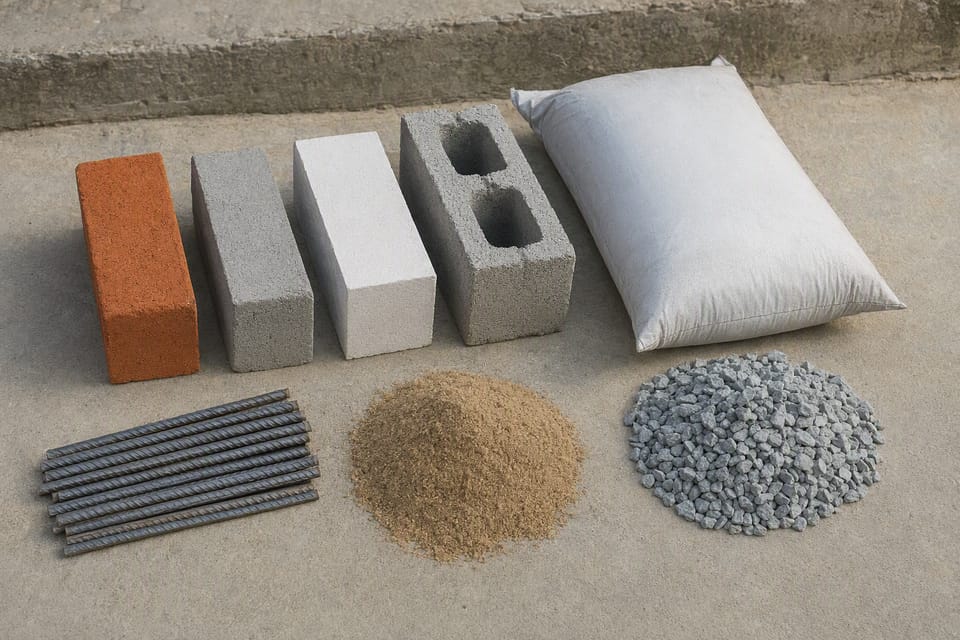
This answers the common search “brick masonry IS code”: IS 2212 covers how brickwork is built, IS 1905 covers the structural design of masonry walls, and IS 1077 covers the bricks themselves.
| Code (current edition on BIS) | What it covers | Our guide |
|---|---|---|
| IS 2212:1991 | Brick works: construction of brick masonry and erection of brick walls | Mortar ratio for brick walls, English vs Flemish bond |
| IS 1905:1987 | Structural design of unreinforced masonry walls, load-bearing and non-load-bearing | Which walls can be 4.5 inch? |
| IS 1077:2025 | Common burnt clay (red) building bricks. Replaced the 1992 edition. | Brick and block sizes in India |
| IS 12894:2002 | Pulverized fuel ash-lime bricks (the usual “fly ash brick”) | Brick and block sizes in India |
| IS 13757:1993 | Burnt clay fly ash building bricks (fired bricks with fly ash) | |
| IS 2185 (Part 1):2005 | Hollow and solid concrete blocks | |
| IS 2185 (Part 3):1984 | Autoclaved cellular aerated concrete blocks, the AAC block | Brick and block sizes in India |
Note that “fly ash brick” can mean different products under different codes. IS 12894 is for fly ash-lime bricks; IS 13757 is for burnt clay bricks made with fly ash.
Which codes cover plaster, waterproofing and finishes?
| Code (current edition on BIS) | What it covers | Our guide |
|---|---|---|
| IS 1661:1972 | Application of cement and cement-lime plaster to walls, columns and ceilings | Plaster quantity, plaster curing |
| IS 3067:1988 | Design details and preparatory work for damp-proofing and waterproofing of buildings | Terrace leakage and waterproofing |
| IS 13182:2020 | Waterproofing and damp-proofing of wet areas in buildings, such as bathrooms. First revision of the original code. | Bathroom waterproofing |
Which codes cover plumbing, drainage and wiring?
| Code (current edition on BIS) | What it covers | Our guide |
|---|---|---|
| IS 1172:1993 | Basic requirements for water supply, drainage and sanitation in buildings | |
| IS 2470 (Part 1):1985 | Design and construction of septic tanks | Septic tank size |
| IS 2470 (Part 2):1985 | Treatment and disposal of the liquid leaving a septic tank (soak pits, trenches) | Soak pit vs septic tank |
| IS 4985:2021 | Unplasticized PVC (UPVC) pipes for water supplies. Replaced the 2000 edition. | CPVC vs UPVC pipes, PVC pipe sizes |
| IS 15778:2007 | CPVC pipes for potable hot and cold water | CPVC vs UPVC pipes, PVC pipe sizes |
| IS 732:2019 | Electrical wiring installations (BIS lists a revision under way) | MCB vs RCCB vs RCBO |
| IS 3043:2018 | Earthing (BIS lists a revision under way) | Earthing for a house |
Which codes does the structural engineer use?
These set loads and earthquake rules. You will not apply them yourself, but you may see them on drawings.
| Code (current edition on BIS) | What it covers |
|---|---|
| IS 875 (Part 1):2026 | Dead loads: unit weights of building materials. Replaced the 1987 edition. |
| IS 875 (Part 2):1987 | Imposed (live) loads on floors and roofs (BIS marks it reaffirm and archive) |
| IS 875 (Part 3):2015 | Wind loads |
| IS 1893 (Part 1):2016 | Earthquake-resistant design: general provisions and buildings |
| IS 13920:2016 | Ductile design and detailing of reinforced concrete for earthquake forces |
| IS 4326:2013 | Earthquake-resistant design and construction of buildings, including masonry buildings |
A seventh revision of IS 1893 (Part 1) was published in 2025 and then withdrawn. The BIS records show it withdrawn on 5 March 2026, so the 2016 edition is the one listed as in force. Ask your engineer which edition the design follows.
Which codes cover measurement and areas?
| Code (current edition on BIS) | What it covers | Our guide |
|---|---|---|
| IS 3861:2002 | How plinth area, carpet area and rentable area are measured | How to calculate house construction cost |
| IS 1200 (Part 3):2026 | Measurement of brickwork | |
| IS 1200 (Part 12):2026 | Measurement of plastering and pointing |
How do I read an IS code, and check it is the latest?
- Free download from BIS. BIS says Indian-origin (indigenous) standards are available free of cost after you register on its standards portal. Standards adopted from ISO or IEC may not be free.
- Check the edition. Search the code number on the BIS “Know Your Standards” page. It shows the current edition and whether an older one was withdrawn. Codes are revised: several entries in the tables above replaced an older edition since 2020.
- Be careful with free copies elsewhere. Many PDFs online, including the large public archive at law.resource.org (last updated in 2015), are older editions. They are useful for reading, but check the current edition before you rely on a clause.
What mistakes should I avoid?
These come from site practice and from what we saw on other websites:
- Quoting the National Building Code 2016 as current. It was withdrawn on 30 April 2026.
- Using a withdrawn edition, for example IS 1892:1979, IS 1904:1986 or IS 1077:1992, as if it were current.
- Calling IS 2212 the plaster code. IS 2212 is brickwork; IS 1661 is cement plaster.
- Believing a website that says “as per IS code” without naming the code, the edition and the clause.
- Assuming every building product must carry the ISI mark. Only notified products must; for others, check the BIS list.
- Expecting a code to give one thickness or size for every house. Slab thickness, footing size and bar details are designed by your engineer for your house, using codes such as IS 456 and IS 1904.
Frequently asked questions
What is the IS code for brick masonry?
IS 2212:1991 covers how brickwork is built. IS 1905:1987 covers the structural design of masonry walls. The bricks themselves come under IS 1077:2025 for red clay bricks, and IS 12894 or IS 13757 for fly ash bricks.
What is the IS code for AAC blocks?
IS 2185 (Part 3):1984 covers autoclaved cellular aerated concrete blocks. BIS shows it as current.
What is the IS code for fly ash bricks?
IS 12894:2002 covers pulverized fuel ash-lime bricks. IS 13757:1993 covers burnt clay fly ash bricks.
What is the IS code for CPVC and UPVC pipes?
IS 15778:2007 covers CPVC pipes for hot and cold water. IS 4985:2021 covers UPVC pipes for water supplies.
What is the IS code for slab thickness?
No code gives one slab thickness for every house. Your structural engineer designs the slab under IS 456 for your spans and loads.
Is the National Building Code still valid?
The National Building Code of India 2016 was withdrawn on 30 April 2026. It was replaced by the National Building Construction Standards 2026 (SP 7:2026).
Related guides
- OPC vs PPC vs PSC cement: which one for your house?
- Brick and block sizes in India: red, fly ash and AAC
- CPVC vs UPVC pipes: which one to use for home plumbing
- Septic tank size: how it is worked out, with a 10-user example
- Safe bearing capacity of soil explained: SBC, ultimate and allowable
- Brick bonds: English bond vs Flemish bond, and which goes where
- PVC pipe sizes in mm and inches: what the numbers mean
- MCB vs RCCB vs RCBO: what each protects against at home
- Earthing for a house: what it is, earth vs neutral, and why it matters
This guide is general information. Read the disclaimer. Codes are revised often: check the current edition on the BIS website, and let your engineer decide which codes and clauses apply to your house.
Sources
- Bureau of Indian Standards, Know Your Standards (current edition, title and status of each code listed on this page, checked on 16 October 2026).
- Gazette of India Extraordinary No. 299, Part III Section 4, 30 April 2026: SP 7:2026 established, SP 7:2016 withdrawn.
- Bureau of Indian Standards Act, 2016, sections 16 and 17 (compulsory use of the Standard Mark for notified goods).
- BIS press note on Quality Control Orders, 2 August 2022.
- BIS, Products under compulsory certification, Scheme-I (cement and steel entries).
- BIS, Steps to download Indian Standards (free download of Indian Standards after registration).
General information only. It is not a structural design or professional advice. Ask a licensed structural engineer or architect to check your plans and site.