
Short answer
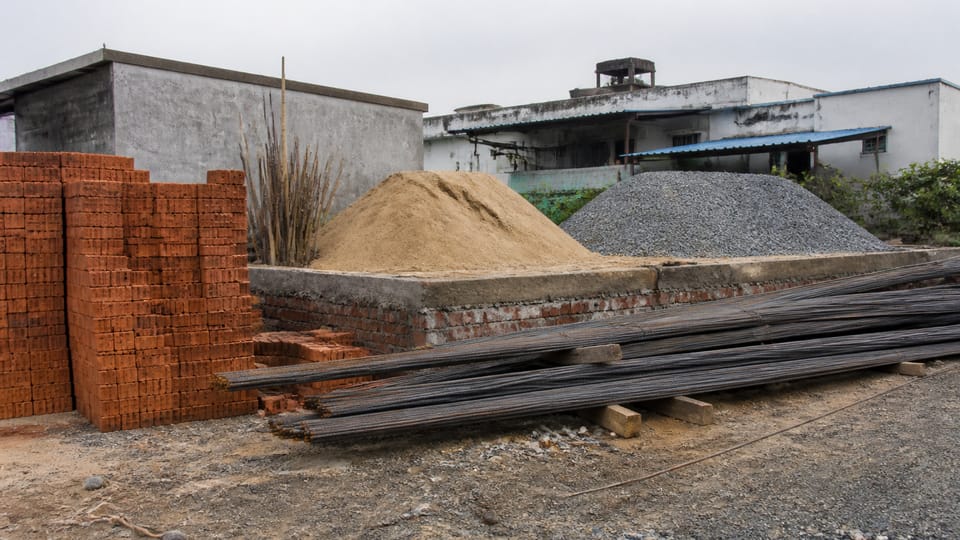
How should building materials be stored on a house site? IS 4082:1996 asks for materials to be stored so they do not deteriorate or pick up foreign matter, and to be protected from rain, sun and moisture. Bricks go in regular tiers on dry firm ground, not dumped. Aggregates go on a hard dry patch in separate piles. Steel bars stay above ground level in long storage. IS 7969 adds the safety rules.
On this page (8)
Materials are bought to be built into the house, yet many of them spend weeks on the plot first, in sun, rain and dust, in front of anyone who walks by. How they are kept decides how much is wasted and how good it still is on the day it goes into the wall. India has a standard for it, IS 4082, and a safety code, IS 7969. This page sets out what they say for bricks, blocks, sand, aggregate and steel, and gives an owner’s checklist. It gives no stack height, no quantity and no price: the standards’ stack sizes are for the engineer and the site supervisor, and many were written for large sites. Cement has its own page: see cement shelf life: how long can cement be stored on site?.
What do the standards say in general?
IS 4082 clause 1 says it “provides general guidance regarding stacking and storage of construction materials and components at site”. Its foreword adds that for special manufactured products, the manufacturer’s instructions shall be followed. The general clauses ask for:
- Planning the layout of the stores with proper access and room for the vehicles that bring the material (clause 3.1).
- Storing materials “in such a manner as to prevent deterioration or intrusion of foreign matter” (clause 3.2).
- Protecting them from “atmospheric actions, such as rain, sun, winds and moisture” (clause 3.3).
- Storing timber, coal, paints and similar materials so there is no fire hazard, and not piling stacks so high that they become unstable under fire-fighting conditions (clause 3.4.1).
- Storing materials affected by soil subsidence, such as precast beams, slabs and timber, on unyielding supports (clause 3.4.2), and protecting materials from being washed away or damaged by floods (clause 3.4.3).
- Not letting stairs, passages and gangways become blocked by materials, tools or rubbish (clause 3.5).
IS 456:2000 sends storage to IS 4082 (clause 5.7), and NBCS 2026 Part B clause 8 says all building materials shall be stored on site “in such a way as to prevent deterioration or the loss or impairment of their structural and other essential properties”.
What do they say for each material?
| Material | What IS 4082:1996 says |
|---|---|
| Bricks (4.5) | Stacked in regular tiers as they are unloaded, to minimise breakage and defacement, and “not dumped at site”. Placed close to the work. Stacked on dry firm ground. Bricks of different types, strength classes, sizes, and solid, hollow and perforated bricks are stacked separately. Bricks from clays containing lime kankar should be thoroughly soaked in water (docked) in the stack to prevent lime bursting |
| Blocks (4.6) | Concrete, light weight, autoclaved aerated, stone masonry and soil blocks are unloaded one at a time and stacked in regular tiers, not dumped. Blocks that have not completed their curing are stacked separately, and the date of manufacture is marked on the stacks |
| Sand and aggregates (4.8) | Stored on a hard, dry and level patch of ground. If there is none, a platform of planks or old corrugated iron sheets, a brick floor or a thin layer of lean concrete is made “so as to prevent contamination with clay, dust, vegetable and other foreign matter”. Fine and coarse aggregates are kept in separate piles, far enough apart that the edges do not mix, and fine aggregates are placed where wind loss is least. IS 4082 has no separate sand clause: sand is a fine aggregate |
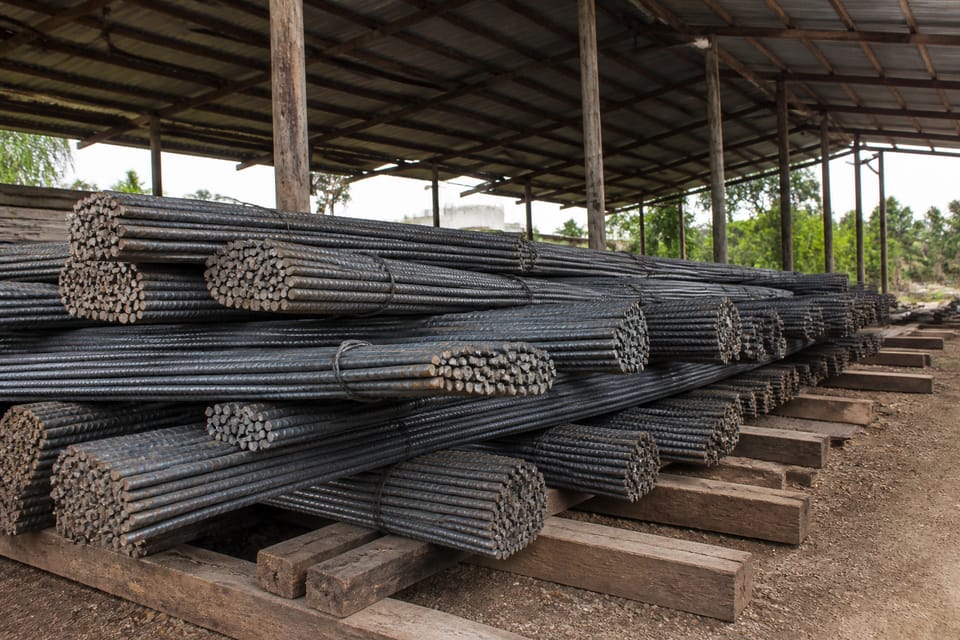
| Steel reinforcement (4.13) | Separate areas for each classification of steel. Stored “to avoid distortion and to prevent deterioration and corrosion”. It is “desirable” to coat reinforcement with cement wash before stacking. For long storage, bars are stacked above ground level, with a cement wash in coastal areas or for long storage. Bars of different classification, size and length are stored separately |
IS 4082 gives sizes for several stacks, such as bricks, blocks, aggregates and timber (for aggregates it calls them “suggested sizes”). They are not printed here. Steel bars have no stack height in IS 4082.
What do the safety rules add?
IS 7969:1975 covers handling and storage of building materials at building sites. Among its rules:
- Materials are “segregated as to kind, size and length and placed in neat, orderly piles that are safe against falling”. High piles are stepped back, and passageways are left between piles for inspection and removal (clause 2.1).
- Stacks stand on “well drained, firm and unyielding surface”, without undue stress on walls or other structures, and in a way that is not a hazard to passers-by, with warning signs and red lights at night where needed (clauses 2.1.1 and 2.1.2).
- Reinforcing and structural steel is stored by length, size and shape on a solid foundation, “in such a manner as to prevent tipping or falling”, with adequate spacing between piles for safe access. Workers handling deformed bars wear gloves (clause 3.7).
- Stockpiles of sand, gravel and crushed stone are placed for easy access, with no overhang when material is withdrawn, and not piled against walls endangered by thrust or along the edges of an excavation (clause 3.8).
- Handlers of cement, lime and pozzolana wear protective clothing, respirators and goggles (clause 3.3). For overhead electric lines, the code gives minimum distances when stacking pipe and steel; ask your electrician or the supply authority on a plot with a line over it.
IS 7969 is older than the 1996 IS 4082 and cites the 1967 edition of it. Where they differ on details such as cement bag stacks and bitumen drums, IS 4082:1996 is the later one. Neither says who, in a small house, is responsible for the stock.
An owner’s checklist (practice)
This is practice, apart from the clauses named.
- Place: near the work, clear of the road, drains and the neighbour’s boundary, with a way in for the delivery vehicle. Ask your local authority if you must keep material on the road or pavement, since rules vary.
- Ground: dry, firm and a little raised, with a way for water to drain off. Put a platform, bricks or a thin concrete layer under sand and aggregate.
- Separation: sand and aggregate in separate piles, bricks by type, steel by size, blocks apart from bricks.
- Cover: steel and block stacks covered in the monsoon, and anything that must stay dry under a roof. For AAC blocks, follow the maker’s guide.
- Order of use: the oldest delivery first. For cement this is in IS 4082; for the rest it is practice.
- Safety: low, stable stacks away from children and from walkways, and no heaps against a fresh wall or at the edge of a trench.
- Records: check each delivery against the challan and the order before it is unloaded, and keep the challan.
- Order sensibly: the more you order at once, the longer it sits in the weather. Match deliveries to what is used.
- Security: a lockable corner for small items, and someone responsible for the site.
What mistakes should I avoid? (practice)
- Cement or steel stored on soil or in mud.
- Sand dumped on soil so that it picks up mud, or sand and aggregate heaped together.
- Sand left open to rain, which leads to silt and uneven mixes: see sand bulking: why damp sand gives you less sand.
- Bricks dumped from a truck and stacked on soft ground.
- AAC blocks left uncovered and wet.
- Tall or unstable stacks near children, and stacks that block the road or a drain.
- Using the newest stock first and leaving old stock to age.
- Not checking the challan, and not marking dates.
- Letting the monsoon catch a site with uncovered stock: see pre-monsoon checklist for your house and your building site.
Frequently asked questions
How should I store bricks on site?
IS 4082 clause 4.5 says in regular tiers on dry firm ground, close to the work, not dumped, with different types and strength classes stacked separately.
Can sand be stored in the open?
IS 4082 asks for a hard, dry, level patch or a platform to keep it clean, and protection from rain, sun and wind. Covering it is practice.
How should steel bars be stored?
Above ground level for long storage, by classification and size, kept from corrosion, with a cement wash coat as IS 4082 clause 4.13 suggests.
Is IS 4082 a rule?
It describes itself as general guidance. NBCS 2026 and IS 456 refer to it. Your contractor and engineer decide how it applies to your site.
Related guides
- Cement shelf life: how long can cement be stored on site?
- Pre-monsoon checklist for your house and your building site
- Sand bulking: why damp sand gives you less sand
This guide is general information. Read the disclaimer. Your contractor and engineer decide how materials are stored on your site.
Sources
- IS 4082:1996, Stacking and Storage of Construction Materials and Components at Site, Recommendations (second revision): clauses 1, 3.1 to 3.5, 4.4 to 4.6, 4.8 and 4.13 (page images read; clause 4.13.1 from the text layer). BIS lists it as in force, valid to 2028-05-31. It describes itself as general guidance.
- IS 7969:1975, Safety Code for Handling and Storage of Building Materials: clauses 2.1 to 2.3, 3.3, 3.7 and 3.8 (page images read). BIS lists it as in force, valid to 2027-03-31.
- SP 7:2026, National Building Construction Standards (NBCS) 2026, Part B Building Materials, clause 8 Storage of Materials (page image read). From an unofficial archive.org copy.
General information only. It is not a structural design or professional advice. Ask a licensed structural engineer or architect to check your plans and site.