
Short answer
What is the difference between MCB and RCCB? An MCB switches off a circuit when too much current flows, from an overload or a short circuit, and so protects the wiring. An RCCB switches off when current leaks to earth, for example through a faulty appliance or a person, and so protects people. An RCCB does not protect against overload or short circuit. An RCBO does both jobs. A house needs both kinds of protection.
On this page (9)
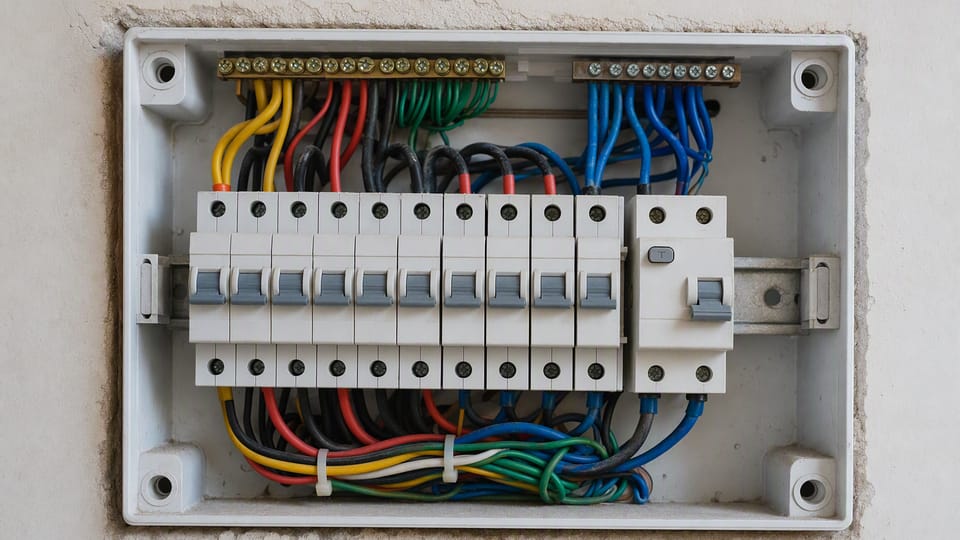
The switches in your electrical distribution board (DB) are not all the same. Some are MCBs, one or two may be an RCCB, and newer boards may have RCBOs. Each protects against a different danger. This page explains what each one does, from the Indian Standards and the Central Electricity Authority’s safety regulations, why a house needs more than one kind, how to use the test button, and what to do when one trips. It gives no ratings or sizes: which breaker goes on which circuit is your electrician’s design.
What does each one do?
| Device | Full name | What it protects against | Indian Standard |
|---|---|---|---|
| MCB | Miniature circuit breaker | Too much current: overload and short circuit. It protects the wiring | IS/IEC 60898 (Part 1) |
| RCCB | Residual current circuit breaker | Current leaking to earth, such as through a faulty appliance or a person touching a live part. It protects people. It does not protect against overload or short circuit | IS 12640 (Part 1) |
| RCBO | Residual current breaker with overcurrent protection | Both: leakage, and overload and short circuit | IS 12640 (Part 2) |
MCB. The MCB standard says these breakers are meant “for the protection against overcurrents of wiring installations of buildings”. Overcurrent can be an overload (too many appliances on one circuit, with nothing broken) or a short circuit (a fault where current takes a path with almost no resistance).
RCCB. IS 12640 (Part 1) defines the RCCB as a residual current breaker “not designed to perform the functions of protection against overloads and/or short circuits”. It is intended principally for protection against electric shock. It watches the current going out on the live wire and coming back on the neutral. If some current goes missing, leaking to earth, it switches off.
RCBO. IS 12640 (Part 2) covers residual current breakers that also protect against overload and short circuit. An RCBO does the work of an RCCB and an MCB for one circuit.
Why does a house need both kinds?
Because they guard against different faults. An RCCB will not switch off for an overloaded or shorted circuit, so each circuit still needs an MCB or a fuse. The RCCB standard itself describes the RCCB working with a short-circuit protective device in series. And an MCB is made to protect the wiring from too much current, while sensing leakage to earth is the job of the residual current device.
Indian rules ask for both:
- The CEA’s 2023 safety regulations say each distinct circuit is to be protected against excess energy by a fuse or a circuit breaker (Regulation 37).
- The same regulations say the use of electricity in an electrical installation “shall be controlled by a residual current device” (Regulation 44), with a specific requirement for domestic installations.
- IS 732, the Indian wiring code, generally asks for additional protection by a residual current device at the incomer of every sub-distribution board that has socket-outlet circuits.
How these apply to your house, and which circuits sit behind which device, is for your electrician to design.
Does an RCCB replace earthing?
No. IS 732 says residual current devices are “not recognized as a sole means of protection” and do not remove the need for the other protective measures, such as earthing and bonding. The CEA regulations also require earthing separately. Think of earthing and the RCCB as two layers of protection that work together.
What does the test button do?
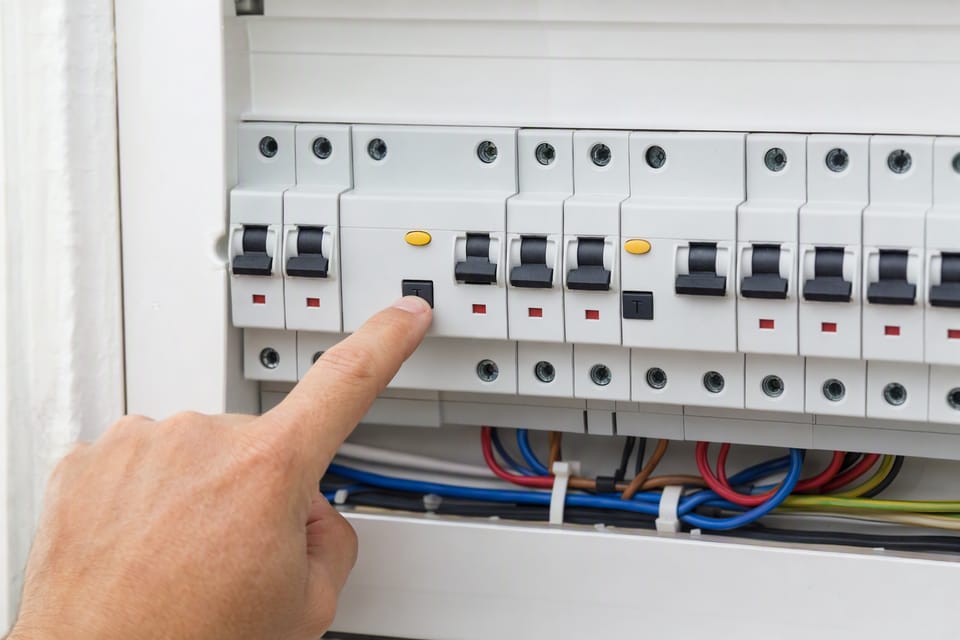
Pressing the test button makes the device simulate a leakage, so it should switch off at once. If it does not, the device is not protecting you.
- How often: follow the leaflet that came with your device. Legrand’s instruction sheet, for example, says that in the absence of national rules on frequency, it recommends testing monthly, and that if the device does not trip, you should “call an electrician immediately”.
- What it does not prove: UK wiring guidance (IET) notes that the electrician’s own test of an RCD is done with a test instrument, independent of the test button. The button checks the device, not your whole installation.
- A simple check: Singapore’s energy regulator suggests that, with the RCCB tripped by the test button, you check your lights and sockets. Any that still work are not protected by that RCCB. Call a licensed electrician soon.
Why does an RCCB or MCB keep tripping?
RCCB trips usually point to leakage:
- a faulty appliance (in practice, often one with water or heat, such as a geyser or washing machine);
- small leakages from several appliances adding up, which an Australian Hager installation sheet mentions;
- moisture: UK guidance (IET) mentions heating elements that take in a little moisture when cold, and in practice water in an outdoor socket during the rains can do the same;
- a wiring fault between neutral and earth, which needs an electrician.
MCB trips usually point to an overload (too much on one circuit) or a short circuit.
What to do, in practice: switch off and unplug the appliances on that circuit, reset the breaker once, then plug the appliances back one at a time. If one causes the trip, have it checked. If the breaker trips again with everything unplugged, or will not reset, call a licensed electrician. Do not keep resetting it, and never bypass or tape a breaker on. If someone got a shock, or you notice a burning smell, smoke or sparks, do not reset the breaker: keep it off and call a licensed electrician.
Do not fit a bigger MCB because one keeps tripping. The MCB is there to protect the wire. A bigger breaker on the same wire can let the wire overheat. Ask your electrician to find the cause.
What mistakes should I avoid?
These come from the standards, the CEA regulations and site practice:
- Using an RCCB without MCBs or fuses for overcurrent protection.
- Thinking an RCCB makes earthing unnecessary.
- Changing an MCB to a higher rating to stop it tripping.
- Never pressing the test button, or ignoring a device that does not trip when tested.
- Buying breakers without the BIS standard mark. BIS lists circuit breakers and RCCBs under compulsory certification.
- Letting an untrained person open the distribution board.
Frequently asked questions
Can an RCCB replace an MCB?
No. An RCCB does not protect against overload or short circuit. You still need MCBs or fuses, or you can use RCBOs, which combine both.
Is an RCCB mandatory in India?
The CEA’s 2023 safety regulations say an electrical installation shall be controlled by a residual current device, with a specific requirement for domestic installations and some exceptions. Ask your electrician how this applies to your house and your supply.
Are ELCB and RCCB the same?
In everyday Indian use, yes: Kerala’s state electricity board has noted that what people commonly call an ELCB in India is in fact an RCCB. UK wiring guidance (IET) notes that an older, voltage-operated type of ELCB worked differently and has not been recognised by the UK wiring regulations since 1981.
Does an RCCB work without earthing?
An RCCB senses current that does not return through the neutral, but it is not a substitute for earthing. IS 12640 (Part 1) describes RCCBs protecting people with the exposed metal parts of the installation connected to an earth electrode, so it assumes earthing is in place, and IS 732 says an RCCB is not a sole means of protection. Your house needs proper earthing as well.
Which MCB do I need for an AC?
That depends on the AC, the wire and the circuit. Follow the AC maker’s installation instructions and let your electrician choose the breaker and the wire together. This page gives no ratings.
Related guides
- Stages of house construction in India: checklist and inspection points
- Pre-monsoon checklist for your house and your building site
- Earthing for a house: what it is, earth vs neutral, and why it matters
This guide is general information, not electrical design. Read the disclaimer. Electrical work must be done by a licensed electrician, who decides the breakers, wires and earthing for your house.
Sources
- IS/IEC 60898 (Part 1), Circuit-breakers for overcurrent protection for household and similar installations (current edition 2015; scope and definitions read from the 2002 edition).
- IS 12640 (Part 1), Residual current operated circuit-breakers without integral overcurrent protection (RCCBs) (current edition 2024; scope and clause 3.3.2 read from the 2008 edition).
- IS 12640 (Part 2), Residual current operated circuit-breakers with integral overcurrent protection (RCBOs) (read from the 2008 edition; check BIS for the current edition).
- IS 732:2019, Code of Practice for Electrical Wiring Installations (Fourth Revision). Clauses 3.157 to 3.159, 4.2.11 and 4.2.15.1.
- Central Electricity Authority (Measures relating to Safety and Electric Supply) Regulations, 2023 (Gazette, 8 June 2023). Regulations 37 and 44. Copy hosted by KSEB.
- BIS, Products under compulsory certification, Scheme-I (circuit breakers and RCCBs).
- IET (UK), Wiring Matters: Inspection and testing of residual current devices. UK guidance, not an Indian standard.
- Legrand, RCD user instruction sheet (testing).
- Hager (Australia), RCCB installation sheet (troubleshooting). Australian product sheet, not Indian.
- Kerala State Electricity Board, press release 'Rising electrical hazards demand vigilance', 27 September 2023 (ELCB and RCCB).
- Energy Market Authority, Singapore, RCCB safety leaflet. Singapore guidance, not Indian.
General information only. It is not a structural design or professional advice. Ask a licensed structural engineer or architect to check your plans and site.