
Short answer
What is the difference between English bond and Flemish bond? In English bond, a course of headers (brick ends) alternates with a course of stretchers (long faces). In Flemish bond, headers and stretchers alternate within every course. IS 2212 says English bond contributes substantially to strength and suits heavily loaded walls, while Flemish bond looks more even. CPWD uses English bond unless otherwise specified, and stretcher bond for half-brick walls.
On this page (9)
“Which bond is your mason using?” is not a question most owners think to ask, but the bond decides how the bricks lock together. This page explains the common brick bonds in plain words from IS 2212, the Indian code for brickwork, and the CPWD specification, says which wall each one suits, and lists what you can check on site with your own eyes. It gives no wall thicknesses, heights or brick counts. For those, see the linked guides and ask your engineer.
What is a bond in brickwork?
A bond is the pattern in which bricks are laid, course after course, so that they tie the wall together along its length and through its thickness. IS 2212 says the pattern is meant to make sure that no vertical joint in one course sits exactly over a vertical joint in the course above or below, and that each brick overlaps the ones below as much as possible.
The code is clear about why: the main purpose of bond is strength. It can also be used for looks where the brickwork is left exposed.
The basic rule in IS 2212 is that the vertical joints in one course should be at least a quarter of a brick length away from the joints in the course below or above. A wall where vertical joints run straight up through several courses is weak at those lines.
A few words you will hear on site:
- Stretcher: a brick laid along the wall, showing its long face.
- Header: a brick laid across the wall, showing its short end.
- Course: one layer of bricks with its bed of mortar.
- Closer: a piece of brick used to keep the bond correct near the end of a course. A queen closer is a brick split along its length.
- Bat: a piece of brick broken across its length, such as a half-bat.
How are English bond and Flemish bond laid?
| English bond | Flemish bond | |
|---|---|---|
| Pattern | One course of all headers, the next course of all stretchers, and so on | Headers and stretchers alternate within every course |
| Starting a course at a corner | The header course starts with a corner header and a queen closer | A queen closer goes next to the corner header in alternate courses |
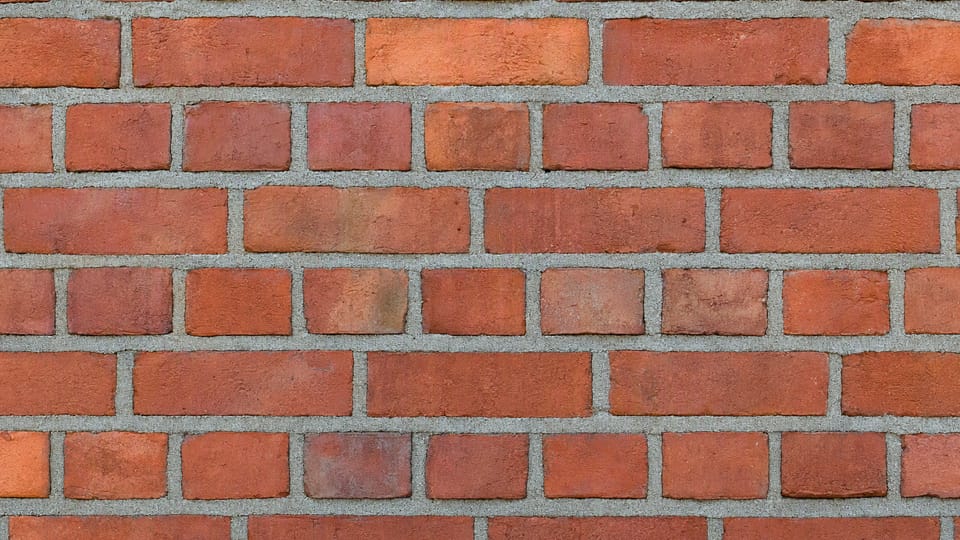
| Look on the face | Bands of headers and bands of stretchers | Each header sits in the middle of the stretcher above and below, giving an even, chequered look |
| Strength, per IS 2212 (double Flemish row) | “Contributes substantially to the strength of brickwork”, suits heavily loaded walls | Considered weaker than English bond, but may suit one-brick (9 inch) house walls with a strong mortar such as cement mortar |
| Where it is used | Mostly load-bearing walls that will be plastered (SP 20) | Mainly exposed brickwork, for its better appearance (SP 20) |
SP 20, the BIS handbook on masonry, says English bond “is considered to give the best strength in masonry and is mostly adopted in all load bearing masonry, that is to be plastered over.” IS 2212 adds a useful balance: less efficient bonds can also give enough strength if the mortar is strong. So bond is one part of strength. IS 2212 lists four: the bricks, the mortar, the bond and the workmanship.
For walls thicker than one brick, Flemish bond comes in two forms. Double Flemish shows the Flemish pattern on both faces. Single Flemish has Flemish on the face and English bond behind. SP 20 says it combines the advantages of both, but IS 2212 says any gain in strength over double Flemish is doubtful.
Which bond goes where?
The CPWD specification gives the simplest rule: bricks are laid in English bond unless otherwise specified, and half-brick walls are laid in stretcher bond. Half or cut bricks are not to be used except as closers where they are needed to complete the bond.
| Bond | How it is laid | Where it is used |
|---|---|---|
| English bond | Header course and stretcher course in turn | The default for brickwork in the CPWD specification; suits walls carrying heavy loads (IS 2212) |
| Flemish bond | Header and stretcher in turn in every course | Exposed brickwork; one-brick walls with strong mortar (IS 2212) |
| Stretcher bond | Every brick a stretcher, each course shifted by about half a brick | Half-brick (4.5 inch) walls such as partitions (CPWD, SP 20) |
| Header bond | Every brick a header | Walls curved in plan, and brick footings (IS 2212, CPWD) |
| Garden wall bond | A header course after three (sometimes five) stretcher courses (English), or one header to three (sometimes five) stretchers in a course (Flemish) | Easier one-brick walls and exposed work (IS 2212) |
IS 2212 also lists American (common) bond, with one header course to several stretcher courses, and mentions others such as Monk, Dutch and English cross bond, used mainly for appearance. It says the common bonds suit both traditional and modular bricks. Which walls are half-brick and which are one brick thick is a separate question, covered in our guide to wall thickness.
What is rat-trap bond?
Rat-trap bond is a way of laying bricks on edge so that the wall has a hollow space inside. It is not one of the bonds listed in IS 2212. A study from Anna University, Chennai, on a project sponsored by HUDCO, tested it and found that the walls failed by the two faces of the wall separating. Our advice: if you are offered a rat-trap bond wall, get your structural engineer’s design and approval first. This page gives no savings figures, because the ones online are not backed by a standard.
What can I check on site?
You do not need to be an engineer to spot these. Each comes from IS 2212 or the CPWD specification:
- No straight vertical joints running up through several courses. Each joint should be offset by at least a quarter brick from the joints in the next course (IS 2212). In a regular bond, joints in alternate courses line up one over the other, as CPWD describes.
- Full joints. Bricks sit on a full bed of mortar, and the vertical joints are packed with mortar, with no hollows. IS 2212 says well-filled joints give strength and keep out moisture.
- Correct corners. At corners, headers and stretchers alternate course by course, with a closer next to the corner header.
- Few cut bricks. CPWD allows cut bricks only as closers where needed to complete the bond. IS 2212 asks for the sides of door and window openings to be sized to whole bricks, to avoid cutting, and the bond at both sides of an opening to be symmetrical.
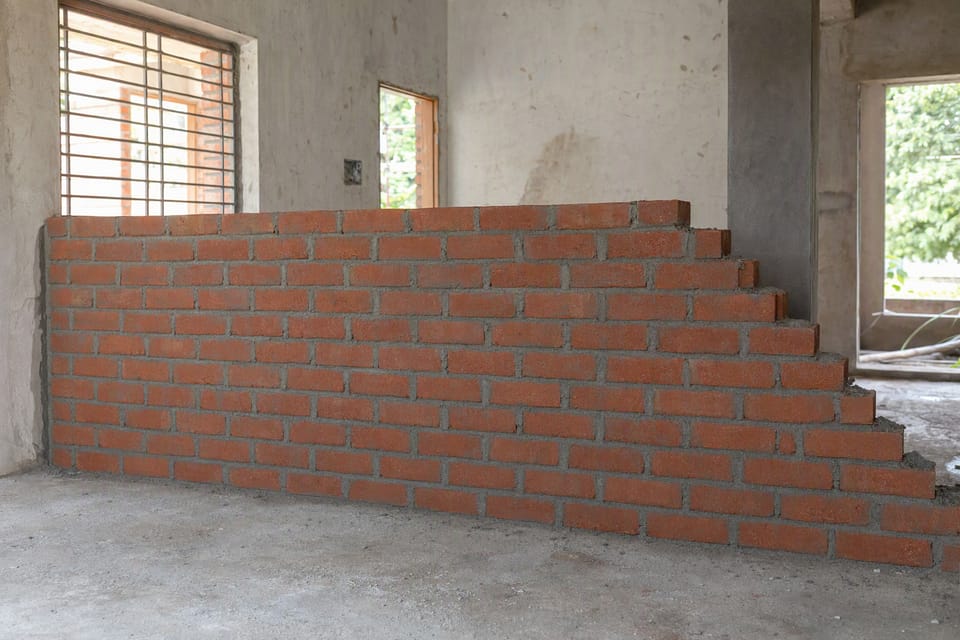
- Racking back, not toothing. Where part of a wall is left to be finished later, the end should be stepped back like a staircase (racking back). Toothing, leaving bricks sticking out in alternate courses, is only for a future extension and is not a substitute, says IS 2212. CPWD says the same.
- Walls built up evenly, not one part far ahead of the rest. Your engineer can tell you the limit for your job.
- Half-brick partitions keyed in. Recesses (indents) are left in the main wall so the partition can bond into it.
One point where the codes differ is the direction of the frog, the hollow in the face of a brick. IS 1905, SP 20 and CPWD say frog up; IS 2212 says bricks with deep frogs go frog down; CPWD lays an exposed top course frog down. Follow your specification or your engineer.
What mistakes should I avoid?
These come from the codes above and from site practice:
- Letting vertical joints line up course after course.
- Filling the bond with many broken bricks instead of proper closers.
- Leaving a wall toothed instead of racked back when work stops.
- Using Flemish bond for a one-brick wall with weak mortar.
- Mixing bonds or brick sizes within one wall (practice).
- Building a rat-trap wall without an engineer’s approval.
Frequently asked questions
Which bond is strongest in brick masonry?
IS 2212 says English bond contributes substantially to strength and suits heavily loaded walls, and SP 20 calls it the bond that gives the best strength. IS 2212 also says less efficient bonds can be strong enough with strong mortar.
Which bond is used for a 4.5 inch wall?
Stretcher bond. The CPWD specification and SP 20 both use stretcher bond for half-brick walls such as partitions.
Which bond is used for a 9 inch wall?
The CPWD specification uses English bond unless otherwise specified. IS 2212 says Flemish bond may also suit one-brick house walls if a strong mortar such as cement mortar is used.
What is a queen closer?
A brick split along its length, so it is as long as a brick but half as wide. It is placed next to the corner header to keep the joints a quarter brick apart.
Is toothing allowed in brickwork?
Only where a future extension is planned. IS 2212 and CPWD say toothing must not be used instead of racking back when part of a wall is left to be built later.
What is the IS code for brick bonds?
IS 2212:1991, the code of practice for brick works. Its Table 2 describes the common bonds and where each is used.
Related guides
- Which walls can be 4.5 inch? Load-bearing and partition walls
- Mortar ratio for brick walls: 1:4, 1:5 or 1:6?
- How many bricks for 100 sq ft of wall? Assumptions shown
This guide is general information. Read the disclaimer. Your engineer decides the bond, the wall thickness and the mortar for each wall of your house.
Sources
- IS 2212:1991, Brick Works - Code of Practice (First Revision). Clauses 3, 6.3, 11, 12 and Table 2 (common types of bonds).
- SP 20 (S&T):1991, Handbook on Masonry Design and Construction (First Revision), Part 2 Section 2 (bonds).
- IS 1905:1987, Structural Use of Unreinforced Masonry - Code of Practice (Third Revision). Clauses 6.3.2 and 6.3.3.
- CPWD Specifications 2019, Volume 1, Sub Head 6 Masonry Work: 6.2.4 and 6.4. Copy hosted by Puducherry PWD.
- Santhakumar, Sivakumar and Ashok (Anna University, Chennai), Validation of Rat-Trap Bond for Cost Effective Housing, 9th Canadian Masonry Symposium (a research paper, not a standard).
General information only. It is not a structural design or professional advice. Ask a licensed structural engineer or architect to check your plans and site.