
Short answer
What does IS 2185 cover? IS 2185 is the Indian standard series for concrete masonry units. Part 1 covers hollow and solid concrete blocks. Part 2 covers lightweight blocks. Part 3 covers autoclaved aerated concrete (AAC) blocks. Part 4 covers foam concrete blocks. The block you buy should have its grade and density marked, and the manufacturer should give a certificate if you ask.
On this page (10)
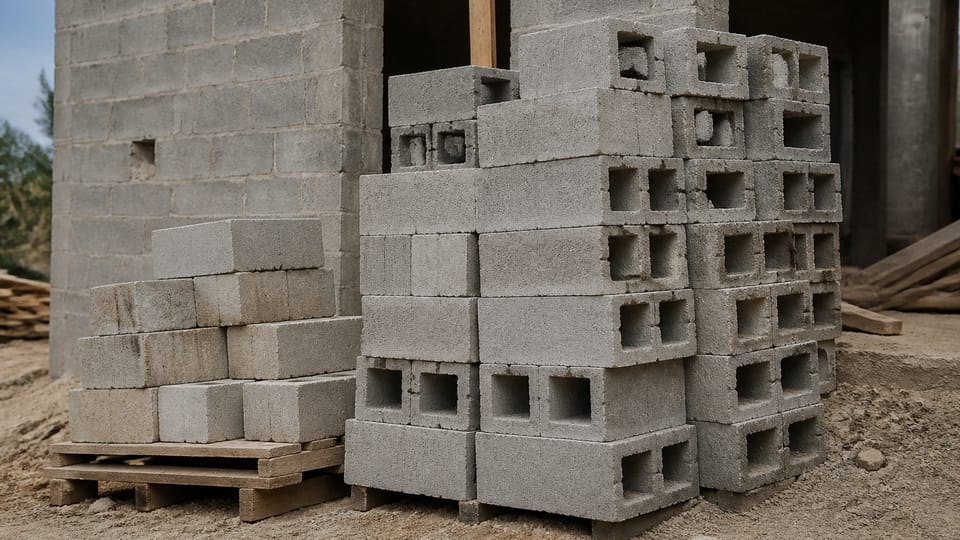
A concrete block wall is only as good as the block. Builders often say “2185 block” when they mean any concrete block, and that is loose wording. IS 2185 is a series of four standards, one for each kind of concrete masonry unit. This page explains which part covers which block, what the foreword and the scope say, and the checks a homeowner can make when the blocks arrive. It gives no block sizes, no strength or density values and no mortar mix. Those are in the standards and in the engineer’s design.
What is IS 2185?
IS 2185 is the Indian standard series for concrete masonry units. The Part 4 foreword lists the other three parts as a series: Part 1 for hollow and solid concrete blocks, Part 2 for hollow and solid lightweight concrete blocks, Part 3 for autoclaved cellular (aerated) concrete blocks, and Part 4 for preformed foam cellular concrete blocks.
Which part covers which block?
| Part | What it covers | Edition read |
|---|---|---|
| Part 1 | Hollow and solid concrete blocks, load-bearing and non-load-bearing, used in load-bearing and partition walls | Third revision, 2005 |
| Part 2 | Hollow and solid lightweight concrete blocks, load-bearing and non-load-bearing | First revision, 1983 (reaffirmed 2005) |
| Part 3 | Autoclaved cellular (aerated) concrete (AAC) blocks within a stated density limit | First revision, 1984 |
| Part 4 | Preformed foam cellular concrete blocks | 2008 |
The table names what each part covers. It does not give sizes, strengths or densities, which are in the standards.
Is AAC for load-bearing walls?
This is the question most owners ask, and the sources do not agree in one place.
- IS 2185 (Part 3) foreword, clause 0.3.2. The foreword says AAC blocks are used for “both load bearing and non-load bearing internal walls, partition and panel walls, inner leaf of cavity walls or as backing to brick masonry and for external load-bearing walls as well as panel walls in steel or reinforced concrete frame construction when protected from weather by rendering or by some other efficient treatment”.
- BMTPC and CBRI compendium. This government technical guidance says AAC blocks are used in partition and non-load-bearing walls of reinforced concrete framed buildings, and lists “not perfectly suitable for load bearing walls” as a limitation.
Present both. Ask the engineer whether the AAC wall carries load, and design it on that basis. The block alone does not decide it.
What does the scope say about hollow and solid blocks?
IS 2185 Part 1 clause 1 covers hollow blocks with open or closed cavities, and solid blocks, in both load-bearing and non-load-bearing types. The scope note in Part 2 says aerated blocks are covered by IS 5482 (1969). Part 3’s foreword says it supersedes IS 5482. So IS 5482 is not the current aerated-block standard. Check the current edition on the BIS portal before you rely on any part.
What do CPWD’s owner checks say?
CPWD cl 1.9.3 applies to blocks generally. The clauses under CPWD’s section 6.14 are its AAC masonry clauses, so check whether they apply to the block you buy. These are the clauses to ask about.
- Certificate (AAC). Under CPWD cl 6.14.10.1, the manufacturer must satisfy himself that the units conform, and must supply a certificate if requested.
- Marking (AAC). Under cl 6.14.13.1, each lot is marked with the manufacturer’s identification, the grade and block density, and the month and year of manufacture. The ISI mark is optional on each block.
- Age. Under cl 1.9.3, blocks cured for 28 days should normally be received. Younger blocks are stacked separately and not used in construction.
- Visual check. Under cl 6.14.5.1 (AAC), blocks must be sound, free of cracks or defects that interfere with placing or impair strength or performance. Under cl 6.14.5.2 (AAC), for exposed wall construction the exposed faces must be free of chips, cracks or other imperfections, but the clause allows a small share of slight cracks or chippings without rejection.
- Independent tests (AAC). Under cl 6.14.11.1, the purchaser or representative may require independent tests on samples taken before or immediately after delivery.
What are the practice points for a homeowner?
These are practice points, not standard clauses.
- Ask the supplier which part of IS 2185 the blocks are made to, and ask for the certificate.
- Check the marking on a few blocks: the grade, the density and the month of manufacture.
- Look at a few blocks for cracks and chips before they go into the wall.
- Ask for a sample test if the certificate is doubtful.
What mistakes should I avoid?
These are practice points, not standard clauses.
- Using blocks of unknown age. Ask for the manufacture date. Blocks cured for less than 28 days should be stacked apart.
- Laying AAC with the wrong mortar. Follow the maker’s and the engineer’s specification for the mortar. Do not assume a mix.
- Treating the block as the design. The load, the wall thickness and the bands come from the engineer’s drawing.
Frequently asked questions
Which block is the best for a house?
No single block is best. The choice depends on the wall type, the load, the climate and the engineer’s design. Ask the engineer.
Is a hollow block the same as a solid block?
No. A hollow block has cavities and a solid block does not. Part 1 covers both. The engineer decides which suits each wall.
Does IS 2185 give the block size?
No. The sizes and the tests are in the standard and in the supplier’s data. Do not use a size from a web page as a code value.
Related guides
- Hollow concrete blocks: sizes, grades and how a hollow block wall is built
- AAC block vs solid concrete block: weight, strength and use
- How to lay an AAC block wall: adhesive or mortar
This guide is general information. Read the disclaimer. A qualified engineer decides the block and the wall design for your house.
Sources
- IS 2185 (Part 1):2005, Concrete Masonry Units: Hollow and Solid Concrete Blocks (third revision), clause 1 (scope). Read from an archive copy.
- IS 2185 (Part 2):1983, Hollow and Solid Lightweight Concrete Blocks (first revision), clause 1.1 and scope note. Read from an archive copy.
- IS 2185 (Part 3):1984, Autoclaved Cellular (Aerated) Concrete Blocks (first revision), clause 1.1 and foreword clause 0.3.2. Read from an archive copy.
- IS 2185 (Part 4):2008, Preformed Foam Cellular Concrete Blocks, clause 1 and foreword. Read from an archive copy.
- CPWD Specifications 2019, Vol 1, cl 1.9.3, 6.14.5.1, 6.14.5.2, 6.14.10.1, 6.14.11.1 and 6.14.13.1.
- Compendium of Building Technologies, a joint publication of CSIR-CBRI and BMTPC (MoHUA), AAC and hollow block entries (government technical guidance, not an IS code). Year as checked on the cover; edition to confirm.
General information only. It is not a structural design or professional advice. Ask a licensed structural engineer or architect to check your plans and site.