
Short answer
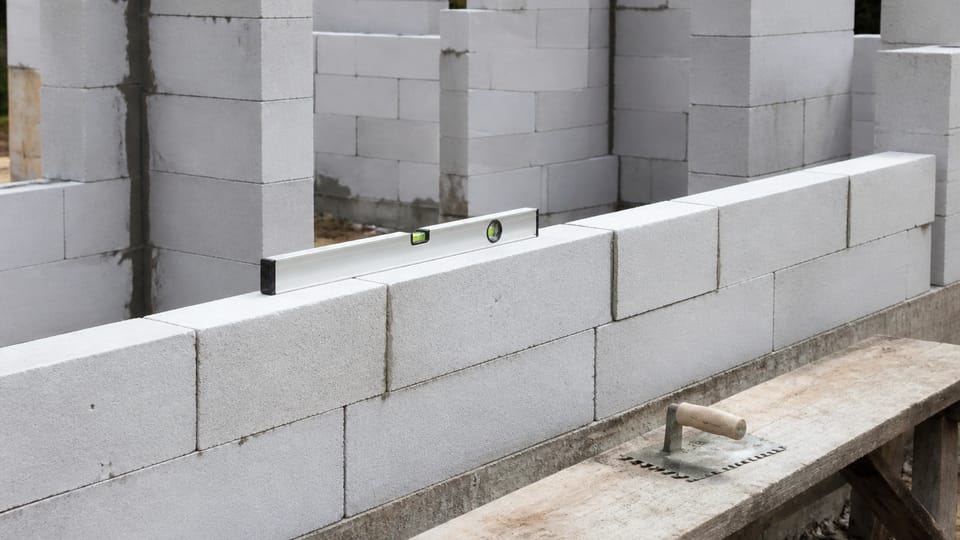
Should AAC blocks be laid with adhesive or cement mortar? The standard for AAC masonry, IS 6041, sets mortar joints of 10 mm for most work. Many makers sell a thin-bed adhesive instead, with joints of about 1 to 6 mm depending on the product. The standard has no clause on adhesive, so follow the data sheet of the product you buy, and ask your engineer to approve the method.
On this page (9)
AAC blocks are light, and they can be cut to size with a saw. They are laid in a different way from bricks. The joints, the first course and the wetting all matter. This guide explains what the Indian standard for AAC masonry says, what the adhesive makers say, and where the two differ. It gives no prices, brands or design values. Your engineer must design the wall, its lintels and its plaster.
What does the standard say about laying AAC blocks?
The Indian code of practice for AAC masonry is IS 6041:1985. It is still current on the BIS record. It describes laying with a mortar joint. It says the mortar should be weaker than the block mix. It gives mortar mixes. The first is “A 1 : 2 : 9 cement-lime-sand mortar may generally be used for normal work, but where either the intensity of load is high or wall is exposed to severe condition 1 : 1 : 6 mortar shall be used” (clause 3.9.2). The mix must be checked with your engineer for your wall.
For the joints, the standard says: “For most of the work the joints, both horizontal and vertical, shall be 10 mm thick” (clause 7.1). The companion standard for the blocks, IS 2185 (Part 3):1984, explains that the nominal size of a block includes the mortar joint: “Actual dimensions shall be 10 mm short of the nominal dimensions (or 6 mm short in special cases where finer jointing is specified)” (clause 3.2).
Adhesive or cement mortar?
The standard describes mortar joints. It has no clause on adhesive. Many makers sell a thin-bed adhesive, and each one states its own joint thickness. The figures below are what the makers print. They are not one rule, and they are not for every product.
| Maker and product | Where it is sold | Joint stated in its data sheet |
|---|---|---|
| JSW Block Grip Adhesive | India (dry-mix product) | “thin layers of 1 mm-3 mm by using notch trowel” |
| CMI Blockfix 187 | Malaysia (2022 sheet) | “Recommended Thickness 2 – 5 mm” in the summary table; “between 3 to 6 mm” in the application steps. The two figures differ. |
| Sika SikaMur-100 Block Bond | Singapore (May 2026 sheet) | “Recommended Joint Thickness 2.0 mm to 4.0 mm thick” |
Use the data sheet of the product you buy. Ask the supplier for the current sheet in writing, and ask your engineer to check the joint before the wall is built.
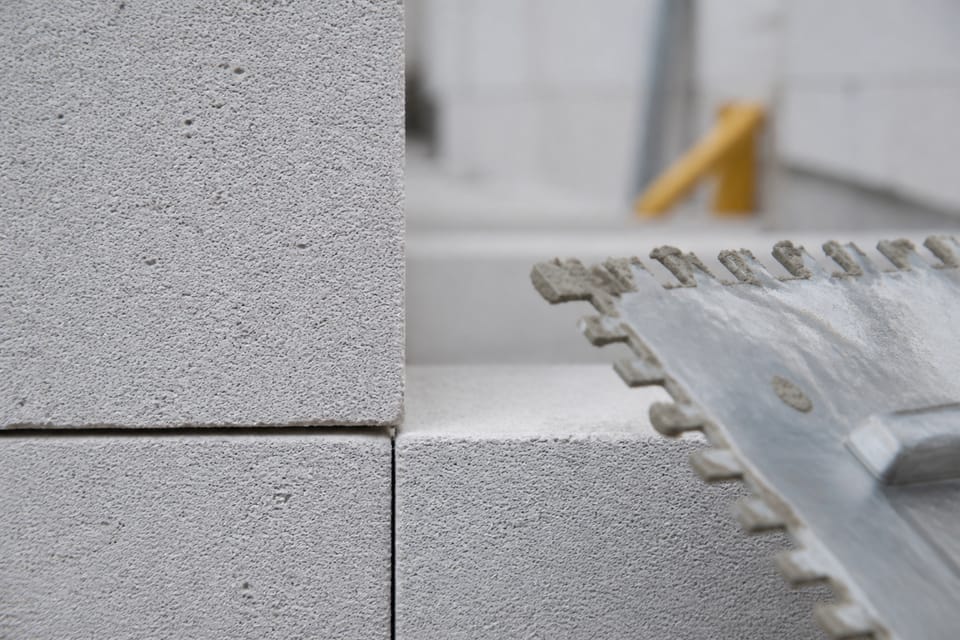
Makers also say how to handle the adhesive. JSW says to add 10 to 11 litres of water to a 40 kg bag. CMI says “Work in a small area at a time and fix blocks immediately to avoid skin over of adhesive bed.” Sika says “This is best achieved by laying the blocks as soon as the mortar is applied.” These are maker instructions. Follow the sheet you have.
How do I lay the first course?
The standard puts great care into the first course. It says the first course “shall be laid with greater care, making sure that it is properly aligned, levelled and plumbed” (clause 7.2.1). The method is: lay the blocks dry along a string stretched between properly located corners. Then remove the two corner blocks, spread a mortar bed, and lay them back “truly level and plumb” (clause 7.2.1.1).
The standard does not allow AAC blocks in foundations or below the damp-proof course: “Autoclaved cellular concrete blocks shall not be used in foundations and for masonry below damp-proof course” (clause 4.1.1). Ask your engineer where the first course sits on your plinth or beam.
Makers differ on the first course. One maker’s brochure says the first course should be laid with a cement and sand mortar bed. The adhesive sheets describe their own bed. Ask the supplier which method its sheet describes, and follow it.
Should I wet the blocks before laying?
The standard says the blocks need not be wetted before or during laying. It allows the top and sides to be slightly moistened only if the climatic condition requires it: “These blocks need not be wetted before or during the laying in the walls; in case the climatic condition so required, the top and the sides of the blocks may be slightly moistened so as to prevent absorption of water from the mortar” (clause 6.1).
The makers disagree with each other on this point. Sika’s sheet says “No pre-wetting of joint surfaces required”. JSW’s sheet says the brickwork must be dry and clean before the adhesive is applied, but also says porous and absorbing surfaces must be in a saturated surface-dry (SSD) condition. One Ambuja brochure shows a tick for “Dip the block in water and lift immediately / use wet cloth or sponge” and a cross for soaking the blocks for a long time. The sheets differ, so do not decide this alone. Follow the sheet for your product and ask your engineer.
Cutting, bonding and lintels
The standard limits cutting: “The cutting of units at the site shall be restricted to the minimum” (clause 4.5). Plan for full and half blocks where you can. One maker’s brochure says to cut with a hand saw, hack saw or rotary cutter, and says that cutting with a hammer and chisel is wrong. Cut with a saw.
Stagger the joints. One maker’s brochure says that joints should be staggered and that vertical joints should line up as little as possible. This comes from the maker, not from the standard.
The standard says that lintels over doors, windows and other openings “shall be made of either RCC cast in situ or precast units or shall conform to IS : 9893 - 1981” (clause 8.2). It gives no size or span here. Your engineer designs them.
What mistakes should I avoid?
This section is practice, except where a source is named.
- Making the joint thicker than the product allows. The Ambuja brochure calls a joint of more than 10 mm wrong for its product. The standard’s 10 mm applies to mortar joints.
- Soaking the blocks when the standard or the sheet says they need not be. See the section on wetting.
- Laying a course before checking the one below for level along its full length.
- Cutting with a hammer and chisel, which breaks the blocks.
- Using AAC in foundations or below the damp-proof course, which the standard does not allow (clause 4.1.1).
- Expecting a wall to be watertight without plaster in wet areas. The BMTPC and CBRI compendium says AAC is not recommended in wet regions without good plaster, because it absorbs water through its porous surface (PDF page 68). Check the plaster with your engineer.
Frequently asked questions
Can I use cement mortar instead of adhesive?
The standard sets mortar joints of 10 mm for most work. Adhesive is a product route that the makers describe; the standard does not cover it. Use the method your product sheet and your engineer approve.
Does AAC need to be soaked before laying?
The standard says no. It allows slight moistening only when the weather needs it (clause 6.1). The makers disagree, so follow the sheet for your product.
Can AAC be used for the foundation?
No. The standard says AAC blocks “shall not be used in foundations and for masonry below damp-proof course” (clause 4.1.1).
Related guides
- Red brick vs fly ash brick vs AAC block: how to choose for walls
- Which walls can be 4.5 inch? Load-bearing and partition walls
- Expansion joints in a house: where walls and slabs need a gap
- Why AAC block walls crack and how to avoid it
This guide is general information. Read the disclaimer. Your engineer decides the wall design, the lintels and the mix for your house.
Sources
- IS 6041:1985, Code of practice for construction of autoclaved cellular concrete block masonry (First Revision). Clauses 3.9.2, 4.1.1, 4.5, 6.1, 7.1, 7.2.1, 7.2.1.1 and 8.2 read from a scanned text copy. Current per the BIS record (valid to 2030-08-01).
- IS 2185 (Part 3):1984, Concrete masonry units: autoclaved cellular aerated concrete blocks (First Revision). Clause 3.2 read from a scanned text copy. Current per the BIS record (valid to 2030-08-01).
- JSW Block Grip Adhesive, technical data sheet (manufacturer, India). Instructions quoted as the maker's instructions, not as a standard.
- CMI Blockfix 187, technical data sheet (Nippon Paint group, Malaysia, 2022). Instructions quoted as the maker's instructions. The sheet gives two joint figures; both are reported.
- Sika SikaMur-100 Block Bond, product data sheet (Sika Singapore, May 2026, version 01.03). Singapore product; quoted as the maker's instructions.
- Ambuja Cool Walls brochure (2019), dos and don'ts section for Ambuja Blockol. Manufacturer's brochure, not a standard.
- BMTPC and CBRI, Compendium of Building Technologies (2021), AAC blocks entry, PDF page 68. Government compendium; no laying procedure in it.
Change log
- : Added Related guides link(s) to newly published article(s): Why AAC block walls crack and how to avoid it. No other text changed.
General information only. It is not a structural design or professional advice. Ask a licensed structural engineer or architect to check your plans and site.