
Short answer
How many concrete cube samples does IS 456 require for a slab pour? IS 456:2000 sets a minimum number of samples by the quantity poured: one sample for 1 to 5 cubic metres, up to four for 31 to 50 cubic metres, and more for larger pours. Each sample is three cubes, tested at 28 days. The count is a minimum, the sampling should be spread over the whole pour, and your engineer may ask for more.
On this page (10)
A concrete slab is hard to check once it has set. The test cubes are the one record of the strength you asked for. IS 456:2000 sets how many samples must be taken and how the results are judged. This page explains the rule, the common misreading that a 7-day cube decides the question, and what the sampling record should show.
It does not give a grade, a strength value or a mix. The grade is on your drawing, and your engineer chooses the mix.
What is a sample?
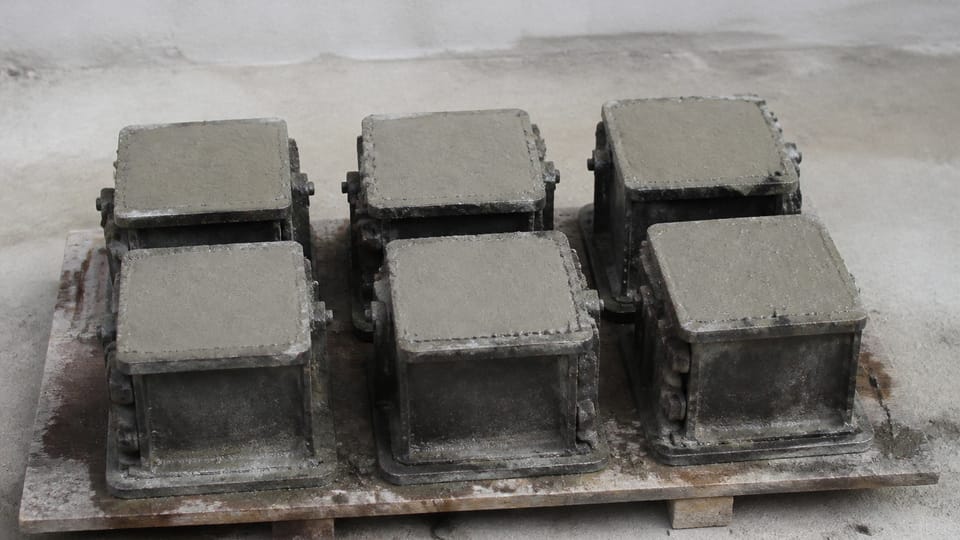
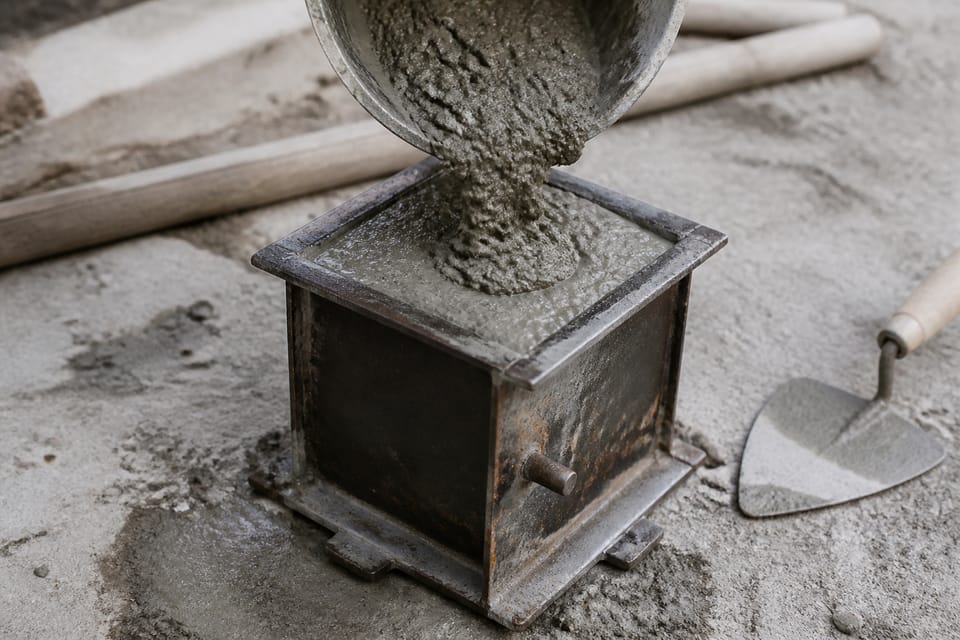
The test cubes are made from fresh concrete taken during the pour, cast in moulds and tested later. IS 456 says samples from fresh concrete are taken as per IS 1199, and cubes are made, cured and tested at 28 days as per IS 516 (clause 15.1). Each sample is three test specimens (clause 15.3).
The sample result is the average of the three specimens. If one specimen varies by more than 15 percent from that average, the result is invalid (clause 15.4).
How many samples for a pour?
Clause 15.2.2 gives the minimum number of samples for the concrete of each grade by the quantity in the work:
| Quantity of concrete in the work | Minimum number of samples |
|---|---|
| 1 to 5 cubic metres | 1 |
| 6 to 15 cubic metres | 2 |
| 16 to 30 cubic metres | 3 |
| 31 to 50 cubic metres | 4 |
| 51 cubic metres and above | 4, plus one for each additional 50 cubic metres or part thereof |
Source: IS 456:2000, clause 15.2.2. The note to the clause adds that at least one sample must be taken from each shift. For ready-mixed concrete from a continuous plant, the frequency may be agreed between the supplier and the buyer.
As an example, the table gives 6 samples for a 150 cubic metre pour. That is 4 for the first 50 cubic metres, and one more for each of the two further blocks of 50 cubic metres. This is arithmetic from the table, not a separate rule.
The samples should be spread across the whole pour. Clause 15.2.1 asks for random sampling, spread over the entire period of concreting and covering all mixing units, so each batch has a reasonable chance of being tested. Taking every cube from the first lorry does not meet this clause.
How is the sample judged?
The 28-day result is the test that counts. Clause 15.1.1 allows 7-day tests, but says that “the 28 days compressive strength specified… shall alone be the criterion for acceptance or rejection of the concrete”. A 7-day cube is an early indication, not the acceptance test.
Compliance is judged on the mean of any group of four consecutive test results (clause 16.1 a), and on each individual result against the individual limit in Table 11 (clause 16.1 b). If the concrete is deemed not to comply, the clause says the structural adequacy of the parts affected shall be investigated (clause 16.4). A low result therefore starts an investigation. It does not, on its own, reject the concrete. The investigation can include cores and load tests (clause 17).
What should the sampling record show?
IS 1199 (Part 1) sets the content of a sampling record in its clause 7. The record should show at least the sample identity, whether the sample is composite or spot, the date and time, the type and grade of cement and admixtures, the works the sample represents, the batch or truck identification, the ambient and concrete temperatures, and any departure from the standard method. It also carries a declaration by the person responsible that the sample was taken to the standard, with that person’s name and signature.
The laboratory report should show the identification mark that links it to the pour, the age at test, the curing condition and the date of test. The record is the link between the cube and the slab.
Inline image
What should I check at the pour?
These checks are practice. They are not steps in the code.
- Ask who takes the samples and who signs the record. IS 456 does not say who takes them, so ask for the name on the record.
- Check that the samples are spread across the pour, not all taken at the start.
- Check the mould is clean, assembled and labelled with the pour, the date and the batch.
- Keep the cubes sheltered and moist until they are tested. The curing and the time out of the tank are set by IS 516, and the details are for the lab.
- Ask for the lab report for each sample, with its identification mark, and keep it with the house papers.
- Ask what happens to a low result. Under clause 16.4 the answer is an investigation, and the engineer decides on cores or load tests.
What mistakes should I avoid?
These are practice points, with the clause they touch:
- Taking every cube from the first lorry or one spot in the discharge. Clause 15.2.1 asks for sampling spread over the whole pour.
- Judging the concrete on a 7-day cube. Clause 15.1.1 says the 28-day result alone is the criterion.
- Averaging two cubes instead of three. Clause 15.4 uses the average of three specimens.
- Labels that do not match the pour. The record and the cube must link to the same pour (IS 1199 clause 7).
- Failed results not recorded or reported. A low result needs the investigation under clause 16.4.
Frequently asked questions
Do I need one cube per 30 cubic metres?
No. IS 456 gives the count in the table in clause 15.2.2. Some sites and blogs quote other numbers. The table is the code, and the project specification may ask for more.
Is a 7-day cube test enough to accept the slab?
No. Clause 15.1.1 says the 28-day strength alone is the criterion for acceptance or rejection. The 7-day result is an early indication.
What happens if a cube test is low?
Clause 16.4 says the structural adequacy of the parts affected shall be investigated, and clause 17 gives the investigation methods, including cores and load tests. The engineer decides what is needed.
Who pays for cores or load tests?
IS 456 does not settle the cost. It leaves the decision on cores to the engineer. Agree the cost in the contract before the work starts.
Related guides
- Concrete cube test: how cubes are made, tested and read
- IS 456:2000 explained: what the concrete code covers
- Before the slab pour: an owner’s checklist for formwork and steel
- Cold weather concreting: pouring a slab in a north Indian winter
This guide is general information. Read the disclaimer. Your engineer decides the grade, the mix and the testing plan for your slab.
Sources
- IS 456:2000, Plain and Reinforced Concrete: Code of Practice (Fourth Revision). Clauses 15.1, 15.1.1, 15.2.1, 15.2.2 (table and note), 15.3, 15.4, 16.1, 16.3, 16.4 and 17.3 read from the archive.org text and the page image of clause 15.2.2.
- IS 1199 (Part 1):2018, Fresh Concrete: Methods of Sampling, Testing and Analysis (sampling clauses 6 and 7). Read for where and how a fresh sample is taken and what the record must hold.
General information only. It is not a structural design or professional advice. Ask a licensed structural engineer or architect to check your plans and site.