
Short answer
How is a concrete cube test made, tested and read? Cubes are cast from the fresh concrete in layers, compacted, levelled and kept in the mould for a set time, then cured in water. They are crushed at a set age, usually 7 and 28 days. IS 456 judges the concrete by groups of results and by single results, not by one cube. A low result is a reason to check the cause and ask the engineer, not an automatic verdict.
On this page (8)
A concrete cube test is the simplest check on the strength of the concrete used in a house. A small cube is cast from the fresh concrete, cured, and crushed in a testing machine. The result is a number that the engineer compares with the grade on the drawing. The test is easy to misread, so this page explains how the cube is made, how it is tested, and how the code groups the results. It gives no pass mark that is not in the code, and it does not replace the engineer’s judgement.
How is the cube made?
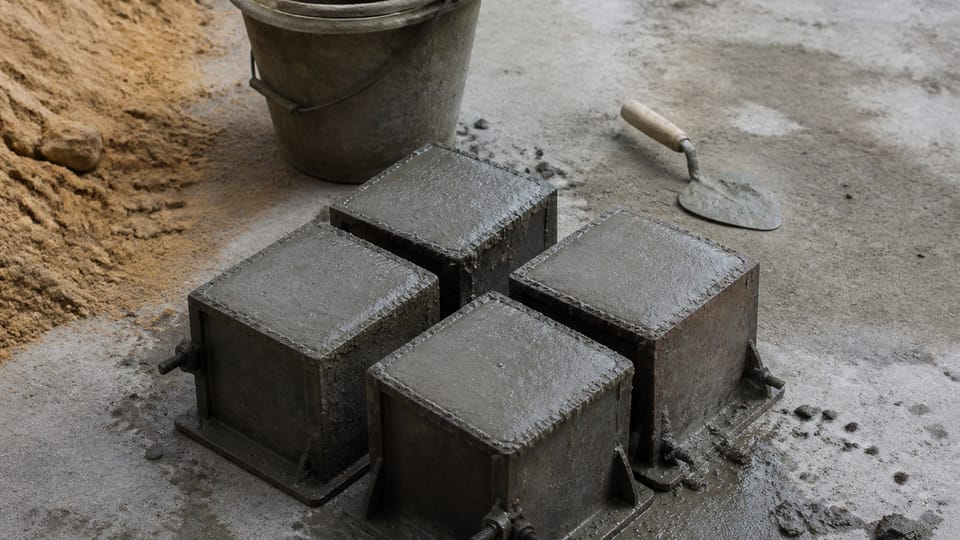
IS 1199 (Part 5) sets the size of the test specimen. The usual cube is 150 mm. A 100 mm cube may be used where the largest aggregate does not exceed 20 mm (clause 4.1.1).
The concrete is placed in layers of approximately equal depth, and each layer is not more than 50 mm thick (clause 6.2 c). Each layer is compacted by one of the methods the code lists, such as a tamping rod, a tamping bar, an internal vibrator or a vibrating table (clause 6.3). The top is then cut level with the top of the mould (clause 6.4).
The cube stays in its mould for at least 16 hours, and not longer than three days, from the time the water is added to the dry materials. After that it is cured in water at 27 °C plus or minus 2 °C (clause 7).
How is the cube tested?
IS 516 sets the ages at which the cubes are tested. The usual ages are 7 and 28 days (clause 3.3). The 28-day result is the one used for the grade (IS 456 clause 15.1.1). The 7-day result is an early indication only.
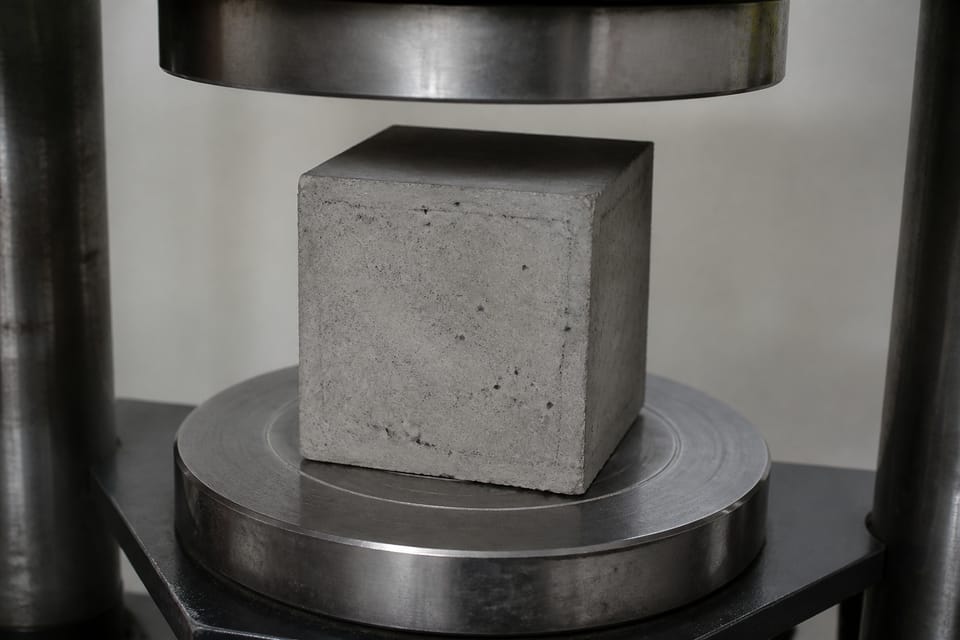
The cube is centred on the lower platen of the machine, to within one percent of its size, and it is squeezed in the direction perpendicular to the direction it was cast (clause 3.5.1). The load is applied without shock and increased at a constant rate until the cube can take no more (clause 3.5.2).
How does IS 456 read the results?
IS 456 takes the result of a sample as the average of the strength of three specimens. The individual specimens should not vary by more than 15 percent of the average. If they do, the result of that sample is invalid (clause 15.4). The engineer should check the lab report for this.
The concrete is judged in two ways (clause 16.1):
| Check | What the clause says | Clause |
|---|---|---|
| Group of results | The mean strength of any group of four consecutive test results complies with the limit for the grade | 16.1 a |
| Individual result | Any individual test result complies with its own limit | 16.1 b |
Both must be met. A single cube does not decide the grade. The limits themselves are in IS 456 Table 11, which the engineer checks.
What does a low result mean?
IS 456 does not treat a low result as an automatic verdict. If the concrete is judged not to comply, the structural adequacy of the parts affected must be investigated, and any action needed must be taken (clause 16.4). If there is doubt about the grade, either because of poor workmanship or based on the results of cube strength tests, the code allows core tests on the concrete in the structure (clause 17.4), or a load test (clause 17.6), or both (clause 17.3). The engineer decides which.
Before any action, check:
- Was the sample taken at the right place in the pour, and labelled correctly?
- Were the cubes made in the layers and compacted as the code says?
- Were they kept in the mould for the right time and then cured in water?
- Did the mix, the water and the cement match the drawing and the delivery records?
What mistakes should I avoid?
These are practice points, not code rules:
- Reading one cube as the verdict on the whole structure.
- Taking the 7-day result as the final strength.
- Casting cubes in a hurry, with the concrete not compacted in layers.
- Leaving cubes in the sun or in the rain instead of in the mould and then in water.
- Losing the labels, so no one knows which pour a cube came from.
- Ordering concrete without asking for the delivery record.
Frequently asked questions
Is the cube test enough to judge the concrete?
The cube is an important check, but the code judges the concrete by groups of results and by the individual results, and it asks the engineer to investigate a failing result. Ask your engineer to read the full lab report with you.
Why do cubes from the same pour give different results?
Sampling, casting, compaction and curing all affect a cube. The code groups the results for this reason. An isolated low result needs its cause found before any conclusion is drawn.
Is a 7-day cube the same as the 28-day result?
No. The 7-day result is an early indication. The grade is judged on the 28-day result (IS 456 clause 15.1.1). For how long the concrete should be kept moist, see how many days to cure a concrete slab.
These answers are practice guidance, not code quotes.
This guide is general information. Read the disclaimer. Your engineer decides what a test result means for your house.
Related guides
- Concrete grades M15 to M25: what the number means on your drawing
- How many days to cure a concrete slab?
- Water for construction: what water is fit for concrete and curing
- How many cubes to take from a slab pour: the IS 456 sampling rule
Sources
- IS 1199 (Part 5):2018, Fresh concrete: methods of sampling, testing and analysis, Part 5: Making and curing of test specimens (clauses 4.1.1, 6.2, 6.3, 6.4, 7). Read from a third-party copy; check against the BIS print.
- IS 516 (Part 1/Sec 1):2021, Methods of tests for strength of concrete: compressive, flexural and split tensile strength (clauses 3.3, 3.5.1, 3.5.2). Read from a third-party copy; check against the BIS print.
- IS 456:2000, Plain and Reinforced Concrete, Code of Practice (Fourth Revision), clauses 15.4, 16.1, 16.4, 16.6, 17.3. Read from an OCR copy; check against the printed code.
Change log
- : Added Related guides link to newly published article(s): how-many-cubes-to-take-from-a-slab-pour-the-is-456-sampling-rule. No other text changed. Approved by the reviewing engineer (owner report, 2026-10-31).
General information only. It is not a structural design or professional advice. Ask a licensed structural engineer or architect to check your plans and site.