
Short answer
Can I pour a concrete slab in winter in north India? Yes, if the concrete is protected. Cold slows the setting and the strength gain, and frost can damage fresh concrete. The Indian code for cold-weather concreting is IS 7861 (Part 2). Keep the forms free of ice, cover the slab against frost, and this page recommends no calcium chloride without the engineer's written approval. Your engineer sets the protection and the timing for removing the forms.
On this page (8)
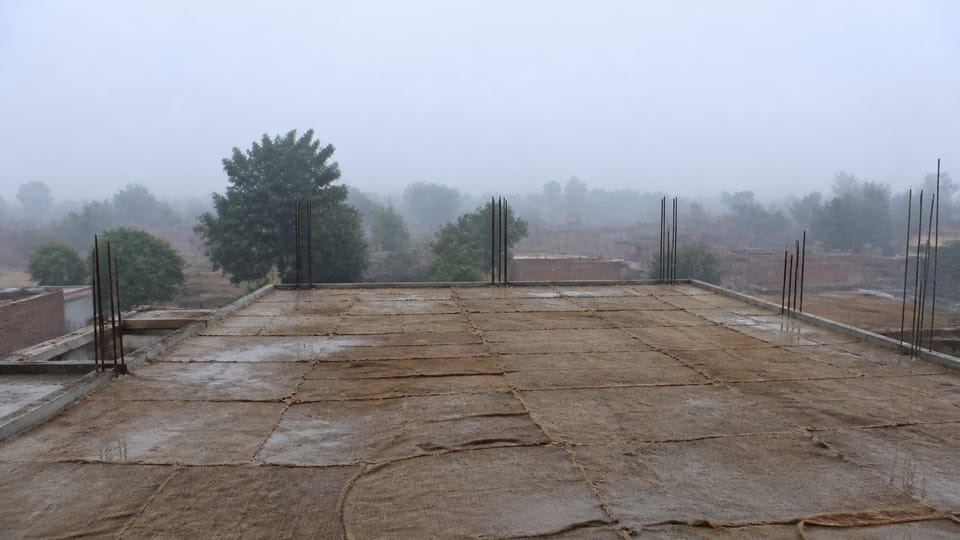
Concrete is poured on roofs in north India in the cooler months, and the winter slab is where many owners first meet the problem. Cold does not stop concrete. It slows it, and if the water in fresh concrete freezes, the damage can be permanent. This page explains the effect of cold, what the Indian code says the job needs, and what an owner should ask for. It gives no temperature limits, no day counts and no mix quantities. Those come from the standard and your engineer.
Why does cold matter for concrete?
Concrete hardens because cement reacts with water. The reaction is slower when the concrete is cold, so the concrete takes longer to set and gain strength. The standard says that when the temperature falls, strength develops more slowly, and that the time before the forms can come off is longer than in normal weather.
The bigger danger is frost. IS 7861 Part 2 explains that concrete still in its soft state can have ice form in its pores as the water freezes and expands. If the water in fresh concrete freezes, the standard warns of “irreparable loss of strength and other qualities,” higher permeability and impaired durability. Repeated freezing and thawing can harm concrete that has set. The standard also warns that large temperature differences inside a member may promote cracking (clause 3.1).
What does the Indian code say?
The Indian code for cold-weather concreting is IS 7861 (Part 2). IS 456 clause 14.1 sends hot- and cold-weather work to IS 7861 Part 1 or Part 2, and Part 2 is the cold-weather code. IS 456 itself does not give a cold-weather temperature limit, so do not look for one there.
The standard’s main points, in plain words:
- Ice and frozen ground. Ice, snow and frost must be removed from the surfaces in contact with new concrete, and those surfaces raised close to the concrete’s temperature (clause 8.1). The standard says: “No concrete shall be placed on a frozen subgrade or on one that contains frozen materials.” Concrete must also not be placed against reinforcement or forms covered with snow or ice (Table 1).
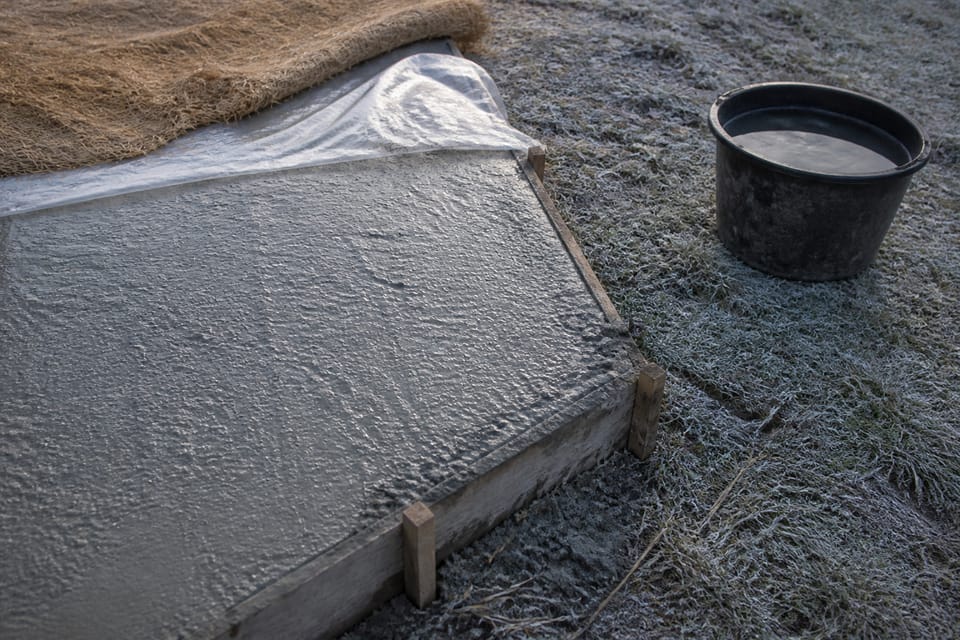
- Cover the concrete. As soon as the concrete is placed, its surface should be covered to keep the heat in and to help prevent freezing. The standard names straw blankets, sacking, tarpaulins, expanded polystyrene and plastic sheeting, used with an air gap or insulation.
- Chemicals. The standard says that calcium chloride, or other chemicals in the mix, if used in permissible amounts, will not lower the freezing point of concrete to any significant degree, and that harmful materials must not be used to protect concrete from freezing (clause 5.2.7). Clause 5.2 allows calcium chloride as an accelerator but lists conditions where it must not be used (clauses 5.2.1 to 5.2.1.4). Requiring the engineer’s written approval is this page’s advice, not a requirement of the code.
- Curing. In freezing or near-freezing weather, water curing is not necessary, because loss of moisture by evaporation is greatly reduced in cold air (clause 8.3). When the formwork comes off, the member should be immediately covered with plastic sheet or tarpaulins (clause 8.3.1), and it must not be soaked with cold water.
- Forms. The standard says removing forms is often better delayed, and that the time limit for removing the side forms of beams, columns and walls shall in no case be less than the prehardening period (clause 8.4; defined in clause 2.2). The exact timing is for the engineer.
- Checks. Record the air and concrete temperatures, and measure at several points and on the surface (clause 9.1). The standard asks for the concrete temperature to be measured at placing, when the protection goes on, and at the frequency set in clause 9.3, until the concrete has resistance to freezing.
Clause 2.1 defines cold-weather concreting by air temperature. This page does not print that threshold or the other values, which the standard gives in its tables. Ask your engineer to confirm them for your site and your slab.
What does a protected winter pour look like?
Practice varies from site to site. As practice, not code, a careful job often does these things:
- Checks the night forecast before the pour. A pour on a night with frost or fog is postponed or fully covered.
- Keeps the forms, reinforcement and any fixings free of ice and snow.
- Asks the concrete supplier to check each truck’s temperature when it arrives, because the plant may preheat only a limited amount of material.
- Covers the slab as soon as it is finished, with more than one layer if the night is cold. One thin sheet is not enough.
- Keeps the surface moist through the curing period, as the mason’s plan sets out, and does not let it dry out.
- Keeps heaters, if used, away from the surface. Direct heat dries and marks the concrete.
- Keeps the mix as agreed. Ask the supplier not to change the mix or add water on site.
The standard covers heated aggregate and heated mixing water (clauses 4.2 and 4.3), with limits and a warning about flash set. These are controlled practices, not a home trick. Ask the engineer and the supplier before using them.
| Stage | What to check | Who decides |
|---|---|---|
| Before the pour | Night forecast, ice and frost on forms and steel, ground not frozen | Mason, with the engineer’s plan |
| At the pour | Concrete temperature on arrival, mix as agreed, no added water on site | Supplier and site engineer |
| After the pour | Cover in place, surface kept moist, heaters not on the slab | Mason, following the plan |
| Form removal | Strength and the prehardening period complete | Engineer, in writing |
What mistakes should I avoid?
These are practice points, not code rules.
- Pouring on a frosty night. The protection is weakest when the night is coldest. Postpone the pour.
- Relying on one sheet. A single thin cover does not keep the slab warm enough.
- Adding salt or calcium chloride to speed the set. Chloride can corrode steel. Use it only with the engineer’s written approval.
- Pouring onto frozen ground or against frozen forms. Thaw and clean them first.
- Pouring at night because it seems slower. Cold at night raises the freezing risk. Protection, not timing, is the answer.
- Removing the forms on a calendar date alone. The removal timing depends on the strength and the engineer’s decision.
- Using a direct heater under or next to the slab. It dries and cracks the surface.
What should an owner ask for?
- A written protection plan for the night, from the mason and the engineer.
- The engineer’s cold-weather requirement, and the strength the slab must reach before it can be exposed to frost.
- Whether warm water, heated aggregate or any accelerator is planned, and the engineer’s written approval for any chloride.
- A check that the forms, reinforcement and ground are free of ice and frost on the day.
- A forecast check before the pour, and a decision to postpone if frost or fog is expected.
- A written plan for when the protection and the forms come off, set by the engineer.
Frequently asked questions
Does cold weather slow concrete?
Yes. Cold slows the reaction between cement and water, so the concrete sets more slowly and gains strength more slowly. That is why the protection and the form-removal timing must be longer than in summer.
What happens if concrete freezes before it sets?
IS 7861 Part 2 warns of irreparable loss of strength and durability. The water in the pores expands as it freezes, which can crack the concrete and leave it weak. Protect the slab so that it does not freeze.
Can I add calcium chloride in winter?
Only with the engineer’s written approval, which is this page’s advice. Calcium chloride can corrode the steel in reinforced concrete, and it does not lower the freezing point of concrete to any significant degree, so it is no protection against frost.
Do I need the engineer to approve a winter pour?
Yes, in practice. The engineer sets the protection, the timing and any chemical use, and should know the pour is in winter. Ask for their approval in writing.
Related guides
- How many days to cure a concrete slab
- Concrete grades M15 to M25 explained
- Best time to build a house in Delhi
This guide is general information. Read the disclaimer. Your engineer decides the protection, the temperatures and the timing for your slab.
Sources
- IS 7861 (Part 2):1981, Code of Practice for Extreme Weather Concreting: Part 2 Recommended Practice for Cold Weather Concreting (reaffirmed). Clauses 2.1, 2.2, 3.1, 4.2, 4.3, 5.2, 5.2.7, 8.1, 8.2, 8.3, 8.3.1, 8.4, 9.1, 9.3 and Table 1 (read from a scanned copy; the numbers in its tables were not used).
- IS 456:2000, Plain and Reinforced Concrete: Code of Practice (fourth revision). Clause 14.1.
General information only. It is not a structural design or professional advice. Ask a licensed structural engineer or architect to check your plans and site.