
Short answer
What does IS 1489 Part 1 require of fly ash Portland pozzolana cement? IS 1489 (Part 1):2015 covers Portland pozzolana cement made with fly ash. The fly ash must be between 15 and 35 percent by mass, the cement has limits on loss on ignition, sulphur trioxide and magnesia, and it must meet setting time, fineness and strength minimums. Each bag must be marked with the fly ash percentage and a batch number.
On this page (10)
Portland pozzolana cement, or PPC, is one of the cement types sold in India, and the bag often says “fly ash based” as well. The Indian standard for this cement is IS 1489 (Part 1):2015. This page walks through what the standard asks of the cement: what it can contain, the limits it sets, and what must be printed on the bag. It gives no price, no brand and no ranking, and it does not say which job PPC suits.
What does the standard cover?
Clause 1 says the standard “covers the manufacture and chemical and physical requirements of Portland pozzolana cement using fly ash as pozzolana”. Part 2 of the same standard covers the calcined clay type. This page is about Part 1 only.
Clause 3.1 defines the cement as “an intimately interground mixture of Portland cement clinker/ ordinary Portland cement and pozzolana with the possible addition of gypsum (natural or chemical)”, or a blend of ordinary Portland cement with fine pozzolana and ground gypsum where required. The fly ash itself must meet IS 3812 (Part 1), as clause 4.1 says. IS 3812 (Part 1) is the fly ash standard.
How much fly ash can it contain?
Clause 5 sets the range: “The fly ash constituent shall not be less than 15 percent and not more than 35 percent by mass of Portland pozzolana cement.” The mix must also be uniform: the fly ash in the same consignment must be within plus or minus 3 percent of the declared fly ash addition.
Clause 5 also allows no material to be added after burning, other than gypsum, water and up to 1.0 percent of air-entraining agents or other agents, including colouring agents, that have proved not to be harmful.
What chemical limits apply?
Table 1 of IS 1489 (Part 1) sets the chemical limits. The ones a reader is most likely to see are:
| Property | Limit in IS 1489 (Part 1):2015 | Table 1 entry |
|---|---|---|
| Loss on ignition | Maximum 5.0 percent by mass | Sl No. iv |
| Total sulphur as SO3 | Maximum 3.5 percent by mass | Sl No. iii |
| Magnesia | Maximum 6.0 percent by mass | Sl No. ii |
The foreword notes that the sulphur limit was raised in this revision and that the user must still limit sulphates in concrete under IS 456:2000. Your engineer handles that check for the job.
What physical limits apply?
Table 2 sets the physical limits. The values below are a selection from Table 2:
| Property | Limit | Test standard named in Table 2 |
|---|---|---|
| Fineness | Minimum 300 m2/kg | IS 4031 (Part 2) |
| Le Chatelier soundness | Maximum 10 mm | IS 4031 (Part 3) |
| Initial setting time | Minimum 30 minutes | IS 4031 (Part 5) |
| Final setting time | Maximum 600 minutes | IS 4031 (Part 5) |
| Compressive strength at 72 hours | Minimum 16 MPa | IS 4031 (Part 6) |
| Compressive strength at 168 hours | Minimum 22 MPa | IS 4031 (Part 6) |
| Compressive strength at 672 hours | Minimum 33 MPa | IS 4031 (Part 6) |
The strength limits are given in hours, not days, and they are minimums. The standard does not set a separate limit for each grade name. Note 4 under Table 2 says the cement must show a progressive increase in strength from the 72-hour value. IS 1489 (Part 1) does not define a “33 grade”. The 33 MPa in Table 2 is the minimum compressive strength at 672 hours.
What must the bag say?
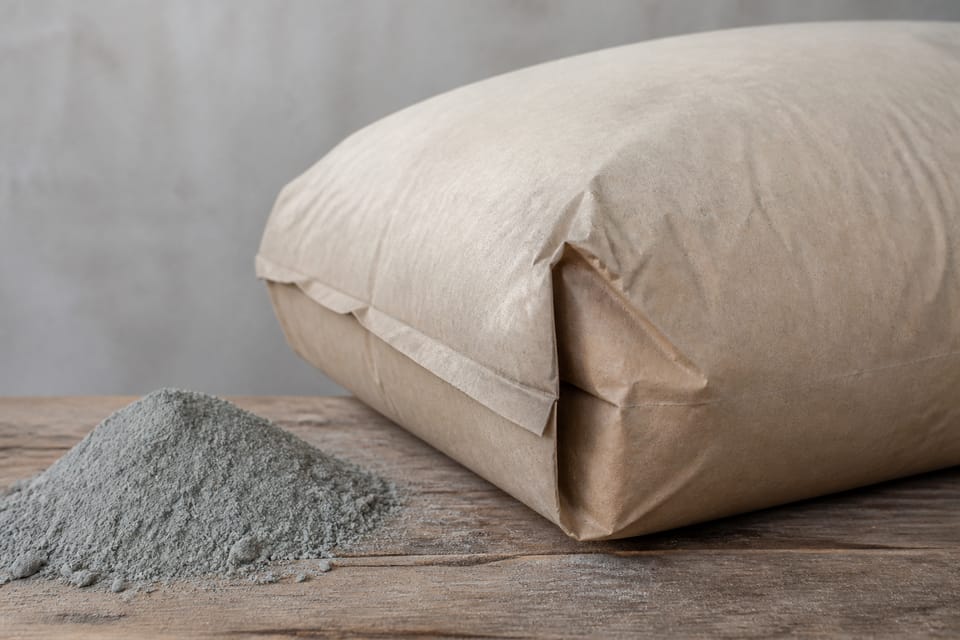
Clause 11.1 lists what each bag or drum must carry, legibly and indelibly. The items include:
- the manufacturer’s name and trade mark, and the manufacturer’s address;
- the words “Portland pozzolana cement: Fly ash based”;
- the net quantity in kilograms (the standard sets 50 kg per bag in clause 10.1.1);
- the batch or control unit number, in terms of the week, month and year of packing (clause 11.1(e));
- a best-before date, three months from the date of packing (clause 11.1(f));
- the percentage of fly ash addition (clause 11.1(j));
- a note on the need for testing cement more than three months old before its use (clause 11.1(g)).
The standard says the cement “may also be marked with the Standard Mark” (clause 11.3), so the BIS mark itself is optional under this clause.
What certificate and tests apply?
Clause 9.1 says that if the purchaser asks, the manufacturer must furnish a test certificate “within ten days of testing of the cement”. The 28-day result follows when that test ends. Clause 12.1.1 says samples must be taken within three weeks of delivery, and tests must start within a week of sampling. Clause 14.2 says bulk cement held at the factory for more than six months, or bagged cement held by a vendor for more than three months after testing, must be retested before use.
What mistakes should I avoid?
- Buying PPC without the fly ash percentage on the bag. Clause 11.1(j) says the bag must show it. If it does not, ask the seller for the figure in writing. This is practice, backed by the clause.
- Using old cement without a retest. Clause 14.2 sets the retest rule for stored cement. Keep the purchase date and check the best-before date. This is practice.
- Taking the grade name on the bag as the standard’s grade. IS 1489 does not name grades; check the strength minimums in Table 2 and the test certificate. This is practice.
- Assuming PPC suits every job. The standard does not say which jobs PPC suits or how long it must cure. Your engineer decides the cement and the curing for each part of the house.
Frequently asked questions
Is PPC the same as OPC?
No. PPC contains fly ash; OPC does not. The OPC, PPC and PSC page compares the types.
Does IS 1489 cover slag cement?
No. IS 1489 (Part 1) covers Portland pozzolana cement made with fly ash. This page does not cover other cement types.
What is the fly ash range?
Clause 5 sets it at 15 to 35 percent by mass, with a +3 percent uniformity tolerance on the declared figure.
Which of these should I check on delivery?
The fly ash percentage, the batch number and the best-before date on the bag. Ask for the test certificate under clause 9.1.
Related guides
- OPC, PPC and PSC: the types of cement
- Types of cement in India and their IS codes: OPC, PPC, PSC, SRC, white, low heat and composite
This guide is general information. Read the disclaimer. Your engineer decides which cement suits each part of your house and how it is cured.
Sources
General information only. It is not a structural design or professional advice. Ask a licensed structural engineer or architect to check your plans and site.