
Short answer
What are the types of cement in India and their IS codes? NBCS 2026 lists OPC (IS 269), Portland slag cement (IS 455), Portland pozzolana cement (IS 1489 Parts 1 and 2), composite cement (IS 16415) and calcined clay limestone cement (IS 18189) for general concrete, and sulphate resisting, white, low heat, rapid hardening, hydrophobic and others for specific uses. Counts differ by source. The engineer picks the type for each job.
On this page (10)
- What does NBCS 2026 say about cement types?
- What are the types and their IS codes?
- Which of these does a house actually use?
- What do 33, 43 and 53 mean, and how are they different from M20?
- How do I read a bag?
- What should I ask before buying?
- What mistakes should I avoid?
- Frequently asked questions
- Related guides
- Sources
“How many types of cement are there?” has no single answer. A BIS blog speaks of standards for about fifteen hydraulic cements, another source says thirteen, and a certification site lists sixteen codes: the count depends on what is included. This page lists the types that have an Indian Standard, with the code, the scope line of the standard in plain words, and a note where we could only read an older edition. It does not say which cement is best, names no brand, and gives no strength, chemical or price figure. For a house, the engineer chooses the cement for each job, and the choice between OPC, PPC and PSC has its own page: OPC vs PPC vs PSC cement: which one for your house?.
What does NBCS 2026 say about cement types?
NBCS 2026, Part C Section 5, Annex A, clause A-2.1 says: “For general use in plain, reinforced and prestressed concrete construction, cement used shall be any of the following and the type selected should be appropriate for the intended use”. The list is ordinary Portland cement (IS 269:2015), Portland slag cement (IS 455:2015), Portland pozzolana cement, fly ash based and calcined clay based (IS 1489), composite cement (which the clause allows for reinforced concrete construction, with a declared minimum clinker content, a maximum fly ash content and a minimum 28-day strength set out in the clause) and Portland calcined clay limestone cement (IS 18189:2023, which at locations where temperatures are predominantly cold, as the clause defines, is not permitted in underground structures and structural elements in contact with ground water).
Clause A-2.2 adds that “other cements as given below can be used for specific applications”: sulphate resisting, microfine ordinary Portland, hydrophobic, low heat, rapid hardening, high alumina, supersulphated and white. The same clause list is the best short answer to the question above.
What are the types and their IS codes?
| Type | IS code | What the standard’s scope line says | Edition read, status |
|---|---|---|---|
| Ordinary Portland cement (OPC) | IS 269 | Manufacture and chemical and physical requirements of ordinary Portland cement | We read the 2013 edition (33 grade), now withdrawn. NBCS lists IS 269:2015, which is in force and was not readable |
| OPC 43 and 53 grade, older codes | IS 8112, IS 12269 | The same scope line, for 43 grade and 53 grade | 2013 editions read; BIS lists both as withdrawn, and NBCS cites IS 269 alone |
| Portland pozzolana cement (PPC), fly ash based | IS 1489 (Part 1) | Cement using fly ash as the pozzolana | 2015, read; in force |
| PPC, calcined clay based | IS 1489 (Part 2) | Cement using calcined clay, or calcined clay with fly ash, as the pozzolana | 2015; in force |
| Portland slag cement (PSC) | IS 455 | Manufacture and chemical and physical requirements of Portland slag cement | 2015, read; in force |
| Composite cement | IS 16415 | Manufacture and chemical and physical requirements of composite cement | 2015, read; in force |
| Portland calcined clay limestone cement | IS 18189 | Manufacture and chemical and physical requirements of the cement | 2023, read; in force |
| Sulphate resisting Portland cement | IS 12330 | Manufacture, requirements and testing of sulphate resisting Portland cement | 1988, read; in force |
| White Portland cement | IS 8042 | Manufacture and chemical and physical requirements of white Portland cement | 2015, read; in force |
| Low heat Portland cement | IS 12600 | For use where low heat of hydration is required, as in mass concrete for dams | 1989, read; in force |
| Rapid hardening Portland cement | IS 8041 | Rapid hardening cement; the note says it “should not be confused with ‘quick-setting’” | 1990 read (that edition is now withdrawn); a 2026 edition is current and was not readable |
| Hydrophobic Portland cement | IS 8043 | Hydrophobic Portland cement | 1991 read (that edition is now withdrawn); a 2026 edition is current and was not readable |
| Supersulphated cement | IS 6909 | Composition, manufacture and testing of supersulphated cement | 1990 read (that edition is now withdrawn); a 2026 edition is current and was not readable |
| Masonry cement | IS 3466 | Masonry cement “to be used for all general purposes where mortars for masonry are required” | 1988 read; a 2026 edition is current and was not readable |
| High alumina cement for structural use | IS 6452 | Its use as a structural building material in the colder regions; refractory use is not covered | 1989 read; BIS lists a 2026 edition too |
| Microfine OPC | IS 16993 | Manufacture and requirements of microfine ordinary Portland cement | 2018; in force |
Ground granulated blast furnace slag (IS 16714:2018) is the slag material used in making cement and as a mineral admixture, not a cement, so it is not in the table.
We quote the scope lines from the text of each standard and have not rendered those pages, and the older editions may differ from the current ones. For older-only rows, treat the line as indicative and ask your engineer or supplier for the current edition.
Which of these does a house actually use?
Most houses use OPC, PPC or PSC, chosen by the engineer in the specification. The rest are for particular jobs: sulphate resisting where the soil or groundwater calls for it (IS 456 Table 4, which the OPC, PPC and PSC page cites), white cement for finishing, grouting and repairs (see wall putty vs POP vs white cement: which goes where), low heat cement for mass concrete such as dams, rapid hardening cement where early strength is wanted, and masonry cement for mortar. White cement has its own standard, IS 8042, with a whiteness requirement, and is not simply OPC with a colour added. The uses named for white, low heat, rapid hardening and masonry cement are practice or the standard’s own scope lines, not design rules: the type for each member is the engineer’s call.
What do 33, 43 and 53 mean, and how are they different from M20?
The grade number names the cement’s strength class (the standards set a minimum compressive strength for each grade), so 43 and 53 describe the cement. M20 and M25 describe the concrete: see concrete grades M15 to M25 explained. In the 2013 editions the three OPC grades were separate standards, IS 269 for 33 grade, IS 8112 for 43 and IS 12269 for 53; BIS now lists IS 8112 and IS 12269 as withdrawn and NBCS cites IS 269:2015 alone for OPC. We could not read IS 269:2015, so we do not state its grades here. A web page that gives IS 8112 as the current code for 43 grade is out of date.
How do I read a bag?
This is practice, following BIS marking guidance. The bag should carry the ISI Standard Mark with the IS number, the licence number, the type and grade, the maker, the net quantity, a batch number and the packing date. Page-by-page detail is in checking cement on site: bag marks, licence and lab tests, and the storage limit is in cement shelf life: how long can cement be stored on site?. Maker-specific batch-code decoders on websites are unverified: do not rely on them. For a list of the codes a house build touches, see IS codes for house construction: which standard covers what.
What should I ask before buying?
- Which cement type and grade the drawing or the specification names; do not switch type between plan and site without asking the engineer.
- That the bill names the type (OPC, PPC, PSC) and not only the grade, and that the bags carry the Standard Mark with the matching IS number.
- That the batch and packing date are recent.
- For a special cement, which standard and which edition applies, since several have a newer edition than the one we could read.
What mistakes should I avoid?
These are practice unless a standard is named.
- Treating the count of cement types as a fixed number.
- Using the old IS 8112 or IS 12269 as the current code for 43 and 53 grade.
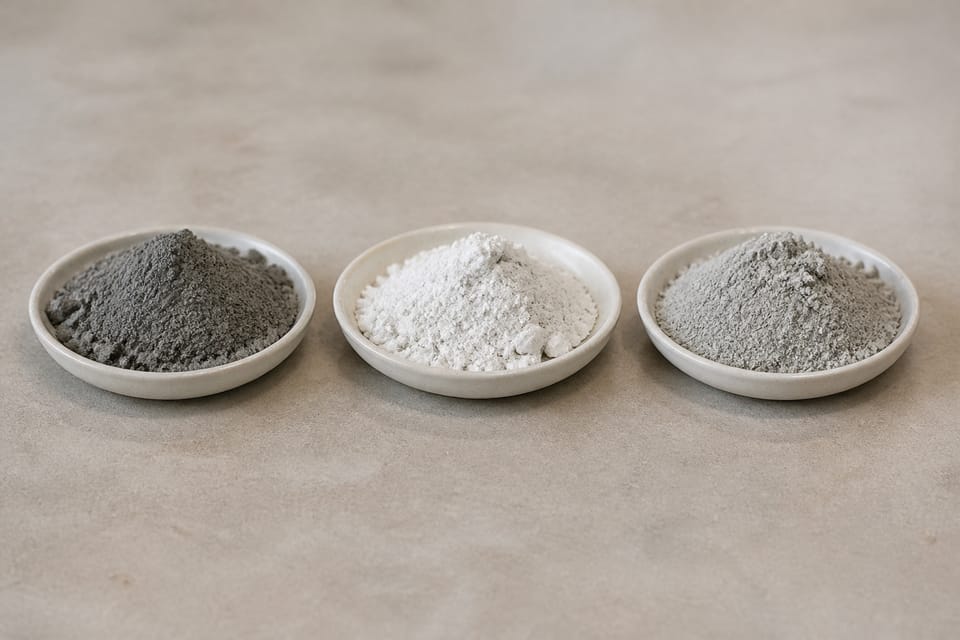
- Taking the colour of the powder as the type.
- Using white cement as a structural cement, or a “waterproof” or “special” cement in place of curing and proper waterproofing.
- Mixing types in one pour without asking the engineer.
- Ordering by grade name alone, without the type.
- Believing a batch-code decoder blog instead of the BIS licence check.
Frequently asked questions
How many types of cement are there in India?
It depends on what is counted. BIS has standards for about fifteen hydraulic cements, and NBCS 2026 lists a different set of general-use and specific-use cements.
Which IS code is for OPC, PPC and PSC?
IS 269 for OPC, IS 1489 (Part 1 fly ash, Part 2 calcined clay) for PPC, and IS 455 for PSC, each in its 2015 edition as NBCS lists them.
Is white cement just OPC with colour?
No. It has its own standard, IS 8042, with a whiteness requirement. In practice it is used for finishing, grouting and repair work; the 1989 edition of the standard described it as generally for non-structural use.
What is composite cement?
It is a cement with its own standard, IS 16415, which NBCS lists for general use in reinforced concrete when its declared clinker, fly ash and 28-day strength conditions are met.
Is 53 grade always better than 43 grade?
The standards do not say so. The grade is a strength class, and the engineer specifies the cement for the job.
Related guides
- OPC vs PPC vs PSC cement: which one for your house?
- Checking cement on site: bag marks, licence and lab tests
- Concrete grades M15 to M25 explained
This guide is general information. Read the disclaimer. Your engineer decides the cement type and grade for each part of your house.
Sources
- SP 7:2026, National Building Construction Standards (NBCS) 2026, Part C Section 5, Structural Concrete, Annex A clauses A-2.1 and A-2.2 (page image read); the front list of cement standards of the same volume (text layer). From an unofficial archive.org copy.
- IS 1489 (Part 1):2015 and IS 455:2015, IS 8042:2015, IS 12330:1988, IS 12600:1989, IS 16415:2015, IS 18189:2023: clause 1 scope lines (text layer of the archive.org copies; page images not rendered). BIS lists each as in force.
- IS 269:2013 (fifth revision, 33 grade), IS 8112:2013 and IS 12269:2013 (older single-grade OPC standards, withdrawn); IS 3466:1988, IS 8041:1990, IS 8043:1991, IS 6909:1990 and IS 6452:1989: clause 1 scope lines (text layer). BIS lists 2026 editions of IS 3466, IS 8041, IS 8043, IS 6909 and IS 6452 as current; those were not readable. IS 269:2015 was not readable either.
General information only. It is not a structural design or professional advice. Ask a licensed structural engineer or architect to check your plans and site.