
Short answer
What does IS 516 cover? IS 516 is the Indian code of methods of test for hardened concrete. It has been split into parts. Part 1 Section 1 covers the compressive, flexural and split tensile strength tests. Other parts cover density, water penetration, pulse velocity and rebound hammer tests. The 1959 edition is withdrawn. Ask the lab which part and section its test followed.
On this page (10)
If a house has a concrete strength test, the report names an IS code. That code is often IS 516, the Indian methods of test for hardened concrete. It is a test code, not a design code. It says how a sample or a structure is tested. This page explains what IS 516 covers, which part holds which test, and what to ask the lab. It gives no strength values, no rebound readings and no test ages, because those belong to the mix and the engineer’s acceptance rules.
What is IS 516?
IS 516 is the methods-of-test code for hardened concrete. The 2021 foreword says the code “has been split into 12 parts”. The parts are separate standards, each with its own number, so a test report should name the part and section it used. The copies read here are the 2021 Part 1 Section 1, the 2018 Part 2 Section 1 and the 2018 Part 5 Section 1.
Which part covers which test?
The table lists the parts named in the copies and the BIS listing. It is not a full list of every part of IS 516.
| Part and section | What it covers | Read for this page |
|---|---|---|
| Part 1 Sec 1 (2021) | Compressive, flexural and split tensile strength | Yes: clause 1 scope, clauses 3 to 5 |
| Part 2 Sec 1 (2018) | Density, and depth of water penetration under pressure | Yes: clause 1 scope |
| Part 2 Sec 2, 3 and 4 | Surface absorption, oxygen permeability, carbonation (accelerated) | Titles only, from the BIS listing |
| Part 4 (2018) | Sampling, preparing and testing of concrete cores | Title only |
| Part 5 Sec 1 (2018) | Ultrasonic pulse velocity | Yes: clause 1 scope and note |
| Part 5 Sec 2, 3 and 4 | Half-cell potential, carbonation depth, rebound hammer | Titles only |
| Part 6 (2020) | Drying shrinkage and moisture movement | Title only |
| Part 8 Sec 1 (2020) | Static modulus of elasticity and Poisson’s ratio in compression | Title only |
| Part 11 (2020) | Portland cement content of hardened concrete | Title only |
The table names what each part covers. It gives no values, because the values are in the standards and depend on the mix.
What does Part 1 Section 1 cover?
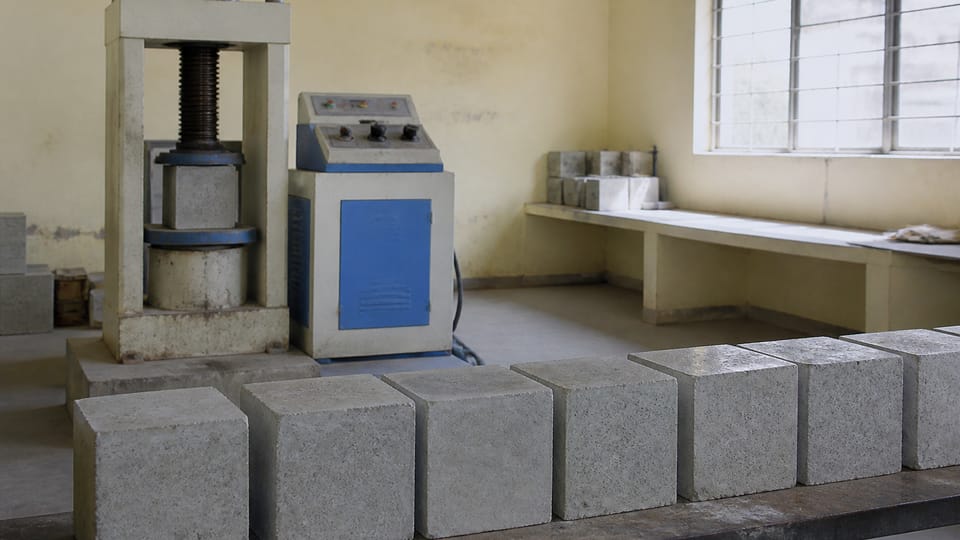
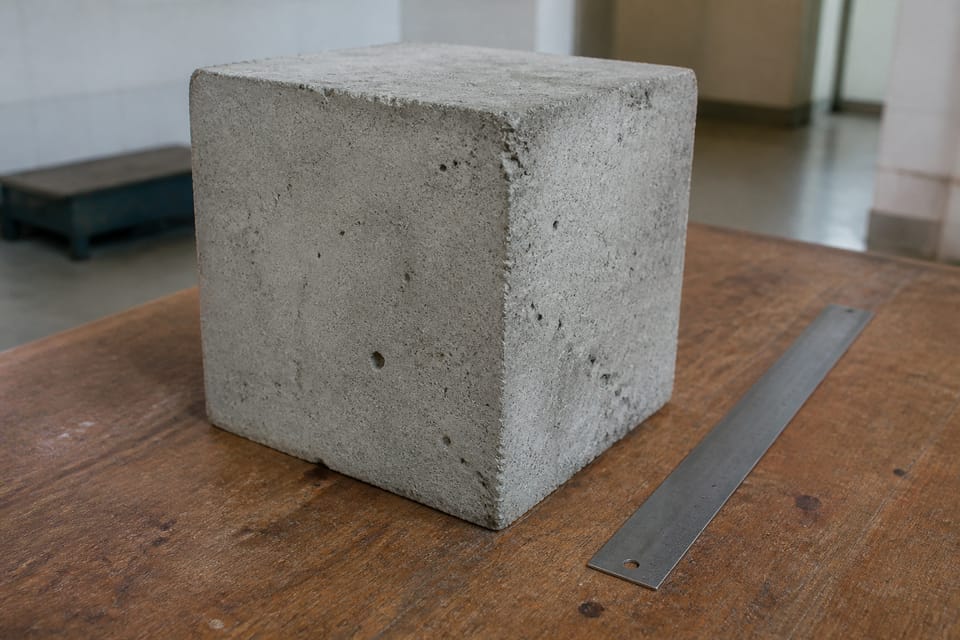
Clause 1 of IS 516 (Part 1/Sec 1):2021 says the standard “covers procedures for testing compressive, flexural and split tensile strength of hardened concrete”. Clause 3 deals with the compressive strength test, clause 4 with the flexural strength test and clause 5 with the splitting tensile strength test. The cube compressive strength test is in clause 3.
What does Part 5 Section 1 cover?
Part 5 is about non-destructive testing. Part 5 Section 1 covers only the ultrasonic pulse velocity test. Its clause 1 note says that results obtained by one method shall be complemented by other tests. So a pulse velocity reading is not a substitute for a cube or core result on its own.
What happened to the 1959 edition?
The BIS listing records IS 516:1959 as withdrawn on 14 March 2022. The 2021 Part 1 Section 1 cover note says IS 516:1959 “shall be superseded after the publication of all the parts of the standard”. So the old edition is not the one to quote today. A report that cites IS 516:1959 should be asked to name the part and the year it used.
What should I ask the lab?
These are practice points, not standard clauses.
- Which part and section of IS 516 was the test done to? For a cube, the answer is Part 1 Section 1.
- Was the test a strength test on samples, or a non-destructive test on the structure?
- If a non-destructive test was used, was it followed by other tests? The Part 5 note says it should be.
- Who interprets the result, and which standard does the engineer use to accept it?
What mistakes should I avoid?
These are practice points, not standard clauses.
- Treating a pulse velocity or rebound result as a strength number. These tests need checking against other results. This is practice, not a standard clause.
- Quoting the 1959 edition as current. The BIS listing says it is withdrawn.
- Asking for “the IS 516 result” without a part. The part tells you which test was run.
- Reading a test report without its date and sample details. A result is only as good as its sampling.
Frequently asked questions
The answers below are general practice points, not standard clauses.
Is IS 516 the same as IS 456?
No. IS 456 is the code for the design and construction of plain and reinforced concrete (see the IS 456 explainer). IS 516 is the code for how hardened concrete is tested. The two work together.
Do I need a pulse velocity or rebound hammer test for my house?
Not always. Ask the engineer. These tests are often a check when cube results are doubtful or the work is in question, and the equipment must be calibrated as Part 5 Section 1 sets out. Practice: a qualified person should read the results.
Which IS 516 part should my report quote?
The part for the test done. For the cube strength test, Part 1 Section 1. For the rebound hammer and pulse velocity, Part 5. Ask the lab to name the part on the report.
Related guides
- Concrete cube test: how cubes are made, tested and read
- Rebound hammer and UPV tests: checking hardened concrete
This guide is general information. Read the disclaimer. A qualified engineer decides what testing a house needs.
Sources
- IS 516 (Part 1/Sec 1):2021, Hardened Concrete, Methods of Test, Part 1 Testing of Strength of Hardened Concrete, Section 1 Compressive, Flexural and Split Tensile Strength (First Revision), clause 1 (scope) and clauses 3 to 5. Foreword on the split into parts. Read from an archive copy.
- IS 516 (Part 2/Sec 1):2018, Hardened Concrete, Methods of Test, Part 2 Properties of Hardened Concrete other than Strength, Section 1, clause 1 (scope). Read from an archive copy.
- IS 516 (Part 5/Sec 1):2018, Hardened Concrete, Methods of Test, Part 5 Non-destructive Testing of Concrete, Section 1 Ultrasonic Pulse Velocity Testing, clause 1 (scope and note). Read from an archive copy.
- BIS standards listing (IS 516:1959 withdrawn on 2022-03-14; titles of the other parts).
General information only. It is not a structural design or professional advice. Ask a licensed structural engineer or architect to check your plans and site.