
Short answer
Can a rebound hammer or UPV test tell me the strength of my concrete? Not on their own. The rebound hammer reads the hardness of the surface. UPV measures how fast a sound pulse crosses the concrete, which shows how uniform it is and whether there are voids or cracks. IS 516 says the rebound test is not an alternative to a compression test, and that UPV alone is not adequate for strength. A strength estimate needs a correlation with cubes or cores, and an engineer should read the results.
On this page (11)
- What are the rebound hammer and UPV tests?
- How does the rebound hammer work?
- How does the UPV test work?
- Why are the two tests used together?
- What disturbs the results?
- What are the direct tests?
- When do owners ask for these tests, and what should I ask the lab?
- What mistakes should I avoid?
- Frequently asked questions
- Related guides
- Sources
An owner who doubts the concrete in a column or slab, or who is buying or renovating an old house, hears two test names: the rebound hammer and the UPV test. Both are done on the finished structure and do not take a sample out of it. This page explains what each one does and what it cannot do, and gives questions to ask the lab. It gives no pass values. Those need an engineer, and the standards themselves say so. For the normal cube route, see the concrete cube test guide.
What are the rebound hammer and UPV tests?
Both are non-destructive tests on hardened concrete. They are described in IS 516 Part 5. The rebound hammer test is Section 4 (2020), and the UPV test is Section 1 (2018). Their forewords say they replace the older IS 13311, but IS 456 clause 17.8 still names the older numbers.
| Rebound hammer | UPV (ultrasonic pulse velocity) | |
|---|---|---|
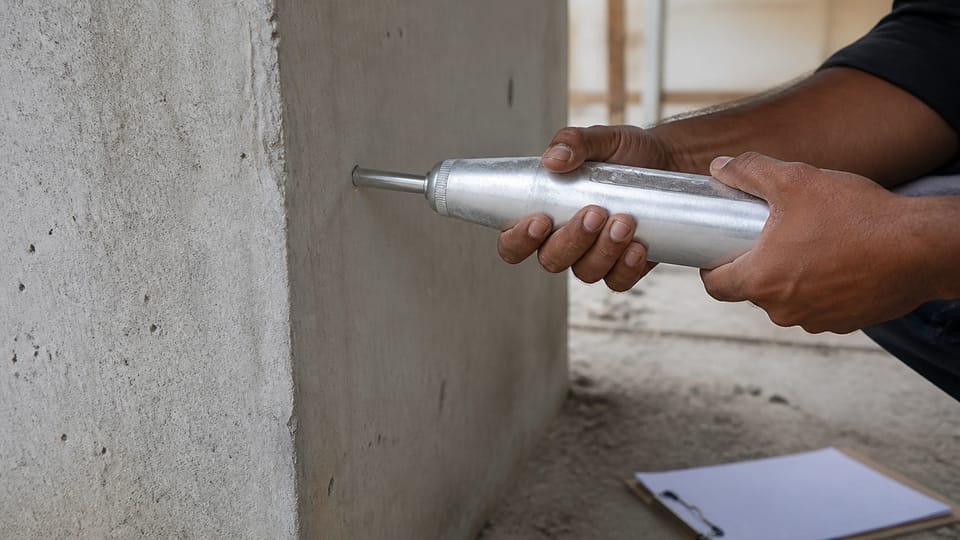
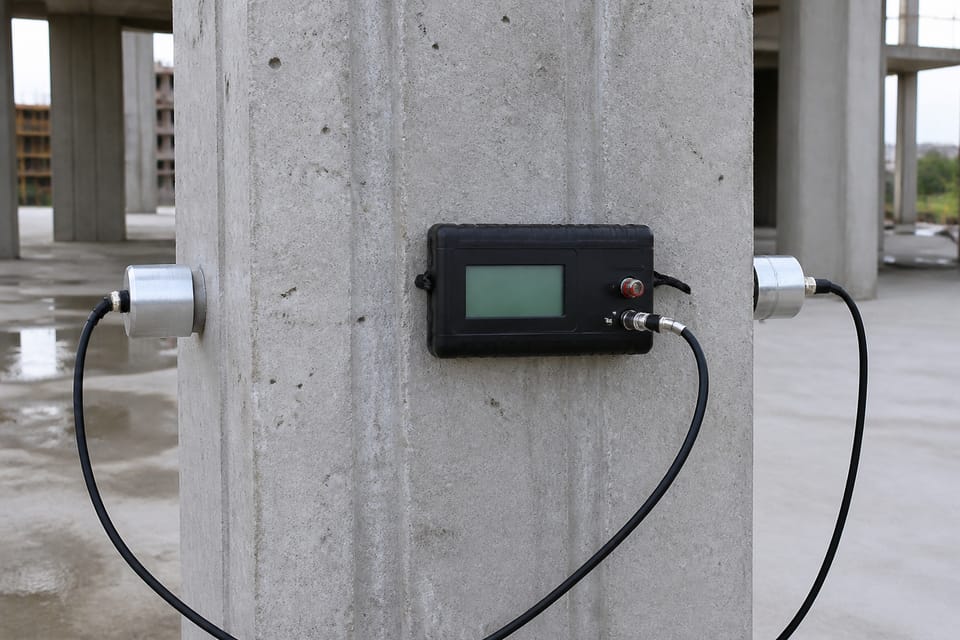
| What it does | A spring-driven steel mass hits the surface and bounces back. A scale shows the rebound number. | A pulse is sent through the concrete between two transducers. The time it takes gives the pulse velocity. |
| What it reads | The hardness of the surface layer | How uniform and dense the concrete is along the path, including cracks and voids |
| What it cannot show | What the inside of the member is like | Strength, without a correlation |
| Needs | A smooth, clean, dry concrete surface | Good contact between the transducer and the concrete, and plaster or coating removed |
How does the rebound hammer work?
IS 516 says the extent of the rebound “depends upon the surface hardness of concrete”, and that this hardness is taken to be related to the compressive strength. The test result is a number from a scale on the instrument.
The standard is careful about what that number can tell you. The reading reflects the concrete only to a limited depth from the surface. If the member has internal micro-cracking, flaws or non-uniformity across its section, the hammer will not show it. The note to the scope says the method “is not intended as an alternative for the compressive strength determination of concrete”. With a suitable correlation it can give an estimate of in-situ strength.
The scale on the hammer, or a chart supplied by the maker, is not enough. The standard says a maker’s relationship should be used only to show relative strength at different places in a structure. To estimate strength, a correlation for that concrete and that hammer has to be built using cubes or cores.
How does the UPV test work?
IS 516 explains it in simple terms. Higher velocities go with good density, homogeneity and uniformity. Poorer concrete gives lower velocities. A crack, void or flaw in the path weakens the pulse and makes it travel around the defect, so the path is longer and the velocity is lower. This is why UPV can point to voids and honeycombing inside a member, where the hammer cannot.
UPV has its own limits. The standard says its quality table is only for quality grading, and “shall not be used for estimating the concrete grades”. It says assessing compressive strength from pulse velocity alone is “not adequate” because the statistical confidence of the link with strength is not very high. Comparing different parts of one structure that were built at the same time, with similar materials and supervision, is more meaningful and reliable than any absolute criterion.
Why are the two tests used together?
The rebound standard says combined use of UPV and the rebound hammer “is a must for proper interpretation”. It also says that where the quality assessed by UPV is doubtful, no assessment of strength is to be made from the rebound hammer. Both standards say that, because each non-destructive method has limits, results from one method should be complemented by other tests.
What disturbs the results?
These are from IS 516 Part 5. The standard gives percentages for some of them. We leave them out, because they suggest a precision that a house owner cannot use.
- Rebound hammer: the type of cement and aggregate, surface condition, moisture, age and carbonation of the surface. Trowelled or floated surfaces read higher than moulded surfaces and tend to overestimate strength. A wet surface underestimates. A carbonated surface overestimates. Honeycombed or no-fines concrete is unsuitable. Rough, spalled or tooled surfaces should be avoided. The hammer is checked on a test anvil before and after the test.
- UPV: reinforcing bars near the path, where the reading is usually higher than in plain concrete. Moisture, where saturated concrete reads higher. A rough surface or poor contact. Cracks and voids. Any plaster or coating has to be removed from the test surface.
Plain-word effect: steel bars can make UPV look better than the concrete is. Both tests can mislead on a damp or rough surface. The UPV standard asks for plaster or coating to be removed at the test points. The rebound standard does not mention plaster or paint, so as practice, test bare, clean concrete.
What are the direct tests?
The direct methods are a core test and, for flexural members, a load test. IS 456 clause 17.3 says that where there is doubt about the grade of concrete, core tests and/or a load test may be carried out. In the core test, a small cylinder of concrete is drilled out and crushed in a lab. IS 516 Part 4 says drilling through reinforcement is to be avoided, and that a reinforcement detector (cover meter) can be used to choose a core location free of steel. Core locations are specified by the engineer in charge.
IS 456 clause 17.7 says members other than flexural members, such as columns, should preferably be investigated by analysis. Clause 17.8 says non-destructive tests can be an alternative to core tests or can supplement a limited number of cores, and that if they are used, the acceptance criteria shall be agreed upon before testing. As practice, an owner should not fix a pass line alone, and the line should be agreed in advance.
For what happens next when cubes fail, see the cube test guide.
When do owners ask for these tests, and what should I ask the lab?
This section is practice, not a standard. The standards do not say who must carry out or interpret the tests, so ask for an engineer’s reading, not a bare sheet of numbers.
People usually ask for them when assessing an old house before renovation (see renovate or rebuild an old house), when cube results are doubtful, or when concrete looks poorly compacted. Ask the lab:
- Was the hammer checked on the test anvil? (IS 516 asks for this.)
- Was the surface smooth, clean, dry and free of plaster or paint?
- Where were the test points, and were they away from bars? Was a cover meter used?
- Was the hammer reading correlated with cores or cubes for this concrete?
- Was UPV done alongside the hammer, as the standard asks?
- What does the report say about uncertainty, and who has signed it?
- Were the acceptance criteria agreed before testing?
What mistakes should I avoid?
These are practice, not code rules.
- Reading the rebound number as the concrete grade.
- Testing over plaster, paint, a wet patch or a rough, honeycombed spot.
- Using one reading, or one member, to judge a whole building.
- Treating a “good” UPV value as proof of strength. Steel can raise it.
- Comparing results from different members, ages or pours as if they were alike.
- Accepting a number sheet from a vendor without an engineer’s interpretation.
- Skipping cores or a load test when the result is doubtful.
Frequently asked questions
What is a rebound hammer test?
A rebound hammer test measures how far a spring-driven mass bounces off the concrete surface. The bounce depends on surface hardness. IS 516 treats it as an indication, not a direct strength test.
Can the rebound number give the grade, such as M20 or M25?
No. The standard says maker charts show only relative strength at different places. A strength estimate needs a correlation for the actual concrete, using cubes or cores. Even then, the result is an estimate.
What does a UPV test show?
It shows how uniform and dense the concrete is along the path, and it can point to cracks and voids. IS 516 says it is not adequate for estimating strength alone.
Does the test damage the concrete?
These tests do not take a sample out of the member, and the standards do not describe any damage from the hammer. UPV needs plaster or coating removed at the test points. A core test removes a cylinder.
Can I do the test myself?
In practice, instruments can be bought. The standards say neither test is enough alone, and they depend on correlation and careful reading. Have an engineer read the result.
Related guides
- Concrete cube test: how cubes are made, tested and read
- Concrete grades M15 to M25 explained
- Renovate or rebuild an old house
This guide is general information. Read the disclaimer. Your structural engineer decides how the results are read for your house.
Sources
- IS 516 (Part 5/Sec 4):2020, Hardened Concrete: Methods of Test, Rebound Hammer Test (first revision), clauses 1 and its Note, 3.2, 5.1, 5.2, 6.1, 7.1, 8.1 to 8.3 and the foreword. Text read from archive.org (OCR). Its foreword says it replaces IS 13311 (Part 2):1992.
- IS 516 (Part 5/Sec 1):2018, Hardened Concrete: Methods of Test, Ultrasonic Pulse Velocity Testing (first revision), clauses 1, 2.1, 2.4.1, 2.5.1 to 2.5.4 and Annex B. Its foreword says it supersedes IS 13311 (Part 1):1992; BIS records show IS 13311 Part 1 as withdrawn.
- IS 516 (Part 4):2018, Sampling, Preparing and Testing of Concrete Cores (first revision), clauses 5.2 and 5.9.
- IS 456:2000, Plain and Reinforced Concrete: Code of Practice, clauses 17.3, 17.7 and 17.8 (OCR text; check the wording against the PDF). Clause 17.8 still names the older IS 13311.
General information only. It is not a structural design or professional advice. Ask a licensed structural engineer or architect to check your plans and site.