
Short answer
What is the difference between TMT, HYSD, CTD and mild steel bars? HYSD (high yield strength deformed) names a class of ribbed bars covered by IS 1786. TMT and cold-twisting are routes to make such bars, and IS 1786 leaves the process to the manufacturer. Mild steel bars are plain bars under IS 432. The engineer's drawing names the bar for your house; the owner does not choose.
On this page (10)
Steel bar names are used loosely in shops and on sites. TMT, HYSD, CTD, TOR, MS and “rebar” are said as if they were six kinds of steel, and the dealer’s word often decides the argument. The Indian standards sort them more simply: one standard for high strength deformed (ribbed) bars, another for plain mild steel bars, and nothing that says which is better. This page sets out what the two standards say, where the common words come from, and what to check. It gives no brand, no price and no bar size. The grade names, the full form of TMT and the grade table are on TMT bar full form and grades: what Fe500, Fe500D and Fe550D mean, which this page does not repeat.
What do the words mean?
| Word | What it is | What the codes say |
|---|---|---|
| HYSD | High yield strength deformed bars. A class of ribbed bar, not a process | IS 1786:2008 is titled “High strength deformed steel bars and wires for concrete reinforcement”. NBCS 2026 uses the abbreviation HYSD in its Table 2 for the Fe 415 to Fe 600 bars |
| TMT | A production route: hot rolling followed by controlled cooling | IS 1786 Annex A (informative) describes “hot rolling followed by controlled cooling (TMT process)”, with the bar quenched in water and then self-tempered. Clause 3 has no definition of TMT |
| CTD or cold-twisted | In common usage, cold-twisted deformed: a hot-rolled bar that is cold-worked, such as by twisting. IS 1786 does not use the letters CTD | The IS 1786 foreword says the standard was once titled for cold-worked bars, and that high strength bars “are being produced in the country for many years by cold twisting and by controlled cooling and micro-alloying” |
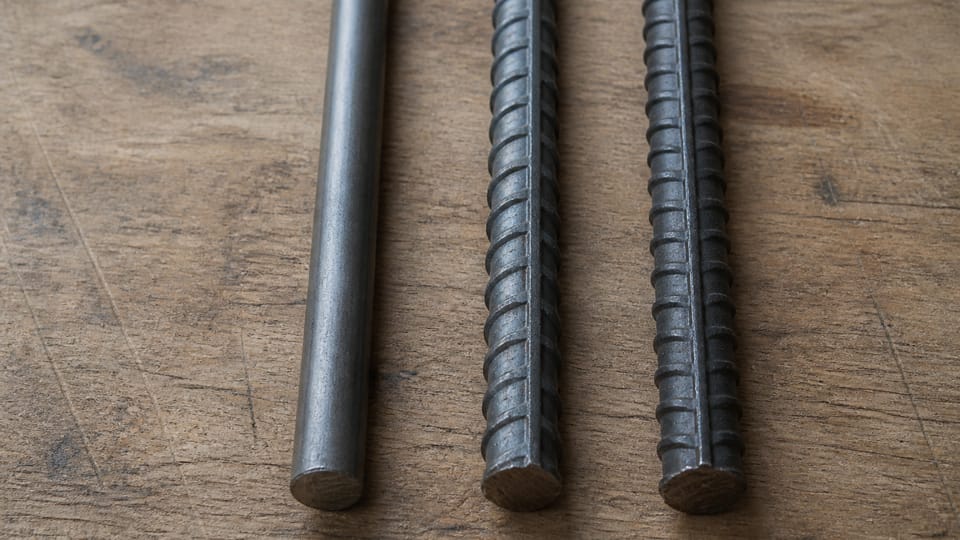
| Mild steel (MS) | A plain round or square bar, with no ribs | IS 432 (Part 1) covers “mild steel and medium tensile steel plain bars in round and square sections for use as reinforcement in concrete” |
| Rebar | Any reinforcement bar | Not a term in these standards |
So HYSD is the class, and TMT and cold-twisting are two ways of making a bar in that class. HYSD and TMT are not opposites. A brand is none of these: TMT is a process, not a company.
What does IS 1786 say about the process?
Clause 1.3 says the standard applies to hot-rolled steel without subsequent treatment, to hot-rolled steel with controlled cooling and tempering, and to cold-worked steel, and “the production process is at the discretion of the manufacturer”. Clause 4.1.3 says the bars are made by hot rolling, which may be followed by cold working or in-line controlled cooling. The standard therefore sets what the bar must do, which is the grade and its tests, and does not say a TMT bar is better than a cold-worked one. A bar made by re-rolling finished products such as plates and rails, or from steel whose history is not known, is “not acceptable” under the standard (clause 1.6).
What does IS 432 say about mild steel?
The 1982 edition of IS 432 (Part 1) covers plain bars in two kinds, mild steel bars (Grade I and Grade II) and medium tensile steel bars. Its foreword cautions that Grade II mild steel bars “are not recommended for use in structures located in earthquake zones subjected to severe damage”. IS 432 (Part 1) was revised in 2026, and BIS now lists the 1982 edition as superseded. We could not read the 2026 text, so this page quotes only the 1982 edition and does not say what changed. IS 456:2000 clause 5.6 still lists mild steel and medium tensile steel bars to IS 432 (Part 1) among the steels permitted as reinforcement, alongside the high strength deformed bars to IS 1786. We found no standard that bans mild steel; the drawing decides.
Can you tell the types apart by eye?
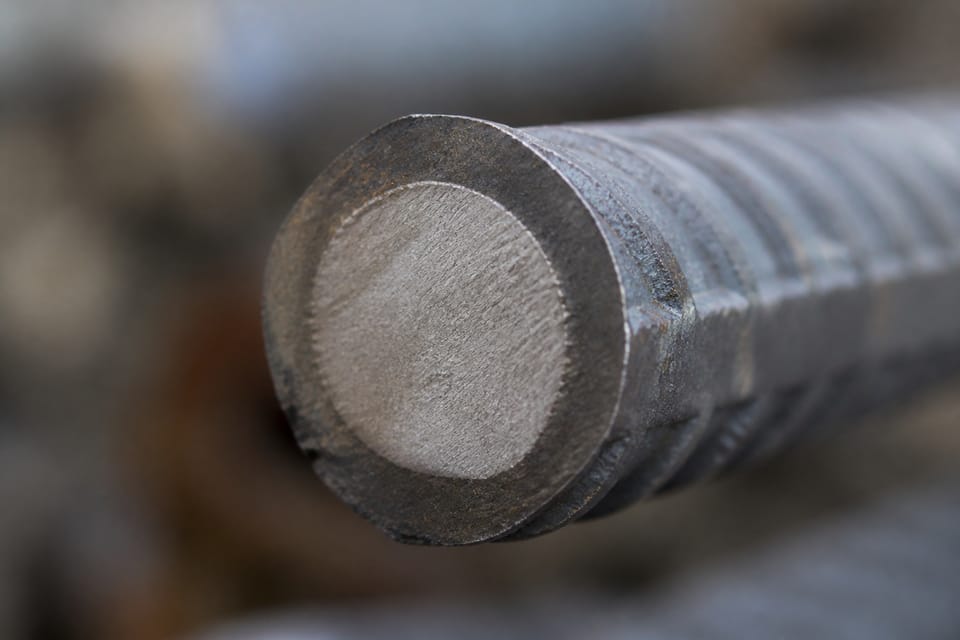
Ribs show a deformed bar from a plain one. Ribs, which grip the concrete, are part of the IS 1786 requirements (clause 5). The process is a different matter. Annex A says that a bar that has had the heat treatment and a mild steel deformed bar “cannot be distinguished visually”, and describes a laboratory etch test on a cut piece that should show “a darker annular region” and “a lighter core region”. It adds that the test “is not to be regarded as a criterion for rejection”: a bar that meets the standard’s chemical and physical requirements is acceptable. So the look of the cut end proves nothing by itself. The test certificate does.
What can I check on site?
IS 1786 clause 13 gives the marking:
- A tag on each bundle or coil with the cast or lot number, grade and size (clause 13.2).
- Bars should carry marks or brands rolled in during rolling that identify the manufacturer (clause 13.3).
- The BIS Standard Mark on the bundle may be used, in which case the test certificate also bears it (clause 13.4).
Ask the supplier for the test certificate for the lot, and keep it. The grade on the tag and the certificate must match the grade on the engineer’s drawing. See before the slab pour: an owner’s checklist for formwork and steel for the rust, oil and welding checks before concrete.
Who chooses the bar? (practice)
This is practice, apart from the clauses named.
- The engineer’s drawing and schedule name the grade, diameter and spacing. The owner and the dealer do not choose.
- Ask the engineer which grade the drawing wants, whether a bar of another grade or lot may be used, and what to do about a bar that is bent wrongly or rusted.
- Ask the supplier for the licence details, the test certificate for this lot and the batch number.
- Do not swap grades for stock or saving. A stronger bar does not mean the drawn quantity can be reduced, and a lower grade is not a saving the engineer approved.
What mistakes should I avoid? (practice)
- Treating TMT, HYSD and CTD as three unrelated steels.
- Believing “TMT” is a brand, or that it is always better than a cold-twisted bar. IS 1786 does not say so.
- Using plain mild steel bars where the drawing says deformed bars.
- Buying “TMT” with no certificate and no tag or rolled-in marks.
- Rusty, oily or muddy bars going into the pour.
- Heating and bending bars on site, or bending a bar back and forth, without the engineer’s approval.
- Mixing grades or lots in one member without telling the engineer.
- Taking a dealer’s “Fe 500D” on trust without the certificate showing it.
Frequently asked questions
Is TMT the same as HYSD?
No. HYSD is the class of high strength deformed bars. TMT is one route to make a bar in that class.
What is CTD bar?
In common usage, a cold-twisted deformed bar. IS 1786 does not use the letters CTD. Its foreword says high strength bars have been produced for many years by cold twisting and by controlled cooling, and the standard leaves the process to the manufacturer.
Is TMT better than mild steel?
The standards do not rank them. IS 1786 and IS 432 cover different bars: ribbed high strength bars and plain bars. Your engineer’s drawing names the one for your house.
Are mild steel bars banned?
We found no standard that says so. IS 456:2000 clause 5.6 lists mild steel bars to IS 432 as permitted reinforcement, and the drawing decides.
How do I tell TMT from other bars?
IS 1786 Annex A says a heat-treated bar and a mild steel deformed bar cannot be distinguished visually, and its etch test is not a criterion for rejection. Use the tag, the rolled-in marks and the test certificate.
Related guides
- TMT bar full form and grades: what Fe500, Fe500D and Fe550D mean
- Before the slab pour: an owner’s checklist for formwork and steel
- IS codes for house construction: which standard covers what
This guide is general information. Read the disclaimer. Your engineer decides the steel for your house.
Sources
- IS 1786:2008, High Strength Deformed Steel Bars and Wires for Concrete Reinforcement (fourth revision), with Amendment 1 (2012): foreword, clauses 1.1, 1.3, 1.6, 4.1.3, 13.2 to 13.4 and Annex A (page images read). BIS lists it as in force, valid to 2028-01-31.
- IS 432 (Part 1):1982, Mild Steel and Medium Tensile Steel Bars and Hard-Drawn Steel Wire for Concrete Reinforcement, Part 1 Mild Steel and Medium Tensile Steel Bars (third revision): clauses 0.4, 0.5, 1.1, 3.1 and 11.2 (page images read). BIS lists this 1982 edition as superseded by IS 432 (Part 1):2026, which we could not read.
- IS 456:2000, Plain and Reinforced Concrete, Code of Practice: clause 5.6 (page image read). BIS lists it as in force, valid to 2030-07-12. SP 7:2026, National Building Construction Standards (NBCS) 2026, Part C Section 6B, Composite Construction: clause 5.4.1 and Table 2 (page image read). From an unofficial archive.org copy.
General information only. It is not a structural design or professional advice. Ask a licensed structural engineer or architect to check your plans and site.