
Short answer
How many types of shuttering are there? The standards give materials, not a count. IS 14687 says falsework may be of timber, plywood, steel, aluminium, PVC, plastics, ferro-cement or any engineering material. IS 4990 covers shuttering plywood in plain, coated and film-faced types (2011 edition read; the 2024 edition is in force). No standard ranks them, and your engineer clears the shuttering before the pour.
On this page (10)
- What can shuttering be made of?
- What does IS 4990 ask of shuttering plywood?
- What do the standards say about reuse and care?
- What does IS 456 ask of any shuttering?
- What do the standards not say?
- What should I ask? (practice)
- What mistakes should I avoid? (practice)
- Frequently asked questions
- Related guides
- Sources
“How many types of shuttering are there?” is a common question and the answer from the standards is not a number. They name the materials a mould for wet concrete may be made of, say what shuttering plywood must be, and leave the choice to the design and the engineer. This page sets out what IS 14687, IS 4990 and IS 456 say, what each leaves open, and what to ask your contractor. It gives no stripping time, reuse count, thickness, prop spacing, price or brand. For the words shuttering, centering and staging, see shuttering vs centering vs staging: the terms explained.
What can shuttering be made of?
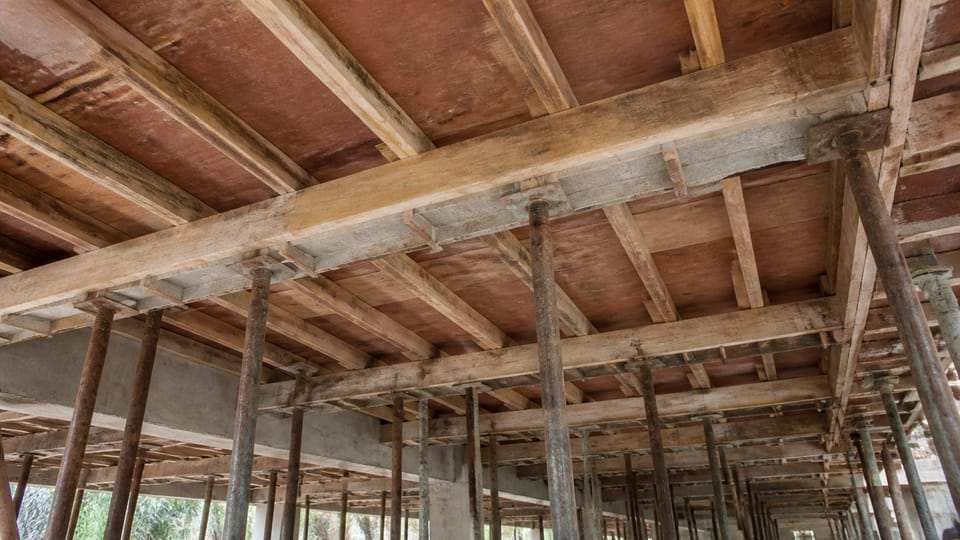
IS 14687:1999 clause 6.1 says “the falsework may consist of timber, plywood, steel, aluminium, PVC, plastics, ferro-cement or any engineering material.” It then says, by material:
| Material | What the standard says |
|---|---|
| Timber | “Softwood of partially seasoned stock to avoid swelling or warping” (clause 6.1.1) |
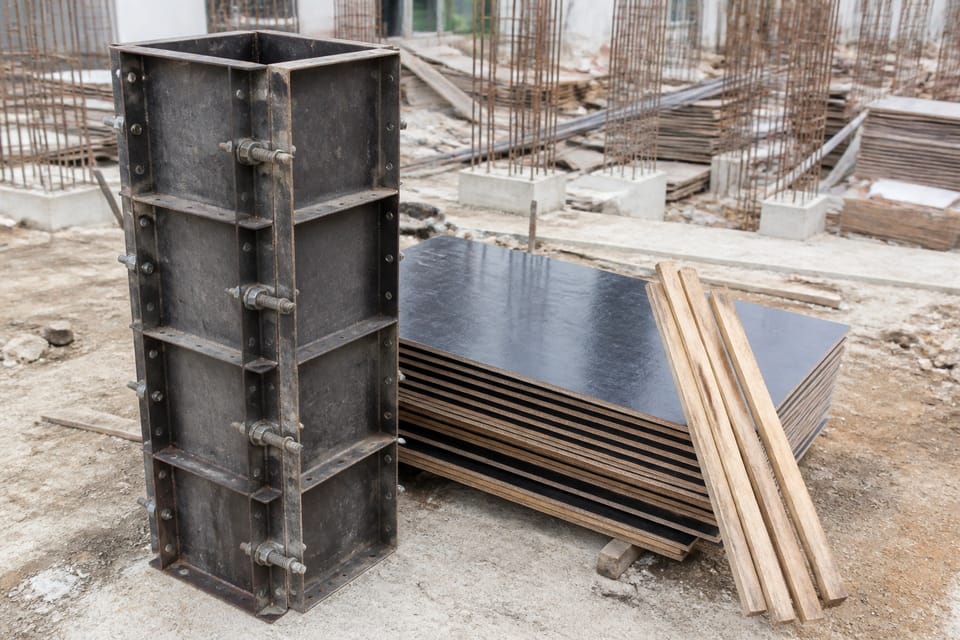
| Plywood | “Plywood conforming to IS 4990 may be used for form lining, sheathing and panel” (clause 6.1.2) |
| Steel | Steel sheet plates may be used for form and form lining, and rolled sections and tubes for steel forming and bracing (clause 6.1.3) |
| Others | Aluminium, PVC, reinforced plastics, high density polyethylene, polypropylene and ferro-cement may be used (clause 6.1.4) |
Clause 4.4.4 says “the materials of formwork shall depend upon the final finished surface required”, and that the formwork should be hard enough not to be damaged by fixing steel, pouring, vibrating and removal. No standard we read ranks these materials, says which is best for a house, or gives a count of types. “Centering sheets”, the steel plates used under slabs in many cities, are a trade name; we found no standard definition of the term.
What does IS 4990 ask of shuttering plywood?
IS 4990:2011 says concrete shuttering plywood is “a BWP grade plywood, preservative treated and specially suited for use in concrete shuttering and form work”. Clause 4 gives three types: Type 1 plain (CS), Type 2 with plastic coating (CSC) and Type 3 with a suitable overlay, film faced (CSFF). The adhesive is the BWP type of IS 848 with no extenders (clause 5.2), and the plywood is given a preservative treatment after manufacture. The standard’s tests include moisture content, glue shear, resistance to water and bending strength, with numbers in the standard that this page does not print.
IS 4990:2011 clause 12.1 asks that each board be marked with the manufacturer’s mark, the year of manufacture, the type and, where it applies, the ECO-Mark criteria. The Standard Mark “may” also be marked (clause 12.2). The IS number is not on the marking list. BIS now lists the 2024 fourth revision as the edition in force. We could not read it, so what it changed is unknown; ask the seller which edition the plywood is made to.
What do the standards say about reuse and care?
IS 4990:2011 Annex E says it is claimed that shuttering plywood can be reused many times, and that the reuse value “depends on the care taken in handling the boards and following the manufacturer’s instructions”. It prints no count. Its Annex E asks that boards be stored flat in a clean, dry, covered place, protected from rain, not dragged over one another, coated with a suitable mould oil, with cut edges sealed. Annex E also says plywood has an advantage over steel sheeting in very hot or cold weather, and says nothing the other way round. IS 14687 clause 9.3 asks that timber forms with rot, edge cuts or distortion be discarded or derated, and that metal forms be cleared and repaired between uses. It does not address plywood or aluminium reuse. CPWD 5.2.3.3 asks that shuttering have “sufficient stiffness” and tightly butted joints; for CPWD works it says only steel shuttering shall be used, except for unavoidable portions and very small works, where approved waterproofing ply may be used (5.2.3.3(c)). That is a departmental contract rule, not a rule for a private house.
What does IS 456 ask of any shuttering?
IS 456 clause 11.1 says the formwork “shall be designed and constructed so as to remain sufficiently rigid during placing and compaction of concrete, and shall be such as to prevent loss of slurry from the concrete”. Clause 11.2 asks that rubbish, “particularly, chippings, shavings and sawdust”, be removed from the forms and that release agents be applied “so as to provide a thin uniform coating to the forms without coating the reinforcement”. Clause 11.3 gives a strength rule and a table of stripping times that “may deem to satisfy” it; the engineer decides when forms come off, and this page prints no time.
What do the standards not say?
- Which material is best, or how many types of shuttering exist.
- How many times any material may be reused.
- A standard for steel shuttering plates, aluminium forms or plastic forms: the BIS searches found none; IS 14687 only points to steel standards, some now withdrawn.
- Price, brand or rental terms.
What should I ask? (practice)
This is practice, apart from the clauses named.
- Which material will the contractor use for slabs and beams and for columns, and in what condition? Worn or warped sheets with gaps leak slurry.
- Who supplies it, and is it rented or owned? Settle that in the contract.
- Check before the pour: faces clean and tight, props vertical and on a firm base, no oil on the steel bars, and the engineer’s go-ahead. See before the slab pour: an owner’s checklist for formwork and steel.
- Removal: the engineer says when, in writing; curing and stripping are different, see how many days to cure a concrete slab?.
What mistakes should I avoid? (practice)
- Worn, warped or gapped sheets.
- No bracing, or props leaning.
- Props on soft ground or loose bricks.
- Removing the shuttering early to save time.
- Oil on the steel bars.
- Wood pieces and rubbish left inside the forms.
Frequently asked questions
What is shuttering plywood?
IS 4990 describes it as BWP grade, preservative-treated plywood in plain, coated and film-faced types. The 2011 edition was read; the 2024 edition is in force.
How many types of shuttering are there?
The standards list materials, not a count: timber, plywood, steel, aluminium, PVC, plastics, ferro-cement and others.
Can ordinary plywood be used for shuttering?
IS 14687 says plywood conforming to IS 4990 may be used. Ask your engineer before using anything else.
Is steel or plywood better?
No standard says so. IS 4990:2011 notes plywood’s advantage over steel in very hot or cold weather.
How many times can shuttering be reused?
No standard we read gives a count. IS 4990 says reuse depends on the care taken.
Related guides
- Shuttering vs centering vs staging: the terms explained
- Before the slab pour: an owner’s checklist for formwork and steel
- How many days to cure a concrete slab?
This guide is general information. Read the disclaimer. Your engineer decides the shuttering for your house.
Sources
- IS 14687:1999, Falsework for Concrete Structures, Guidelines: clauses 4.4.4, 6.1 to 6.1.4 and 9.3 (page images read). BIS lists it as in force, valid to 2029-03-31. It cites 1990s editions of the steel standards, some now withdrawn.
- IS 4990:2011, Plywood for Concrete Shuttering Works, Specification (third revision): foreword and clauses 4, 5.2, 6.6, 10.1, 12.1 and 12.2 and Annex E (foreword, clauses 4, 12 and Annex E page images read; clauses 5.2, 6.6 and 10.1 text). BIS shows this edition as withdrawn and IS 4990:2024 (fourth revision) as in force, valid to 2029-04-30; we could not find a copy of the 2024 edition, so what changed is unknown.
- IS 456:2000, Plain and Reinforced Concrete, Code of Practice: clauses 11.1, 11.2 and 11.3 (page image read). BIS lists it as in force, valid to 2030-07-12.
- CPWD Specifications 2019, Volume 1, clause 5.2.3.3 (page image read). Copy hosted by Puducherry PWD. CPWD is a specification for the works it covers, not a BIS standard.
General information only. It is not a structural design or professional advice. Ask a licensed structural engineer or architect to check your plans and site.