
Short answer
How do I list renovation work before taking quotes? Walk each room with a notebook and write every item, its place, whether it is repair, replace or new, and a size you can measure. List removal and disposal separately from supply and fixing, and making good as its own line; IS 1200 Part 18 measures demolition and dismantling separately. Give every bidder the same list and ask for item-wise prices. Have an engineer check cracks, damp and termite first.
On this page (8)
A renovation quote is only worth comparing if every bidder prices the same job. Without a written list, each contractor walks the house, imagines his own scope, and quotes a figure you cannot set side by side. This page is the list-making step. It explains how to list repair items room by room, how IS 1200 treats dismantling, plaster removal and old-surface painting as separate measured items, and which small works the model bye-laws leave without a permit. It gives no rate, percentage or repair method. For how a bill of quantities is laid out, see what is a BOQ? bill of quantities for a house, with a sample format.
How does IS 1200 measure dismantling?
IS 1200 (Part 18):1974 covers demolition and dismantling. Its note to clause 1.1 says “dismantling implies carefully taking up or down and removing without damage”, with articles passed by hand where necessary and lowered, not thrown, and “demolition implies taking up or down, or breaking up”. The rules that matter to an owner are these:
| Rule | What the standard says |
|---|---|
| Measure before removal | “Measurement of all work, except hidden work, shall be taken before demolition or dismantling” (clause 2.3.1) |
| Demolition and dismantling are separate | “Works required to be demolished and those required to be dismantled shall each be measured separately” (clause 2.8) |
| Serviceable material | The description includes separating serviceable material from unserviceable and stacking it within a stated lead, and disposal of debris; removal beyond that lead is measured separately (clause 2.9) |
| Services and making good | After “any necessary disconnecting or maintaining of services”, “an item shall be provided for making good if required” (clause 2.11) |
| Doors and windows | Enumerated, each; removal of the frames (chowkhats), architraves, holdfasts and other attachments is included in the item (clause 12.1) |
IS 1200 Part 18 does not say who keeps the value of salvaged material, and it gives no rate. Credit for reusable doors, tiles or fixtures is a matter for your contract.
How are plaster removal and painting of old surfaces measured?
IS 1200 (Part 12):1976 says removing plaster by scraping or otherwise “shall be measured separately in square metres” (clause 3.3), and that repair work is described stating the thickness of dubbing, if any (clause 3.1.3). IS 1200 (Part 13):1994 says work on old treated surfaces “shall be measured separately and so described” (clause 2.9), with the preparatory work included in the main item (clause 2.6.2). Both parts have newer editions in force, which we could not read, so ask your contractor which edition the measurement follows.
How do I make the work list? (practice)
This is practice, apart from the clauses named. IS 1200 gives measurement rules for each item; it does not give a template for an owner’s list.
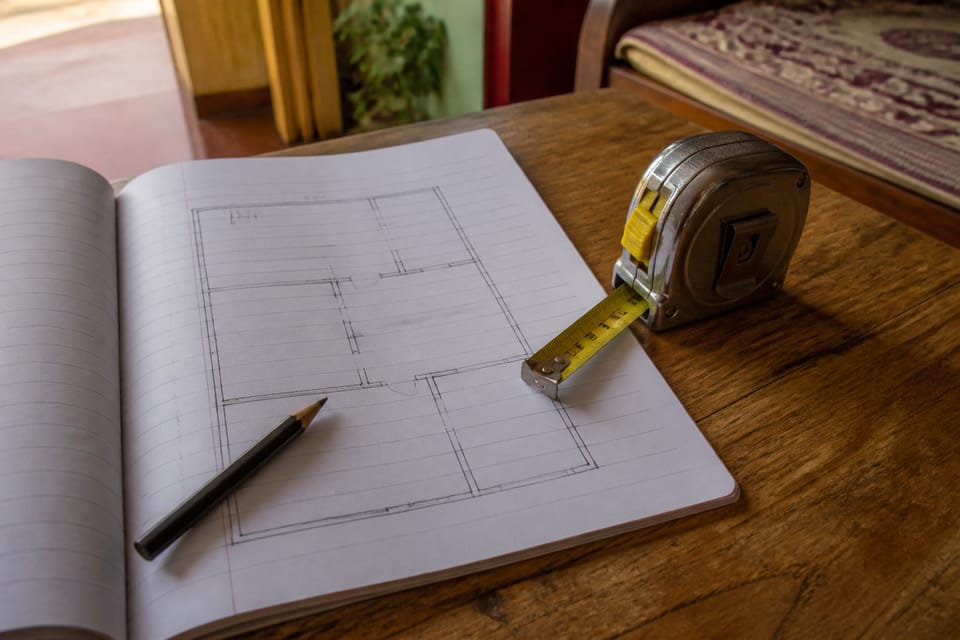
- Walk every room with a notebook, a tape and a phone camera. Photograph and date the existing condition.
- Write one line per item: what it is, where it is, whether it is repair, replace or new, and the size you can measure: area for walls, ceilings and floors, running length for skirting and pipes, and a count for doors, windows and fixtures.
- Keep removal and fixing apart: one line to remove and dispose, one to supply and fix, and one to make good. IS 1200 Part 18 covers the removal side only (clauses 2.8 and 2.11); the rest of this split is our practice advice.
- Mark what stays, and what must be saved for reuse.
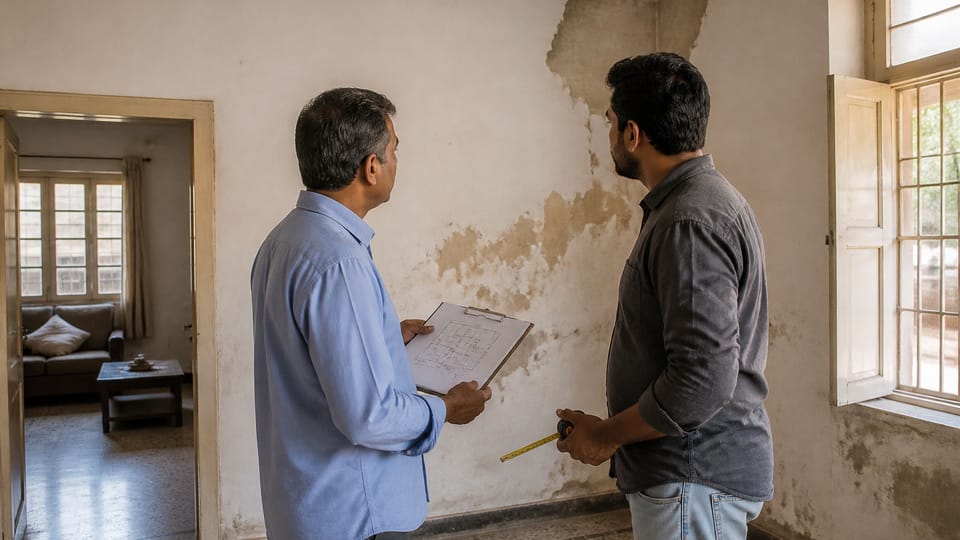
- Mark the doubtful items: cracks, damp patches, sagging, termite signs, old wiring and old pipes. These need an engineer or specialist before quotes, because they decide the scope. See damp walls: rising damp, seepage or condensation, and the fix.
- Send the same list to every bidder and ask for item-wise prices, with exclusions written down. Lump sums only where an item cannot be broken up.
Which small works need no permit?
The Model Building Bye-Laws 2016 (clause 2.12.1) say no notice and building permit is needed for certain alterations, if they do not otherwise break the general building, structural stability and fire safety requirements. The list includes plastering and patch repairs, re-roofing at the same height, flooring and re-flooring, opening and closing windows and doors, replacing fallen bricks, stones, pillars and beams, white-washing and painting, erecting a false ceiling at the permissible height that cannot be used as a loft, rebuilding portions damaged by a natural calamity to the same extent, and erecting or re-erecting internal partitions. Some of these carry conditions in the clause. The bye-laws are a model, not law: your local rules and, in an apartment, your society’s rules govern, so ask both in writing before you start. A change to layout or structure is for your engineer.
What mistakes should I avoid? (practice)
- Comparing quotes by a per sq ft figure with no list.
- Letting each bidder write his own scope.
- Not photographing and dating the existing condition.
- Not separating removal, supply and fixing, and making good.
- Skipping the check of damp, cracks and old wiring before quotes.
- Painting over damp or hollow plaster.
- Forgetting debris disposal, or assuming it is included.
- Changing the scope mid-way without a written change.
Frequently asked questions
How do I estimate a house renovation?
As practice, first list the work: walk each room, write the items and sizes, and get item-wise quotes on the same list. This page gives no cost figure.
Can I make a BOQ for renovation myself?
You can make the item list. Measurement rules are in IS 1200; your contractor or engineer checks the quantities after opening up.
Should demolition be priced separately?
IS 1200 Part 18 measures demolition and dismantling separately (clause 2.8), and provides a making good item when services are disconnected (clause 2.11). In practice, ask for each as a separate line.
Do I need permission for repair work?
The model bye-laws list small repairs that need no permit, but they are not law. Ask your local authority and your society.
Who keeps the old material?
IS 1200 does not say. Write it in the contract.
Related guides
- What is a BOQ? Bill of quantities for a house, with a sample format
- Renovate or rebuild an old house? How to decide
- Choosing a building contractor for your house: questions and checks
- How painting area is measured: IS 1200 door, window and grill factors
This guide is general information. Read the disclaimer. Your engineer decides which repairs are structural.
Sources
- IS 1200 (Part 18):1974, Method of Measurement of Building and Civil Engineering Works, Part XVIII Demolition and Dismantling (third revision): clauses 1.1 (Note), 2.3.1, 2.8, 2.9, 2.11 and 12.1 (page images read). BIS lists it as in force, valid to 2027-09-30; the cover says reaffirmed 2002.
- IS 1200 (Part 12):1976, Plastering and Pointing: clauses 3.1.3 and 3.3 (page images read). BIS lists a 2026 edition as in force, which we could not read.
- IS 1200 (Part 13):1994, White Washing, Colour Washing, Distempering and Painting of Building Surfaces, fifth revision: clauses 2.6.2 and 2.9 (page images read). BIS lists a 2024 edition as in force, which we could not read.
- Model Building Bye-Laws 2016, Ministry of Urban Development (TCPO; hosted by MoHUA; a model, not law): clause 2.12.1 (page images read).
Change log
- : Added Related guides link to newly published article(s): how-painting-area-is-measured-for-doors-windows-and-grills-is-1200-part-15-coefficients. No other text changed. Approved by the reviewing engineer.
General information only. It is not a structural design or professional advice. Ask a licensed structural engineer or architect to check your plans and site.