
Short answer
How do I choose a building contractor for my house? Compare written quotes for the same scope, ask to see finished houses the contractor built, and speak to past clients. Make sure the contract lists the materials and their grades, the quantities, the payment stages tied to finished work, and what happens to extra work and late completion. The model bye-law leaves most house-building registration to local rules, and architects are covered by the Architects Act, 1972. Ask your local body what it requires for the contractor and for your plot.
On this page (11)
- Before you ask for quotes
- Questions to ask each contractor
- What to check on a finished site
- What the written contract must cover
- Are there licence rules for a house contractor?
- Which checks matter most?
- What are the warning signs?
- What mistakes should I avoid?
- Frequently asked questions
- Related guides
- Sources
Most house owners choose a contractor once, for a job that can run for many months. A good choice saves money and rework. A poor one can leave you with a half-built house and a dispute. This page gives a checklist to work through before you sign, and the points the written contract should cover. It gives no prices, no percentages of cost and no names of firms. Those depend on your plot, your design and the market where you build.
Before you ask for quotes
Start with what you want built, and get the drawings and the structural design first. A quote is only comparable if every contractor prices the same work.
- Drawings and structure. Have the approved drawings and the structural design ready. Ask the engineer or architect to confirm the specification. The model bye-law says the owner must start construction under the supervision of an architect or engineer, as Appendix E sets out. Who is that professional for your plot? Ask your local body.
- Scope in writing. List what is in the job: foundation, walls, roof, plaster, flooring, plumbing, electrical, and finishes. Say what is not in the job.
- Materials. Decide the grades of cement and steel and the main materials you want, in general terms, and ask every contractor to quote on the same grades.
Questions to ask each contractor
- Can you show me a finished house of a similar size and type that you built?
- Can I visit a house that is still going on, and see the work at its current stage?
- Can I speak to the last two or three clients, including one whose job ran late?
- How many houses have you finished in the last few years, and how long did they take?
- Who will be my site supervisor, and will the same person be on site for the whole job?
- Is your quote a lump sum or item rate? If item rate, how and when is each item measured?
- Will you give me a written quote listing the scope, the grades of materials, the quantities, what is excluded and the payment stages?
- Can you show me the test certificate for the steel and cement you will use, for each delivery?
- What happens if the work runs late, and what happens if I ask for a change?
- How will defects be reported and fixed after handover, and within what period?
- Who is the registered employer of the workers on site, and what cover do they have if they are hurt?
What to check on a finished site
A visit tells you more than a brochure. Walk the site with a checklist and look at:
- Plaster: whether it is even, flat and free of large cracks.
- Walls and corners: whether they are straight and plumb.
- Floors and tiles: whether the tiles line up and sit flat.
- Joinery: whether doors and windows open and close without force.
- Electrical and plumbing: whether the switches and pipes are tidy and fixed firmly.
Ask the owner what went wrong, how long it took to fix, and whether the contractor came back.
What the written contract must cover
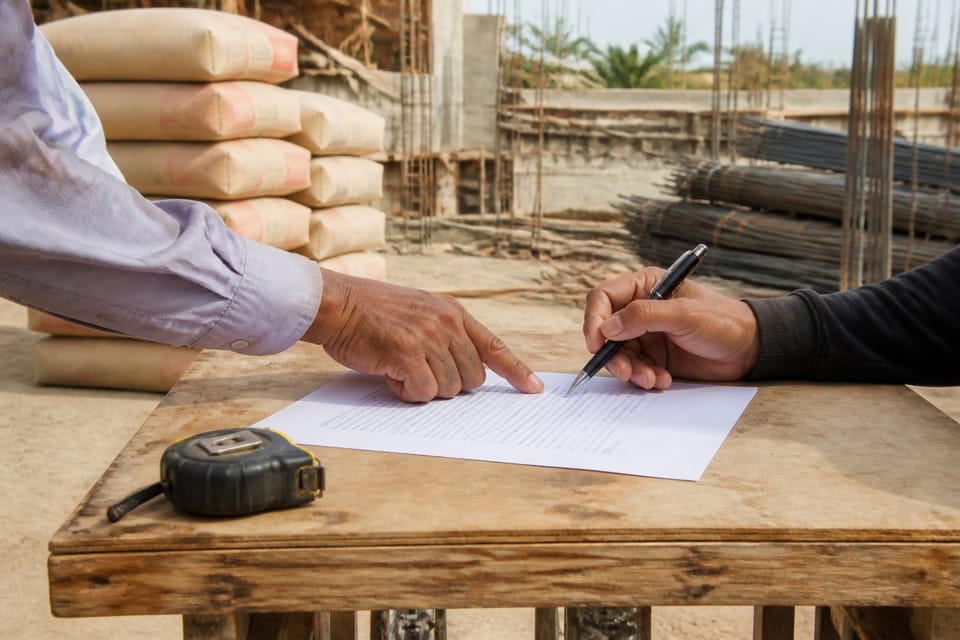
Under the Indian Contract Act, 1872, all agreements are contracts if they are made by the free consent of parties competent to contract, for a lawful consideration and with a lawful object, and are not expressly declared void (section 10). Consent is not free if it is caused by coercion, fraud, misrepresentation, mistake or undue influence (section 14). The Act does not require every contract to be in writing, but a written contract is the practical way to prove the terms. A verbal promise is hard to prove later.
The written contract should say:
- The scope of work, the drawings it follows, and the specification of materials and grades.
- The quantities, and how extra work is measured and approved in writing before it is done.
- The payment stages, each tied to finished work that you have inspected.
- The completion date, and what happens if the work runs late.
- How defects are reported and fixed, and for how long after handover.
- Who buys the materials, and who checks their quality.
- Who the workers’ employer is, and who is responsible for their safety and insurance.
- How disputes are settled.
Are there licence rules for a house contractor?
For other professions, the model bye-law says (cl. 6.3.6) that “there is no legislative frame available/applicable,” apart from architects, who are covered by the Architects Act, 1972. Its appendix on qualifications notes that plumbers, electricians and fire consultants “may not need registration.” It is a model, and local rules can differ, so ask your local body what it requires for your plot.
The model bye-law does set the owner’s duties. Under cl. 2.15.1(a), the grant of permission, the approval of drawings and inspection by the authority do not relieve the owner of “full responsibility for carrying out work in accordance with these Bye-Laws.” Under cl. 2.15.2, the person to whom the permit is issued must keep a copy of the building permit and the approved drawings and specifications posted in a conspicuous place on the property. Test records of materials must be kept available for inspection during construction and for the period the authority requires. Under cl. 2.16, the owner submits the notice of completion through the professional who supervised the construction.
Which checks matter most?
The table sets out the main checks, what to look for and why each one matters. These are practice points, not legal rules.
| Check | What to look for | Why it matters |
|---|---|---|
| Quote | Same scope, grades and quantities as every other quote | Only comparable quotes show the real difference |
| Finished work | Plaster, walls, tiles, joinery, wiring and pipes that are neat | Shows the standard of work the firm delivers |
| References | Past clients who can speak about delays and extra charges | Shows how the firm behaves when things go wrong |
| Contract | Written scope, payment stages, change orders, completion date and defects | Gives you a basis if a dispute arises |
| Materials | Test certificates for steel and cement for each delivery | Shows the grades on site match the grades agreed |
| Records | A dated site diary, progress reports and photographs | Lets you check what was done and when |
What are the warning signs?
These are practice points, not legal rules.
- A quote much lower than the others, or lower than your own estimate of the same scope.
- Pressure to pay in cash, or to pay a large share up front.
- No written agreement, or terms that are only spoken.
- No business address, or no way to check who the firm is.
- Refusal to show a finished house or to give references.
- Reluctance to list the materials, grades or quantities.
- Demands for extra payment in the middle of the job without a written change order.
What mistakes should I avoid?
These are practice points, not legal rules.
- Choosing on the lowest quote alone. Compare quotes only when they cover the same scope and materials.
- Starting without a written programme. Ask for stage dates before the work starts.
- Paying ahead of work. Pay for work that is done and that you have checked.
- Skipping the slab casting check. Ask who will check the steel and the cover before concrete is poured.
- Keeping no record. Keep a dated file of the quotes, the drawings, the payments and the messages.
Frequently asked questions
Do I need a licence to hire a house contractor?
The model bye-law does not set one licence for house contractors, and architects are covered by the Architects Act, 1972. Ask your local body whether it requires registration for the work on your plot.
How do I compare two quotes?
Compare the same scope, the same grades and the same quantities. If one quote leaves out an item, ask the contractor to add it, so that the totals can be compared.
Should I hire a contractor without an architect?
Who may sign your drawings for approval depends on your local bye-law, not on whether the contractor calls himself an architect. Ask your local body which professional must sign for your plot, and keep that person’s role separate from the contractor’s.
What do I do if the contractor stops work?
Check your contract first. Put the problem in writing, ask for a plan and a date, and keep records. If the contract has a dispute clause, follow it. Ask a lawyer before you end the contract.
Related guides
- Stages of house construction checklist
- How to calculate house construction cost
- Building plan approval process and documents
This guide is general information. Read the disclaimer. Your local body, your engineer and a lawyer you trust decide what applies to your house and your contract.
Sources
General information only. It is not a structural design or professional advice. Ask a licensed structural engineer or architect to check your plans and site.