
Short answer
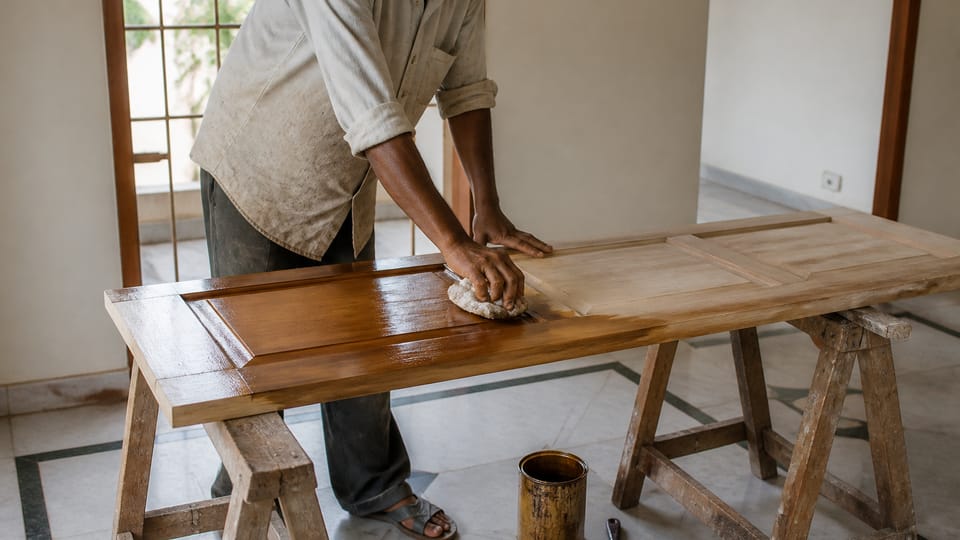
How should wooden doors and windows be painted or polished? IS 2338 (1967) gives the order: for paint, seasoned wood with knots treated, then priming of all joinery, cut ends and faces against walls before fixing, stopping and filling after priming, an undercoat and finishing coats. For a clear finish, filling, staining, sealing and finishing. It does not cover PU or melamine.
On this page (10)
- What does a finish do, and what does it not do?
- What is the order for a painted finish?
- Why prime before fixing?
- What is the order for a clear finish?
- What do the standards not say?
- What should I decide and check? (practice)
- What mistakes should I avoid? (practice)
- Frequently asked questions
- Related guides
- Sources
A new timber door or window shutter goes to a carpenter, then to a painter or polisher, and the order and the finish are usually settled by habit. The Indian code for finishing wood, IS 2338, is from 1967, but it still sets out a sequence for paint and for clear finishes, and it says plainly what it does not cover. This page sets out what it and the CPWD specifications say, in plain order, and flags the modern finishes the code leaves out. It gives no coat count, drying time, thinning ratio or price, because those belong to the maker’s data sheet. For why timber moves and sticks in the rains, see doors jamming in the monsoon: why it happens and what to check.
What does a finish do, and what does it not do?
IS 2338 Part 1 clause 0.3.1 says the protection a finish gives is “mainly a matter of retarding the absorption and subsequent drying out of moisture”, and clause 0.3.2 says finishes “as a rule do not protect wood from biological decay”. The IS 287:1993 foreword says that a paint or varnish “reduces changes in moisture content with changes in humidity of the surrounding air”. So a finish slows moisture movement. It does not cure wet or badly seasoned timber and is not a termite treatment; for termites, see termites in a finished house: post-construction treatment explained.
IS 2338 Part 1 clause 1.1.1 says clear finishes “such as nitro-cellulose, polyester, polyurethene, acid catalysed cold cure amino-plast and similar type of finishes are not covered”. The code names PU, polyester, nitro-cellulose and amino-plast finishes as not covered, and does not mention melamine polish, WPC or laminated faces. For those, follow the maker’s data sheet.
What is the order for a painted finish?
IS 2338 Part 1 sets out the sequence for new wood, in its own words and clauses:
| Step | What the code says |
|---|---|
| Seasoned wood | Clause 4.1.2: before painting, wood “shall be properly seasoned” with moisture near equilibrium, to avoid uneven shrinkage and cracks in the paint |
| Unsound parts | Clause 6.1.1: discoloured sapwood and large resinous or loose knots are cut out and replaced with sound wood |
| Sanding | Clause 6.1.3 and 6.1.4: mouldings smoothed with abrasive paper; flat portions smoothed across the grain before painting, and with the grain before staining |
| Knots and resin | Clause 6.1.5: knots, resinous streaks or sapwood too small to cut out are treated with shellac knotting, and aluminium primer may be used instead |
| Priming | Clause 6.2: if not already primed, a priming coat is applied; all joinery to be painted is primed, and all cut ends are primed |
| Stopping and filling | Clause 6.3: “Stopping and filling should be done after priming”, because otherwise the stopping may shrink and fall away |
| Undercoat | Clause 6.4: applied after the surface is primed, stopped, filled and rubbed down, and rubbed down again before the next coat |
| Finishing | Clause 6.5: “Cleanliness is essential” and the work is done “in normal dry conditions” |
For paint finishes, Part 2 Table 1 (interior) and Table 2 (exterior) show the same order as columns: primer, undercoat, first finishing coat, second finishing coat. Clause 5.2.3 says undercoat and finish “shall be made sure … compatible with each other” and that it is safer to use primer and finishing paints from the same manufacturer. IS 3536:2016 is a wood primer standard (“intended for use as a primer for wood”), and IS 133:2023 covers interior enamel, undercoating and finishing; Part 2 of the 1967 code names earlier editions of both (IS 3536E-1966 and IS 133-1965).
Why prime before fixing?
IS 2338 Part 1 clause 5.1 says that since water can enter through unpainted surfaces or joints, wood in contact with brickwork or concrete is primed before fixing. Door posts and sash frames “shall be adequately primed all over, taking special care to prime any cut surfaces before fixing” (clause 5.1(c)), and frames flush with the wall face need priming because the paint is likely to fail otherwise (5.1(a)). CPWD Specifications Volume 2 (13.24.2.1) say the same: the priming coat is applied before the wood work is fixed in position. For doors and windows, CPWD 13.23.4.7 says “tops of shutters and surfaces in similar hidden locations shall not be left out in painting”, and where the bottom edge cannot practically be painted, primer is applied on it before fixing the shutters. CPWD also says painting, except the priming coat, generally starts after the other building work is practically finished.
What is the order for a clear finish?
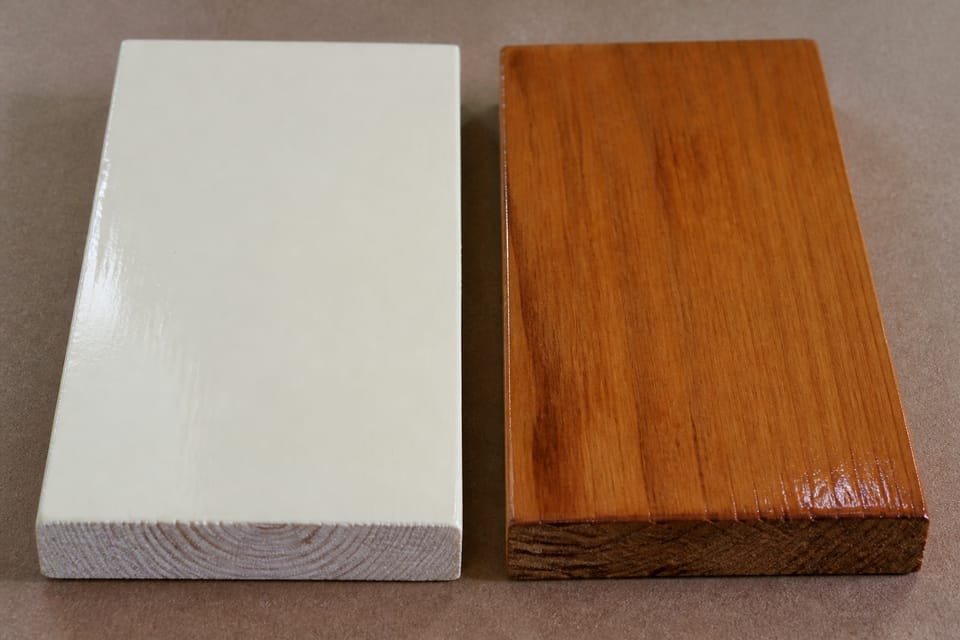
Clause 7.1 gives the sequence generally adopted: “Filling, Staining, Sealing, and Finishing”. Staining is optional. Clause 7.3.1 says staining is for indoor fittings, “and even then only for subsequent clear finishes”, and clause 7.4 asks for a sealer on the filled and sanded surface to stop the wood absorbing the succeeding coats and to stop stain and filler bleeding into the finish. Clause 7.5 covers varnishing: damp air and draughts are avoided, “for exterior work, a normal dry day should be chosen”, and varnish that has begun to set should not be retouched. Clause 8 covers French polish: pure shellac in methylated spirit, applied with a pad, with the pores filled first because the polish is otherwise absorbed. IS 348 says French polish is “not intended for use on bare wood”.
Clause 7.0 gives a limit that matters for a main door: clear finishes “are generally used for interior surfaces as their durability when used on external surfaces is less than that of pigmented coating”, because ultraviolet rays destroy them. CPWD 13.37A describes a melamine polish, for polishing an old surface, as a closed pore polish, refers the mix ratio of base and catalyst to the manufacturer’s specification, and gives its own thinner and spray figures, which are not printed here. Plywood, blockboard, hardboard and particle board “have greater dimensional stability than solid wood” (clause 4.1.4) and are finished as the code describes.
What do the standards not say?
- Neither IS 2338 nor CPWD names a number of coats for a house door in a way a page should repeat: coat counts, drying times and thinning ratios come from the maker’s data sheet and the specification you agree.
- IS 2338 does not define polishing, French polish, varnish, enamel or stain.
- The bottom-edge rule is in CPWD only, a government specification, not a BIS standard.
- IS 2338 cites paint standards from the 1950s and 1960s. The wood primer, enamel and other standards have since been revised, so check the current one.
- The standards do not cover modern PU or melamine systems on house doors, WPC, or laminated faces. (In practice, laminated and WPC faces are not painted: follow the maker’s data sheet.)
What should I decide and check? (practice)
This is practice, apart from the clauses named.
- Opaque or clear: coloured paint, or a clear finish showing the grain. For a main door that gets sun and rain, IS 2338 itself says paint lasts longer than a clear finish.
- Write the system on the quotation: the layers, from primer to finish, and the maker’s data sheet. Ask that the primer and finish come from the same maker.
- Order of work: the carpenter fits and planes first and the painter finishes after. Prime every face and cut end before the frame goes into the wall.
- Check: all faces and edges coated, including the top, bottom and the lock and hinge cut-outs; no runs or dust; the door not hung or closed while the finish is tacky.
What mistakes should I avoid? (practice)
- Finishing only the visible face.
- Skipping the top and bottom edges and the cut-outs.
- Painting over wet or fresh timber.
- No primer on bare wood under enamel.
- Sanding dust left on before the next coat.
- Wall emulsion on a door.
- An interior finish on an exposed door.
Frequently asked questions
Do I need a primer on a wooden door?
For a painted finish, IS 2338 says a priming coat is applied if the wood is not already primed, and all joinery to be painted is primed, with cut ends. Part 2 shows the primer as the first column of the paint schedules.
Which finish is better outside, paint or polish?
IS 2338 clause 7.0 says clear finishes are generally for interior surfaces because they are less durable than pigmented coatings outdoors.
Do I paint the bottom edge of a door?
CPWD 13.23.4.7 asks for primer on the bottom edge before fixing the shutter where painting is not practicable.
Does polish protect against termites?
No. IS 2338 says finishes as a rule do not protect wood from biological decay.
Does IS 2338 cover PU or melamine?
No. Clause 1.1.1 says polyurethane, polyester, nitro-cellulose and amino-plast clear finishes are not covered.
Related guides
- Doors jamming in the monsoon: why it happens and what to check
- Windows leaking in rain: frame, sill and drip, and where to start
- Termites in a finished house: post-construction treatment explained
This guide is general information. Read the disclaimer. Your carpenter and painter decide the finish for your doors and windows.
Sources
- IS 2338 (Part 1):1967, Code of Practice for Finishing of Wood and Wood-Based Materials, Operations and Workmanship: clauses 0.3.1, 0.3.2, 1.1, 1.1.1, 4.1, 5.1, 5.2.1, 5.2.2, 6.1 to 6.5, 7.0, 7.1, 7.3.1, 7.3.6.2, 7.4, 7.5 and 8 (page images read except 0.3). BIS lists it as in force, valid to 2030-09-10. It is an old code and cites paint standards that have been revised since.
- IS 2338 (Part 2):1967, Schedules (Finishing of Wood and Wood-Based Materials), Table 1 and Table 2 (page images read). BIS lists it as in force, valid to 2030-09-17.
- CPWD Specifications 2019, Volume 2, clauses 13.23.2, 13.23.4.7, 13.24.2.1 and 13.37A (page images read). Copy hosted by Puducherry PWD. CPWD is a specification for the works it covers, not a BIS standard.
- IS 287:1993, Maximum Permissible Moisture Content of Timber Used for Different Purposes, Foreword (page image read). IS 3536:2016, Ready Mixed Paint, Brushing, Wood Primer, clause 1.2 (page image read). BIS lists it as in force, valid to 2031-06-22. IS 133:2023, Enamel, Interior, Undercoating and Finishing, clause 1 (page image read). BIS lists it as in force, valid to 2028-08-31. IS 348:1968, French Polish, foreword 0.2.1 (page image read).
General information only. It is not a structural design or professional advice. Ask a licensed structural engineer or architect to check your plans and site.