
Short answer
How do I know if termites are in my finished house, and what treatment is done? Signs include mud tubes on walls, winged swarms, hollow-sounding wood and sawdust-like pellets. The 2001 text of IS 6313 Part 3 for existing buildings asks for a thorough inspection first, to find the extent of the infestation and the routes of entry. Treatment may combine soil treatment, treatment of voids, treatment of wood and replacement of badly damaged timber. Treatment may need repeating, so keep watching in humid and hot seasons.
On this page (10)
Finding termites in a house that is already built is harder than preventing them, and the usual first step, a sprayer and a quick fix, often misses the real problem. Termites come up from the soil, work through the walls and the wood, and do much of their damage out of sight. This page explains how to recognise the signs, what the Indian standard for existing buildings (IS 6313 Part 3) asks for, and what an owner should keep doing afterwards. It names no company or product, and it gives no chemical, rate, hole size or waiting time. Those belong to the inspector’s written plan and the product label.
This page reads the 2001 (second revision) text of IS 6313 Part 3. The BIS listing (searched 22 October 2026) shows IS 6313 (Part 3):2022, Fourth Revision, valid to 2027-03-31; its text was not read for this page. Check it before relying on any clause.
How do I recognise termites in a house?
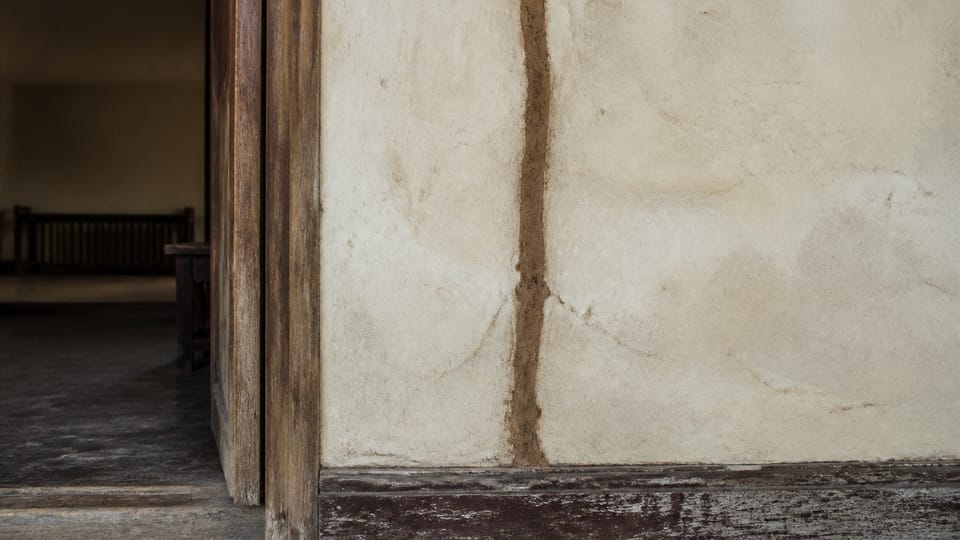
The standard says that the signs of termites in a building are “the tell-tale shelter tubes which are termites runways.” These are the thin mud tubes on walls and columns, which subterranean termites build to cross open air.
Other signs the standard describes:
- Winged swarms. “Swarms of winged reproductives flying from the soil or wood are the first indication of termite infestation in a building.” Often the flight is not seen, but the discarded wings are a sign of a colony nearby. The standard notes that winged adults emerge at certain periods, particularly after a few warm days followed by rain (Annex A-2).
- Hollow wood. The standard says termite damage is not always visible from outside. Woodwork may be eaten from inside and can be found hollow when tapped.
- Blisters on wood. The standard says termites “may further be noticed by blisters on wood surfaces,” because they form chambers close to the surface, leaving “only a thin film of wood on the surface” (Annex A-3.2).
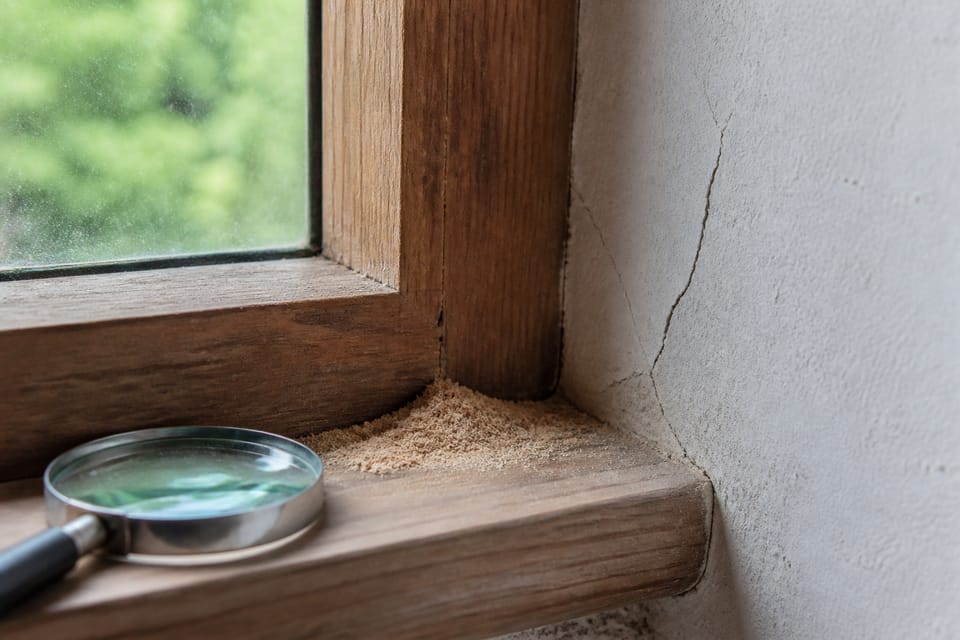
- Pellets of excreta. The standard links pellets of excreta to drywood termites, not to subterranean termites (Annex A-3.2). The standard’s scope is subterranean termites only (clause 1), so pellets of this kind call for a different inspection and treatment.
| Sign | What the standard links it to |
|---|---|
| Mud tubes on walls or columns | Subterranean termites |
| Winged swarms, or discarded wings | A colony nearby, often after warm days followed by rain |
| Hollow-sounding wood, or blisters on wood surfaces | Damage inside the wood |
| Pellets of excreta | Drywood termites, a different type from subterranean termites |
As practice, do not break open mud tubes or pierce wood to test them before the inspector sees them. The inspector may use a probe (Annex D). The standard says it is “not advisable to remove or destroy termite runways during inspection.”
Where do termites come in?
Subterranean termites come from the ground and enter at the soil level under the building. The standard says the inspector should start with the parts in contact with or near the soil: the basement, the ground floor, the steps, the columns and the porches. Damp and humid places are likely spots: bathrooms, toilets, kitchen sinks, and places with leaky pipes or drains.
The standard names other routes too:
- Cracks in masonry and the gaps where wood is set into concrete or brickwork.
- Hidden spaces such as ceilings behind wood panelling, wiring battens, conduits and switchboards.
- Covered shafts and casings for lift wells, wiring, telephone cables and utility pipes. The standard says these are “ideal routes for termites,” and that termites can travel from floor to floor through them.
So a sign on one floor means the whole building should be searched.
What does the inspection involve?
The standard says that before any treatment, “a thorough inspection shall be made of the infestation in the building with a view to determine the extent to which it has spread, and the routes of entry of termites into the building.” It adds that a study of the foundation and the ground floor helps show how the termites get in, and so how the treatment should be done.
The inspector should carry a bright light and a sharp probe, and should have the technical knowledge to find early infestation. Ask who is doing the inspection and what experience they have. The standard does not set a licence or qualification for this work.
What treatments does the standard describe?
The standard describes these categories. It does not give the chemical details, rates or depths here, and those belong to the inspector’s written plan.
- Soil treatment. Soil beside and under the building, along cracks and joints, forming a chemical barrier between the soil and the structure.
- Voids in masonry. Termites can enter through voids in masonry foundations and walls, so these are treated as well.
- Points where wood meets masonry. Woodwork that is both in contact with the floor or walls and infested by termites is sprayed at the points where it meets the masonry (clause 5.3.1.6).
- Electrical switch boxes. If an infestation is found inside a switch box, the cover is removed, the inside treated, and the cover fixed again.
- Timber. Woodwork damaged beyond repair must be replaced. Slightly damaged woodwork that does not need replacing is treated as clause 5.3.2.2 describes.
The standard also says that removing the damaged material and breaking off the shelter tubes may suffice when the damage is slight. In other cases these simple remedies “may have to be supplemented by the application of chemical toxicants.” The success of treatment depends on whether the prescribed methods can be used in the particular building, on its construction, and on the amount and installation of its woodwork.
What happens after treatment?
The standard is clear that treatment is not a one-off. It says: “Periodical inspection and vigilance are necessary after carrying out the preventive treatment.” It asks that follow-up action continues “during subsequent humid and hot seasons if termites appear.” If there are signs of reinfestation, it may be necessary to repeat the treatment. Watch for signs each season, not only once.
What mistakes should I avoid?
These are practice points, not standard rules.
- Assuming a mud tube cleaned out means the problem is gone. The standard asks for tubes to be removed so that new infestation can be seen, but the colony still needs to be found and treated.
- Treating only the wood. The standard treats the soil and the joints as well.
- Letting leaks and damp continue. Subterranean termites need moisture and soil contact to survive, so a leak or a damp wall keeps the risk alive. See the damp walls page and the terrace leakage page.
- Storing wood against the wall. Firewood and timber stacked against the wall give termites a bridge into the building.
- Doing a DIY job. A treatment needs the right coverage, which is hard to judge without training. The US extension sheet used for this page says do-it-yourself and over-the-counter baiting are not recommended for this reason.
- Trusting a sales pitch. Do not accept claims of secret formulas, university endorsements or ultrasonic devices. The US extension sheet warns against these.
What should an owner ask for?
These are good practice. The standard does not require all of them:
- A written inspection report with a sketch or diagram that marks the areas active termites, the areas of past damage, the entry routes, and the soil and drainage problems.
- The treatment areas in general terms, and the product’s name and label, so the registration can be checked.
- The operator’s name and contact details, and the company’s local address.
- The warranty in writing: the period, the excluded areas, what it covers, what voids it, and who signs.
- Whether a periodic inspection is required to keep the warranty.
- Before digging, landscaping, adding a room or planting trees near the foundation, ask whether the treated soil will be disturbed. The US extension sheet says a warranty is a service guarantee, not a barrier guarantee, so read its exclusions closely.
- Whether the wells or springs near the treated area were protected from contamination (IS 6313 Part 3, Annex C-1.5).
Frequently asked questions
Can termites be removed from a house that is already built?
Yes, the standard describes treatment for existing buildings. The method depends on the extent of the infestation and the routes they use.
Does termite treatment last forever?
No. The standard asks for follow-up in humid and hot seasons, and says treatment may need repeating if there are signs of reinfestation. No fixed period is given here.
Is termite damage to a wooden door a reason to treat the whole house?
It is a reason to inspect the whole house. The standard says that activity in one place means the building should be searched, including upper floors.
Is this the same as treatment before construction?
No. The pre-construction stages for a new house are a separate job. This page covers existing buildings.
Related guides
- Damp walls: rising damp, seepage or condensation
- Terrace leakage and waterproofing methods
- Pre-monsoon checklist for house and site
This guide is general information. Read the disclaimer. The inspector’s written plan, the product label and your local rules decide the treatment for your house.
Sources
- IS 6313 (Part 3):2001, Anti-termite Measures in Buildings: Treatment for Existing Buildings (second revision; the text read for this page). Foreword; clauses 1, 3.2, 5.1, 5.2, 5.3.2.1, 6; Annex A-1.3, A-2, A-3.1, A-3.2; Annex C; Annex D-1.1 to D-1.8. The BIS listing shows a later revision in force; its text was NOT read for this page.
- Oklahoma Cooperative Extension Service, Choosing a Pest Management Company to Protect Your Home (EPP-7308). US practice; used only as a checklist for owners, not as an Indian rule.
General information only. It is not a structural design or professional advice. Ask a licensed structural engineer or architect to check your plans and site.