
Short answer
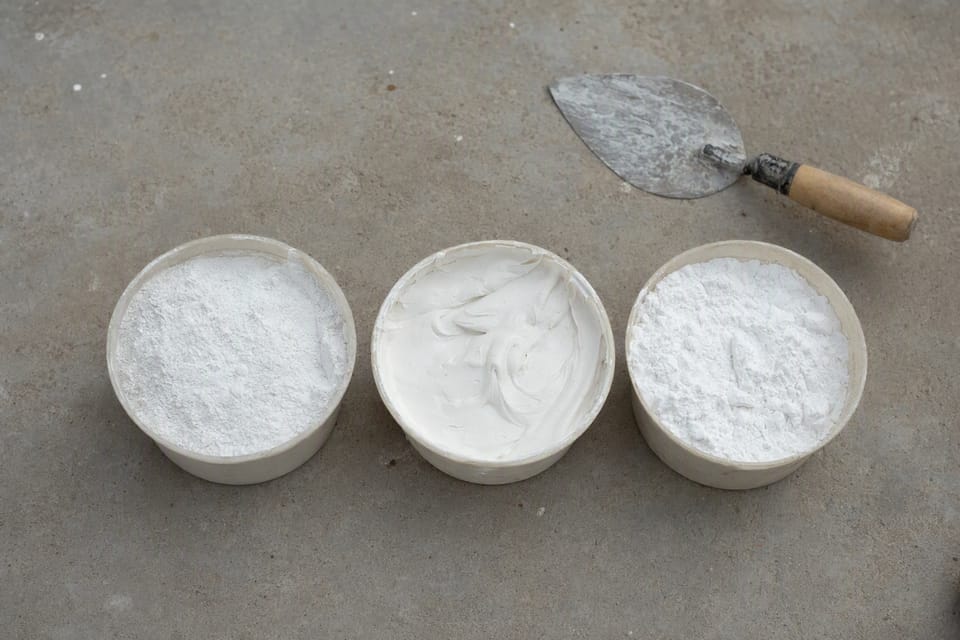
What is the difference between wall putty, POP and white cement? Wall putty is a ready-made skim coat with white cement as its key ingredient plus fillers and polymer, applied thin to smooth plaster before paint. POP (plaster of paris) is a gypsum plaster used on dry inside walls and ceilings, never outside. White cement is a cement, used for grouting, cement wash and repairs. They are different products with different Indian Standards.
On this page (8)
Painters offer “putty”, “POP” or “white cement” for the same job, smoothing walls before paint, and the words get mixed up. They are three different materials with three different Indian Standards. This page explains what each one is, where each suits a wall or ceiling, and the mistakes that lead to flaking and cracks. It gives no prices and ranks no brand. For how much putty to buy and how many coats, see our guide to wall putty coverage and coats.
What is each one?
| Wall putty | POP (plaster of paris) | White cement | |
|---|---|---|---|
| What it is | A ready-made skim coat with white cement as the key ingredient, plus fillers, additives and polymer | A gypsum plaster | A cement, like grey cement but white |
| Indian Standard | IS 17545:2021 | IS 2547 (Part 1), as one class of gypsum building plaster | IS 8042:2015 |
| Main job | A thin skim coat on plaster to get a smooth surface for paint | Levelling and smoothing (punning) dry inside walls and ceilings, and ceiling work | Grouting, cement wash, filling gaps, and as the base of white-cement products |
| Inside or outside | The standard covers internal and external plastered surfaces; check your product | Inside only | Depends on the job |
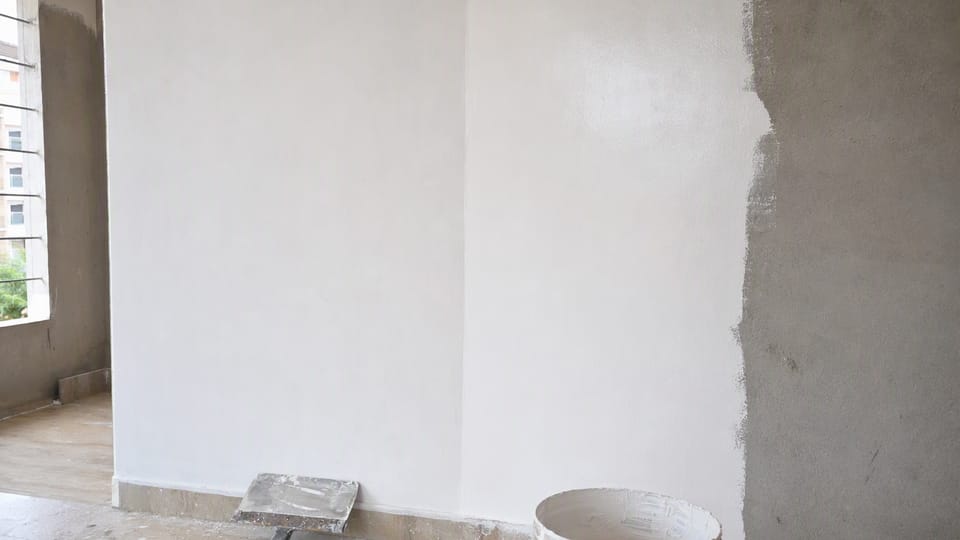
Wall putty. IS 17545 describes it as a thin layer mortar, usually less than 3 mm, applied on concrete or plaster to get a smooth, even surface for internal or external paints. It says white cement “shall be key ingredient”; the putty may also contain fillers and other additives, and must contain a minimum amount of polymer. That polymer and the additives are what make putty different from plain white cement.
POP. IS 2547 lists plaster of paris as one class of gypsum building plaster. In practice it sets fast and gives a very smooth, white surface. Bagged gypsum plasters sold for walls are related products from the same family.
White cement. IS 8042 covers white Portland cement. The withdrawn 1989 edition recommended it for finishing and decorative work and called it “generally meant for non-structural use”. Birla White lists uses such as tile grouting, cement wash, marble fixing and filling the gaps left after plumbing work.
Is wall putty the same as white cement?
No. White cement is one ingredient. IS 17545 requires putty to contain a minimum amount of polymer, allows fillers and other additives, and sets its own tests. A wall finished with a plain white cement slurry is not the same as one finished with putty. Using plain white cement as a full-wall skim coat is site practice that we found no standard or maker sheet supporting.
Where should each one go?
| Surface | Wall putty | POP | White cement |
|---|---|---|---|
| Dry inside wall, to be painted | Yes, as a thin skim coat | Yes, for levelling or punning, then the paint system | For repairs, or as a cement wash where the maker lists it |
| Ceiling inside | Yes, where the product sheet allows | Yes | Not a usual ceiling finish (our reading) |
| Outside wall | Only a putty the maker says is for exterior use | No. IS 3630 says gypsum plaster is not suitable for external walls, and POP is a gypsum plaster (our reading) | CPWD uses it to repair cracks and holes before exterior painting |
| Bathroom, kitchen or any damp wall | Only after the damp is fixed, and only if the product allows | No. IS 2395 warns that retarded hemihydrate gypsum plasters fail when kept damp; we apply this to POP as our reading | For grout and fixing; fix the damp first |
| Wide cracks | No: fix the crack first | No | As part of a proper repair |
Two points from the codes are worth knowing:
- Cement paint does not go on gypsum. IS 2395, the painting code, says gypsum plasters, once set and dry, can take “almost any type of paint except cement paint”.
- Putty is not a crack filler. IS 2395 says major cracks in plaster should be cut out in a V and made good before painting. Asian Paints’ sheet for its wall putty says plainly: “Do not apply the material to fill cracks”. Our guide to hairline cracks in plaster explains which cracks need repair first.
Why do older contracts mention POP putty? CPWD’s painting specifications still describe making good unevenness with “putty, made of plaster of paris mixed with water”. So in government specifications, “putty” can mean POP. Read the item carefully.
Do they need curing or primer?
- Wall putty: the makers’ sheets we read say no water curing is needed after application, but the wall should be wetted before the first coat. Asian Paints says to apply a primer over the putty before emulsion paint. Follow the sheet of the putty and the paint you use.
- POP and gypsum plasters: gypsum plaster makers describe their products as self-setting, without water curing. One maker, Sakarni, says: “Never cure gypsum plaster with water.”
- White cement: it is a cement, so where it is used in a mortar or a wash, it follows the usual care for cement work.
What mistakes should I avoid?
These come from the codes, the makers’ sheets and site practice:
- Using POP or gypsum plaster on an outside wall, or on a wall that stays damp.
- Applying putty or POP before fixing a leak or rising damp. See our guide to damp walls.
- Using putty to fill cracks or to level a very uneven wall. Makers limit putty to thin coats.
- Skipping the pre-wetting the putty maker asks for, or the primer where the sheet asks for it.
- Using cement paint over POP or gypsum plaster (IS 2395).
- Treating plain white cement as wall putty.
- Mixing up products: read the bag for “interior” or “exterior” and follow that maker’s sheet.
Frequently asked questions
Which is better for walls, putty or POP?
They do different jobs. POP levels and smooths dry inside walls and ceilings. Putty is a thin skim coat just before painting and, for products made for it, can also be used outside. In common site practice, many interior walls get POP punning first and putty after; follow your painter’s system and the product sheets.
Are wall putty and white cement the same?
No. Wall putty has white cement as its key ingredient but also fillers, additives and polymer, under its own standard, IS 17545. White cement alone is a cement under IS 8042.
Can white cement be used instead of putty?
We found no standard or maker sheet that supports using plain white cement as a full-wall skim coat. White cement is used for repairs, grouting and cement wash.
Is POP waterproof? Can it be used in a bathroom?
No. POP is a gypsum plaster. IS 3630 says gypsum plaster is not suitable for external walls, and IS 2395 warns that retarded hemihydrate gypsum plasters fail when kept damp. Our reading is to keep POP to dry inside areas.
Is primer needed after putty?
Asian Paints says to apply a primer over its putty before emulsion paint. Follow the sheets for the putty and paint you use.
Related guides
- Wall putty: coverage per kg, number of coats and why it cracks
- False ceiling vs POP ceiling: differences, damp problems and repair
- Hairline cracks in plaster: causes and what to do
- Gypsum plaster vs cement plaster: where each suits a house
This guide is general information. Read the disclaimer. Your engineer or painter decides the finish for each wall, and the maker’s current data sheet decides how its product is applied.
Sources
- IS 17545:2021, White Cement Based Polymeric Putty - Specification. Foreword, clauses 1 and 4.2.
- IS 8042:2015, White Portland Cement - Specification (Third Revision). Clause 1. The 1989 edition, now withdrawn, is quoted once for its foreword.
- IS 2547 (Part 1):1976, Gypsum Building Plaster, Part 1 (First Revision, with amendments). Clause 3.1.
- IS 3630:1992, Construction of Non-load Bearing Gypsum Block Partitions - Code of Practice. Clause 6.1.1.
- IS 2395 (Part 1):1994, Painting of Concrete, Masonry and Plaster Surfaces - Code of Practice, Part 1: Operations and Workmanship. Clauses 5.1, 7.1.2, 7.2 and Annex A-2.
- CPWD Specifications 2019, Volume 2, Sub Head 13 Finishing: 13.19 to 13.22 (painting preparation). Copy hosted by Puducherry PWD.
- Asian Paints, TruCare wall putty product information sheet (India, 0079).
- Birla White, WallCare putty brochure.
- JK Cement, GypsoMaxX gypsum plaster brochure.
- Sakarni, gypsum plaster product page.
- Birla White, white cement brochure (uses).
General information only. It is not a structural design or professional advice. Ask a licensed structural engineer or architect to check your plans and site.