
Short answer
What is IS 13630, and what does a ceramic tile test report show? IS 13630 is the Indian series of test methods for ceramic tiles. Each part describes one test, from dimensions and water absorption to breaking strength and scratch hardness. The pass or fail limits are not in IS 13630; they are in the product standard. A test report shows the test results on a sample of tiles, and the owner should check that it matches the tiles delivered.
On this page (11)
A tile is sold as a product, but its quality is only known from tests. IS 13630 is the Indian series that describes how those tests are done. This page explains what the series covers, part by part, what a test report contains, and what the methods do not tell you.
The page gives no pass or fail value. The limits a tile must meet are in the product standard, IS 15622, and the current edition should be checked by the supplier or the engineer.
What does IS 13630 cover?
IS 13630 is titled “Ceramic Tiles: Methods of Test, Sampling and Basis for Acceptance”. It is published in parts. Each part covers one kind of test:
| Part | What the test measures |
|---|---|
| 1 | Dimensions and surface quality |
| 2 | Water absorption and bulk density |
| 3 | Moisture expansion, using boiling water |
| 4 | Linear thermal expansion |
| 5 | Resistance to thermal shock |
| 6 | Modulus of rupture and breaking strength |
| 7 | Stain and chemical resistance of unglazed tiles |
| 8 | Stain and chemical resistance of glazed tiles |
| 9 | Crazing resistance of glazed tiles |
| 10 | Frost resistance |
| 11 | Surface abrasion of glazed tiles |
| 12 | Deep abrasion of unglazed tiles |
| 13 | Scratch hardness on the Mohs scale |
| 14 | Impact resistance, by coefficient of restitution |
| 15 | Sampling and the basis for acceptance |
| 16 | Lead and cadmium given off by glazed tiles |
Source: IS 13630 (Parts 1 to 16):2019, scope clauses. Each part is in force; the parts are valid to 2029 or 2030 on the BIS record.
Part 15 covers how the tiles are batched, sampled, inspected, and accepted or rejected. It applies to unfixed tiles stored under cover.
What is in the test report?
The report contents are set out in each part. Two examples:
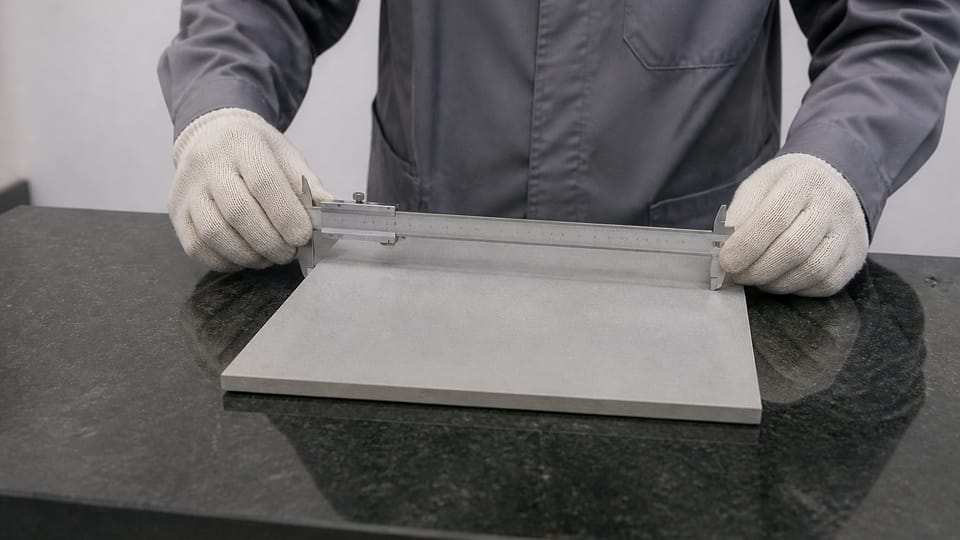
- Part 1 (dimensions and surface quality) reports the length, width and thickness, the straightness of the sides, the rectangularity, the flatness, and the surface quality. The surface quality is the percentage of tiles without defects. Clause 7.1.1 lists the defects assessed, such as cracks, crazing, nipped edges, unevenness, holes and specks.
- Part 2 (water absorption and bulk density) reports the water absorption and bulk density of each tile, and the average for the sample (clause 6.3). The report also has a description of the tiles.
The report does not, under these clauses, have to show a test date, the laboratory name, or the accreditation. Those are good practice, and the owner should ask for them.
What does the water absorption test do?
Part 2 dries the tiles to constant mass, weighs them dry, soaks them, and weighs them wet. It has two methods: a boiling method and a vacuum method. The standard leaves the choice to an agreement between the manufacturer and the buyer (clause 1.2). The result is a percentage of the dry mass, averaged over the sample.
The sample is set out in clause 4. The number of tiles depends on the tile’s area and mass, so a report should say how many were tested.
What does a surface quality test do?
Part 1 views the tiles at a set distance and light level, and records the defects. It is a visual test. It does not measure strength. A tile can look sound and still fail a breaking-strength test, which is Part 6, and a surface test does not replace it.
Inline image
Where do the limits come from?
The limits are not in IS 13630. The product standard IS 15622 holds the limits for the pressed glazed and unglazed floor and wall tiles it covers. The 2006 edition of IS 15622 set limits for water absorption groups and for breaking strength. It was withdrawn on 1 August 2022. The BIS record shows the 2017 first revision, with Amendment 2, as current. This article does not give the limits, because the edition in force should be read from the BIS portal.
What should I ask the supplier?
These questions are practice, not steps in the standard.
- Which test report is this, and for which batch? Check the batch or lot number on the carton against the report.
- Which edition of the product standard was the report tested to? Ask for the edition by year.
- Who did the test, and is the laboratory accredited? Ask for the laboratory’s name and its accreditation.
- When was the test done? A report with no date is hard to check.
- Does the tile delivered match the tile tested? Check the shade, the size and the batch on the carton.
What mistakes should I avoid?
These are practice points:
- Using a report for another batch. The results are for the lot tested, not for every carton.
- Reading a surface test as a strength test. The surface quality test is visual. Breaking strength is Part 6.
- Ignoring the edition. An old edition may have different limits.
- Taking a certification claim as a batch result. A certificate is not a test of the tiles on site.
Frequently asked questions
What is the difference between IS 13630 and IS 15622?
IS 13630 describes the test methods. IS 15622 holds the product requirements, including the limits. A tile is judged against IS 15622 using the tests in IS 13630.
Do I need every test in the report?
No. The tests that matter depend on the room. A floor in a wet area needs different tests from a wall. Ask the engineer or the tile supplier which tests apply to your room.
Is a tile with a good test report always good?
The report shows the tiles tested. Check that the batch matches and that the edition is current. The quality on the site also depends on how the tiles are laid, which is covered on the floor tiles page.
Related guides
- Ceramic vs vitrified vs porcelain tiles: the absorption groups
- Standard tile sizes in India: modular and non-modular, IS 15622
- Anti-skid tiles: what IS 13712 says about slip resistance
- Floor tiles popping up or cracking: causes, standards, fixes
This guide is general information. Read the disclaimer. Your engineer and your tile supplier decide which tiles and tests suit your floor.
Sources
- IS 13630 (Parts 1 to 16):2019, Ceramic Tiles: Methods of Test, Sampling and Basis for Acceptance. Scope and terms of Parts 1 and 2 read in full; the report contents of Part 1 (clauses 2.5 to 7.6) and Part 2 (clause 6.3) read; Parts 3 to 16 checked by BIS title only. The 2006 umbrella edition was withdrawn on 2022-03-14 and is not cited.
- IS 15622 (Pressed ceramic tiles: specification). The 2006 edition, withdrawn on 1 August 2022, was read for its scope and limits only; the 2017 first revision with Amendment 2 is the edition the BIS record shows as current, and its text was not read for this article.
General information only. It is not a structural design or professional advice. Ask a licensed structural engineer or architect to check your plans and site.